











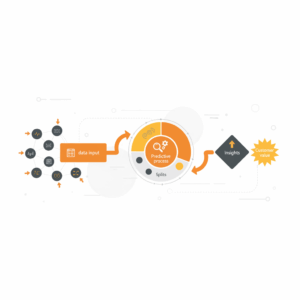
What do predictive features signal, and why does the signal matter?
Predictive features carry measurable information that helps a model anticipate an outcome. Strong signal raises true predictive power, while weak or spurious signal inflates apparent accuracy without transferring to production. Practitioners define a signal as any feature-to-target relationship that persists across samples drawn from the same data-generating process. Teams that chase correlation without testing generalization confuse noise for insight and ship brittle experiences. Customer leaders see the consequences first, because models drift, contact centre routing degrades, and digital journeys lose relevance. A clear definition keeps programs honest. Signal should survive a clean train and test split, maintain directionality under cross validation, and remain available at prediction time. These checks turn feature engineering from a creative exercise into an operational discipline that reliably improves customer experience and service transformation outcomes. The goal is usable lift, not leaderboard wins.¹ ³
What is data leakage, and how does it quietly sink your model?
Data leakage occurs when information that would not exist at the time of prediction slips into model training or evaluation. Leakage can take many forms. Target leakage includes features that encode the label directly or by proxy. Temporal leakage includes future events included when training a model that should forecast those events. Procedural leakage includes preprocessing steps fitted on all data, which lets the model peek at the distribution of the test set. Teams often discover leakage only after deployment, when performance collapses. The industry has documented leakage as one of the most common and costly mistakes in applied machine learning, and it remains prevalent in competitions and production settings. Treat leakage as a defect category with clear detection and prevention controls, not as a rare edge case. The fastest way to lose stakeholder trust is to ship a model that looked brilliant in the lab and fails in the field.¹ ⁶ ¹²
How do correct dataset splits protect signal integrity?
Teams protect signal integrity by making the split first, then performing every learned transformation within the boundaries of each split. This sequence prevents statistical bleed from test into train. A standard random split works for independent and identically distributed data, while stratification preserves outcome ratios in classification problems. Cross validation estimates variance and improves the reliability of performance metrics when data is limited. For time-ordered data, random shuffles break causality and create future leakage into the past. Use forward-chaining splits that train on earlier periods and validate on later periods to reflect the real production path. These practices sound simple, but they require tooling discipline and review checklists to stay consistent across teams and vendors. A split is not a clerical step. It is the gate that decides whether a measured signal is honest.² ⁸ ⁹ ⁴
Where do signals hide in customer experience data?
Customer experience platforms generate multi-grain data. Signals hide in session telemetry, agent notes, order histories, email headers, IVR paths, and identity graphs. The most reliable signals encode stable behaviors that recur across time and channels. Examples include inter-arrival times, sequence motifs across touchpoints, or lagged aggregates at the customer or household key. Teams should define features in business language, then translate them into engineered variables with clear availability rules. A feature that depends on after-call outcomes cannot inform pre-call routing. A feature that depends on a billing cycle close cannot inform real-time fraud screening. Treat availability windows as first-class metadata, and include them in code and documentation. The result is a feature store that anticipates production constraints and reduces rework. Customer leaders benefit when engineered signals map cleanly to operational levers like next best action, staffing, and proactive service.
What mechanisms create leakage in real projects, and how do we detect them?
Common mechanisms include global scaling fitted on the full dataset, target encodings computed with full-sample means, deduplication or imputation performed before splitting, and analyst shortcuts that join labels to event tables prior to time filtering. Temporal joins often create hidden lookahead when the join key includes an object that only exists after the event. Detection blends rules and tests. Rules ban full-sample fitting and enforce split-first workflows. Tests simulate production by running scoring pipelines on a holdout that the training code cannot access. Additional tests compare metrics across random and time-based splits to reveal suspicious gains that vanish under causal order. Finally, code review must include a “feature availability” checklist that documents when and how each feature becomes known. Treat any unexplained jump in validation performance as a red flag to investigate rather than a victory to celebrate.¹² ¹ ⁶
How do we structure cross validation without fooling ourselves?
Cross validation estimates generalization error by cycling train and validation folds and averaging metrics. Teams should choose the scheme that matches the data generating process. K-fold or stratified K-fold works for i.i.d. data and preserves class balance. GroupKFold prevents group leakage when multiple rows share an entity like a customer or case. TimeSeriesSplit preserves causality by using earlier folds for training and later folds for validation. Fold-aware preprocessing ensures that scalers, imputers, and encoders fit only on the training portion for each fold. These rules prevent optimistically biased estimates and improve hyperparameter search stability. When in doubt, default to simple, honest folds that mirror production use. Complex nesting helps only when teams can maintain the same rigor in production orchestration and monitoring. The objective is stable ranking of model candidates, not an illusory bump in offline scores.⁸ ⁹ ⁴
Which feature engineering patterns maximize usable lift without leakage?
Feature engineering should privilege patterns that respect time and identity. Build lag features that aggregate only past events relative to the prediction timestamp. Use windowed statistics with explicit cutoffs. Prefer out-of-fold encodings that compute categorical target statistics using only training rows within each fold. Materialize features into a governed store that enforces time index and entity keys, and attach metadata for freshness, lineage, and availability. When using text or audio, fit vectorizers and embeddings inside the fold boundary and store versioned artifacts for reproducibility. Keep feature sets small and interpretable to reduce the attack surface for leakage and overfit. When business partners ask for a new attribute, add it behind a switch, test it with proper folds, and promote it only if it improves stable metrics. This operating model turns feature work into a managed inventory that compounds value over time.¹² ⁹
How do we measure and monitor leakage risk after deployment?
Production monitoring closes the loop. Track data drift on features and targets, especially freshness and null-rate changes, because pipeline breaks often reintroduce leakage through emergency fixes. Alert on impossible foresight, such as models predicting outcomes before the underlying events can be known. Compare live performance with backtested expectations by time bucket to identify decay. Rotate shadow evaluations on recent holdouts to verify that cross validation still ranks models correctly. When incident reviews find leakage, document the mechanism, add a unit test to the feature pipeline, and update the checklist. Leaders should treat leakage risk as a persistent operational hazard, like security or privacy. A program that measures leakage risk with the same discipline it applies to accuracy will protect customer trust and reduce costly rollbacks.
What is the change an executive should sponsor right now?
Executives should sponsor a split-first, fold-aware feature lifecycle. Fund a central feature store that enforces time and entity constraints by design. Require that every transformation fit only inside training folds, and require time-aware validation for any forecast. Mandate that vendor models deliver feature availability maps and reproducible splits. Institute a model review board that signs off on leakage controls before approving deployment. These steps improve contact centre performance, stabilize digital journeys, and reduce model incident rates. The change is small in concept and large in effect. Teams stop debating leaderboard scores and start shipping robust models that hold up in production, which is where customer experience is won.
How do I implement split-first pipelines with common tooling?
Teams can implement split-first pipelines with standard libraries. Create train and test partitions at the start of every notebook, script, or job, and never fit transformations on the full dataset. Use stratified splits for imbalanced classification to keep label ratios consistent. Wrap preprocessing in fold-aware pipelines that refit within each cross validation fold. For time-ordered data, use forward-chaining validation that never trains on the future. Reference library guidance for the exact APIs and behaviors. Document split seeds, sizes, and stratification keys for reproducibility. Move these patterns from notebooks into versioned pipelines so that the same code that trains in development also runs in production. This approach brings engineering rigor to data science, reduces leakage risks, and makes model governance simpler for audit and compliance teams.² ¹² ⁹ ⁴
Impact: What improvements should leaders expect to see?
Leaders should expect fewer production surprises, clearer feature inventories, and more stable model performance. Customer routing improves when features reflect only what the system knows at decision time. Fraud controls gain precision when temporal order is respected. Digital personalization becomes more consistent because signal, not noise, drives targeting logic. On the cost side, teams spend less time on incident review and rollback work. On the governance side, audits become faster because the program can prove that data transformations happen within split and fold boundaries. These are practical benefits, not academic niceties. A program that treats signals, leakage, and splits as first-class concerns produces reliable outcomes for customers and measurable value for the business.¹² ⁴
FAQ
What is data leakage in predictive modeling, and why is it risky for customer experience programs?
Data leakage is the use of information during training or evaluation that would not exist at prediction time, which inflates offline metrics and fails in production. Customer experience programs suffer because routing and personalization degrade when the false lift disappears after deployment.¹²
How should contact centres split data to protect signal integrity?
Contact centres should create the train and test split first, apply all learned preprocessing only within the training data, and use stratified splits for imbalanced labels. For time-based use cases like call volume forecasting, teams should adopt forward-chaining validation that trains on the past and tests on the future.² ⁴
Which cross validation method fits time series and journey analytics?
TimeSeriesSplit or other forward-chaining methods respect temporal order and prevent training on future data. This approach mirrors production reality and yields honest estimates of generalization for time-dependent journeys.⁴
Which safeguards prevent target leakage in feature engineering?
Safeguards include out-of-fold target encodings, lagged aggregates that use only past data, fold-aware preprocessing, and feature availability maps that document when each attribute becomes known. Enforce these in code and in a governed feature store.¹² ⁹
Why should executives sponsor a split-first, fold-aware lifecycle at Customer Science?
A split-first, fold-aware lifecycle reduces incident rates, stabilizes model performance, and accelerates governance. Customer Science implements these practices to improve routing accuracy, personalization quality, and operational reliability across analytics and service transformation programs.² ¹²
Which signals typically travel well from lab to production?
Signals that encode stable behaviors across time and channels, such as lagged engagement metrics or windowed aggregates at the customer key, travel well. They remain available at decision time and survive honest validation.¹²
How does a feature store help with leakage control on customerscience.com.au programs?
A governed feature store enforces time and entity constraints, captures metadata for availability and freshness, and ensures that training and serving use consistent definitions. This reduces leakage risks and speeds safe deployment across Customer Science solutions.¹²
Sources
Google Developers, “Machine Learning Crash Course,” 2025, Google Developers. https://developers.google.com/machine-learning/crash-course
Scikit-learn Developers, “train_test_split — scikit-learn 1.7.2 documentation,” 2025, scikit-learn. https://scikit-learn.org/stable/modules/generated/sklearn.model_selection.train_test_split.html
Sylvain Arlot and Alain Celisse, “A survey of cross-validation procedures for model selection,” 2010, Statistics Surveys. https://projecteuclid.org/journals/statistics-surveys/volume-4/issue-none/A-survey-of-cross-validation-procedures-for-model-selection/10.1214/09-SS054.pdf
Scikit-learn Developers, “TimeSeriesSplit — scikit-learn 1.7.2 documentation,” 2025, scikit-learn. https://scikit-learn.org/stable/modules/generated/sklearn.model_selection.TimeSeriesSplit.html
Shachar Kaufman, Saharon Rosset, Claudia Perlich, and Ori Stitelman, “Leakage in data mining: Formulation, detection, and avoidance,” 2012, ACM Transactions on Knowledge Discovery from Data. https://dl.acm.org/doi/10.1145/2382577.2382579
Scikit-learn Developers, “Common pitfalls and recommended practices: How to avoid data leakage,” 2025, scikit-learn. https://scikit-learn.org/stable/common_pitfalls.html
Imbalanced-learn Contributors, “Common pitfalls and recommended practices: Data leakage,” 2025, imbalanced-learn. https://imbalanced-learn.org/stable/common_pitfalls.html