































Summary
Government projects succeed or fail based on stakeholder management. Complex accountability, competing interests, and public scrutiny amplify risk. Effective stakeholder management in government requires structured engagement, clear governance, and disciplined communication. When treated as a strategic capability rather than a communications task, stakeholder management accelerates delivery, reduces conflict, and protects public value.
What makes stakeholder environments in government projects uniquely complex?
Government projects operate in multi-layered accountability environments. Stakeholders include ministers, central agencies, delivery partners, regulators, unions, service users, and the public. Each group has different incentives, authority, and risk tolerance.
Unlike private sector projects, government initiatives must balance policy intent, service continuity, and public trust. Decisions are visible and contested. According to the OECD, unmanaged stakeholder complexity is a leading cause of delay and cost escalation in public sector programs¹. Complexity is structural, not incidental.

Why do traditional stakeholder management approaches fall short?
Many projects rely on static stakeholder registers and one-way communications. These tools document stakeholders but do not manage them.
Traditional approaches assume stakeholders are passive recipients of information. In reality, stakeholders actively shape scope, risk, and outcomes. When engagement is reactive, issues surface late and escalate quickly. Research shows that ineffective stakeholder engagement is strongly correlated with project overruns in public infrastructure and service delivery².
What is an effective stakeholder management strategy in government?
An effective stakeholder management strategy is deliberate and adaptive. It recognises stakeholders as decision-makers, influencers, and risk holders.
Key elements include:
-
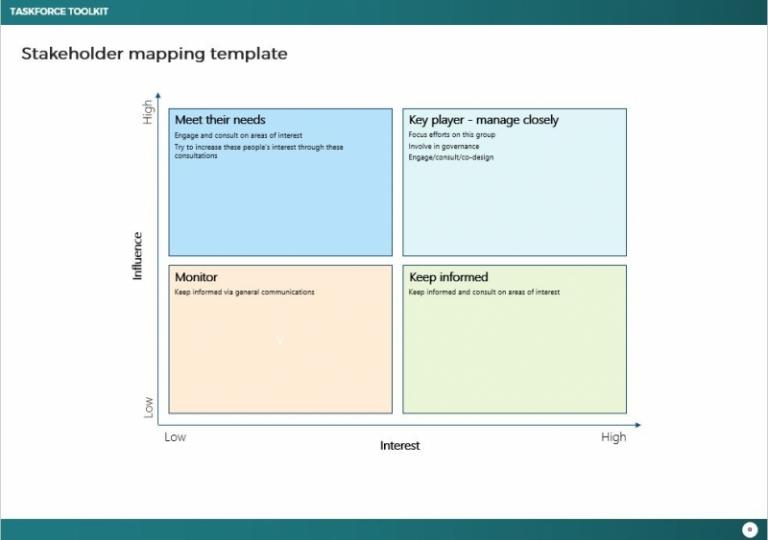
Clear identification of stakeholder power, interest, and legitimacy
-
Explicit engagement objectives for each group
-
Defined decision rights and escalation paths
-
Ongoing feedback and issue sensing
This approach moves beyond communication plans to active relationship management aligned to project outcomes.
How should stakeholders be segmented and prioritised?
Not all stakeholders require the same level of engagement. Prioritisation is essential.
Segmentation should consider formal authority, informal influence, impact on delivery, and exposure to risk. High-power or high-impact stakeholders require continuous engagement. Others can be managed through structured updates. Guidance from the Australian Public Service Commission stresses the importance of tailoring engagement intensity to stakeholder influence and risk³.
What role does governance play in stakeholder management?
Governance provides the forum where stakeholder interests are balanced and decisions are resolved. Without strong governance, stakeholder issues spill into informal channels, increasing noise and politicisation.
Effective governance clarifies who decides what, when, and on what basis. It integrates stakeholder considerations into decision-making rather than treating them as external constraints. Well-designed governance reduces surprise and builds confidence across stakeholder groups.
How does transparency affect public sector stakeholder engagement?
Transparency is both an obligation and a risk management tool. Clear, consistent information reduces speculation and mistrust.
However, transparency without structure can overwhelm stakeholders or expose unresolved issues prematurely. The challenge is disciplined transparency. Information should be timely, accurate, and aligned to decision readiness. According to the Productivity Commission, clarity and consistency in public communication materially improve stakeholder confidence and project legitimacy⁴.
How should conflict and competing interests be managed?
Conflict is inevitable in government projects. Interests will diverge. The objective is not consensus but informed trade-offs.
Effective stakeholder managers surface conflicts early, frame choices explicitly, and document rationale. This reduces personalisation and defensiveness. Structured facilitation supports constructive dialogue, especially where power imbalances exist.
Where does capability building matter most?
Stakeholder management capability is uneven across public sector organisations. Technical leaders are often promoted without formal training in engagement and influence.
Capability building should focus on:
-
Facilitation and negotiation skills
-
Political and organisational awareness
-
Evidence-based communication
-
Managing up, out, and across
Investing in these skills reduces reliance on escalation and crisis management.
How should stakeholder management effectiveness be measured?
Effectiveness is reflected in delivery stability and decision quality. Indicators include:
-
Fewer late-stage scope changes
-
Reduced escalation frequency
-
Timelier decisions
-
Improved stakeholder confidence
Measurement should focus on outcomes, not activity volume. High engagement does not equal effective engagement.
What are the next steps for government project leaders?
Leaders should assess stakeholder complexity at project inception, not after issues emerge. This includes mapping influence, clarifying governance, and allocating skilled resources to engagement roles.
Customer Science Business Consulting and Value Management Consulting services support government organisations in designing stakeholder management strategies, governance structures, and facilitation approaches that align delivery with public value.
Evidentiary Layer
Customer Science service capabilities referenced in this article are based on official Customer Science documentation and solution descriptions.
FAQ
Why is stakeholder management critical in government projects?
Because multiple accountable parties can directly influence scope, timing, and outcomes.
Is stakeholder engagement the same as communication?
No. Engagement involves two-way influence and decision support, not just information sharing.
How early should stakeholder management begin?
At project initiation. Late engagement increases risk and cost.
Can strong governance reduce stakeholder conflict?
Yes. Clear decision rights and forums reduce informal escalation and confusion.
Who should own stakeholder management?
Ownership should sit with senior accountable leaders, supported by skilled practitioners.
Is stakeholder complexity avoidable in government?
No. It must be managed deliberately rather than simplified away.
Sources
-
OECD. Public governance and infrastructure delivery. 2020.
-
Flyvbjerg B. Survival of the Unfittest. Oxford University Press.
-
Australian Public Service Commission. Stakeholder engagement guidance.
-
Productivity Commission. Public sector project governance.