


















frictionless customer journey in 2026 is not about making every interaction shorter. It is about removing unnecessary effort, preserving context across channels, and helping people complete tasks without repeating themselves or losing progress. The best designs reduce operational waste and customer effort together, while keeping privacy, accessibility, and AI governance built into the service model.¹˒²˒³˒⁴˒⁵
What is a frictionless customer journey?
A frictionless customer journey is a service experience in which customers can move from intent to outcome with minimal unnecessary effort, delay, confusion, or repetition. Research published in 2025 defines friction as the effort customers exert to complete tasks related to their goals, which is a useful framing because it shifts attention from channel novelty to task completion.⁶ In practice, a frictionless journey means a customer can start online, move to assisted service, and finish the task without restarting, re-explaining, or being pushed into avoidable handoffs.¹˒⁷
This matters because organisations often confuse more channels with less friction. The evidence on omnichannel customer experience shows the opposite. Customers respond to consistency, continuity, and integration across touchpoints, not just to the presence of more options.⁷˒⁸ So a frictionless customer journey is not a design style. It is an operating outcome.
Why does friction still persist in 2026?
Friction persists because most organisations still operate customer journeys as a chain of team-owned moments rather than one connected service. Digital teams optimise containment. Contact centres optimise queue performance. Operations optimise throughput. Customers then absorb the cost of those internal boundaries.
Australian service guidance points directly at this problem. The Digital Service Standard expects services to be user-friendly, inclusive, adaptable, and measurable, while the APS Experience Design Principles emphasise connected experiences and the need for people to avoid telling their story more than once.¹˒² Those principles are still hard to achieve when identity, case status, policy logic, and workflow live in different places. OECD guidance on digital public infrastructure reaches the same conclusion from an architectural angle: coherent services depend on shared, secure, interoperable building blocks such as identity, data-sharing, and notifications.³
How should the journey be designed?
The cleanest way to design a frictionless customer journey is to work backwards from the customer task rather than forwards from the channel. Start with the job the customer is trying to complete. Then identify where effort rises, where confidence drops, where context gets lost, and where the organisation forces a handoff that adds no value.
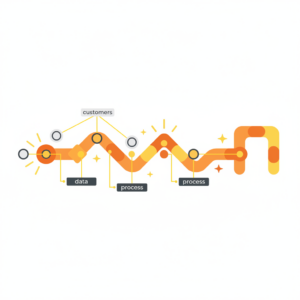
That process usually reveals five design requirements. First, shared identity so the organisation knows who the customer is across touchpoints. Second, shared service state so the next channel can see what has already happened. Third, governed knowledge so customers and staff receive the same answer. Fourth, orchestration so work moves without manual chasing. Fifth, measurement so leaders can see where friction returns.¹˒³˒⁴
What should be removed first?
Remove friction that customers feel and staff can already see. Repeated verification, duplicate data entry, inconsistent answers, unclear next steps, missing status visibility, and failed digital-to-human handoffs are usually higher-value fixes than cosmetic interface changes. Research on omnichannel customer experience and channel integration keeps pointing to the same drivers: continuity, coordination, and cross-channel consistency strongly shape the overall experience.⁷˒⁸˒⁹
This is also where leaders need nuance. Not all friction is bad. The 2025 friction framework argues that some effort can be helpful when it improves confidence, safety, or decision quality.⁶ Identity checks, consent steps, and certain review stages may need to remain. The design task is not to eliminate all effort. It is to remove unnecessary effort while keeping purposeful safeguards.
How does journey design differ from channel design?
Channel design improves an interaction. Journey design improves completion across interactions.
That difference matters because many CX programs still optimise websites, apps, or contact centres separately. A chatbot may look efficient in isolation and still create more friction if it hands customers into voice without context. A branch or field interaction may perform well locally and still damage the journey if staff cannot see digital history or current policy. Research on how omnichannel customer experiences affect engagement intentions reinforces that the total experience across channels shapes downstream trust and continued engagement.⁸
So removing friction from CX means designing for continuity, not just for touchpoint quality. The customer should feel that one organisation is helping them progress, even when several systems and teams are involved underneath.
Applications
The best place to apply a frictionless customer journey model is a high-volume journey with visible failure demand. Complaints, appointment changes, claims updates, onboarding, account changes, and service recovery are all strong candidates because they expose where customers repeat information, where teams lose context, and where effort shifts from one channel to another.
A practical first step is a shared operational view of the journey. Customer Science Insights is relevant here because it is designed to unify real-time service data across voice, digital, bots, CRM, and Genesys Cloud, which helps leaders see where friction shows up in demand, transfers, repeat contacts, and resolution patterns. Internal Customer Science link set supplied by the user. When teams can see the same journey evidence, they stop arguing about channel performance and start fixing the customer task.
What risks should leaders watch?
The first risk is false simplicity. Teams remove steps that looked inconvenient but actually protected quality, consent, or compliance. The second is fragmented ownership. One team improves the front stage while another continues to create back-stage delay. The third is unmanaged AI. In 2026, many journeys use AI for search, drafting, summarisation, routing, or recommendations, and NIST’s 2024 Generative AI Profile makes clear that risk has to be managed across design, deployment, and use.⁴
The fourth risk is privacy debt. OAIC guidance says privacy by design should be embedded into the design specifications and architecture of new systems and processes, because it is more effective to manage privacy risks early than later.⁵ A frictionless journey that quietly increases data exposure, weakens consent logic, or makes decisions harder to explain is not well designed.
How should friction be measured?
Measurement should focus on completion, not only on satisfaction. The Digital Performance Standard tells teams to monitor how well users finish tasks they start and to compile metrics using a holistic approach.¹ That is the right base for a frictionless CX model.
A strong scorecard includes journey completion, avoidable recontact, time to resolution, transfer failure, status-check demand, and customer satisfaction or trust. Then add control measures such as privacy exceptions, AI overrides, and knowledge defects. If speed improves but repeat contact rises, friction has moved rather than fallen.
This is also where design support matters. CX Research & Design fits naturally in the measurement and next-steps phase because friction removal usually needs customer research, journey analysis, service blueprinting, and iterative redesign before technology changes deliver reliable value.
Next steps
Start with one journey, not a whole-enterprise ambition. Map the current task from first signal to final outcome. Identify where customers slow down, where work waits, where answers change, and where context is lost. Then define the minimum changes needed to improve continuity across that path.
Keep the rule simple. Every redesign decision should improve one of four things: customer clarity, task completion, operational flow, or trust. If a change does not improve one of those outcomes, it is probably adding noise rather than removing friction.
Evidentiary layer
The evidence base is consistent on the core point. Friction is best understood as effort against a customer goal, not merely inconvenience.⁶ Omnichannel studies show that continuity and integration across touchpoints shape the perceived experience and later engagement.⁷˒⁸˒⁹ Australian digital-service guidance supports connected, measurable, user-centred services.¹˒² OECD guidance supports shared, interoperable foundations for coherent delivery.³ NIST and OAIC guidance show that AI and privacy controls now belong inside journey design itself.⁴˒⁵ Taken together, that means a frictionless customer journey in 2026 is not just smoother. It is better governed.
FAQ
Is a frictionless customer journey the same as a fast journey?
No. A journey can be fast and still feel difficult if the customer repeats information, loses context, or gets conflicting answers. Friction is about unnecessary effort against the goal, not just elapsed time.⁶˒⁷
Does removing friction from CX mean fewer channels?
Not necessarily. It usually means better continuity between channels, with clearer identity, shared status, and cleaner handoffs.⁷˒⁸
What should be fixed first?
Usually repeated verification, missing status visibility, inconsistent knowledge, and failed handoffs between digital and assisted service. Those problems create obvious effort for both customers and staff.¹˒²˒⁹
How much governance does AI need in a frictionless journey?
A lot. AI used for guidance, drafting, routing, or recommendations should sit inside documented controls for review, escalation, data use, and exception handling.⁴˒⁵
Where does knowledge management fit?
It sits close to the centre. Customers still experience friction when the answer layer is inconsistent, even if the workflow is clean. Knowledge Quest is relevant when slow updates, fragmented content, or weak policy governance are causing customers and staff to get different answers.
How long does it take to show results?
Many organisations can show movement in one priority journey within a quarter, but durable gains usually require several cycles of redesign, measurement, and operational adjustment. That is an inference from the implementation patterns in the cited guidance and research, not a single benchmark.¹˒²˒³
Sources
-
Australian Government Digital Transformation Agency. Digital Performance Standard and Digital Service Standard. 2024. Stable government guidance.
-
Australian Government Architecture. APS Experience Design Principles. 2025. Stable government guidance.
-
OECD. Digital Public Infrastructure for Digital Governments. 2024. Stable OECD report.
-
NIST. Artificial Intelligence Risk Management Framework: Generative Artificial Intelligence Profile, NIST AI 600-1. 2024. Stable primary guidance.
-
Office of the Australian Information Commissioner. Privacy by design guidance. Stable government guidance.
-
Padigar M, et al. Good and bad frictions in customer experience: Conceptual foundations and a strategic framework. Psychology & Marketing. 2025. Stable journal source.
-
Gerea C, Gonzalez-Lopez F, Herskovic V. Omnichannel Customer Experience and Management: An Integrative Review and Research Agenda. Sustainability. 2021;13(5):2824. DOI: 10.3390/su13052824
-
Rahman SM, Carlson J, Gudergan SP, et al. How do omnichannel customer experiences affect customer engagement intentions? Journal of Business Research. 2025;181:115196. DOI: 10.1016/j.jbusres.2025.115196
-
Balbín Buckley JA, De Keyser A, Verleye K, Lemon KN. Effects of channel integration on the omnichannel customer experience. Cogent Business & Management. 2024. DOI: 10.1080/23311975.2024.2364841