































What problem should a digital-first operating model actually solve?
Executives need a model that delivers simple, successful journeys at a lower cost to serve while protecting trust. Customers expect clear steps, current status, and a clean handoff when automation cannot finish. Teams need a way to turn strategy into weekly progress without creating channel silos. A digital-first operating model solves this by organising people, processes, and platforms around journeys, not channels, and by hardwiring measurement, governance, and release cadence into day-to-day work. Research shows that programs which link experience improvements to value secure funding faster and scale more predictably because the path from journey metrics to economics is explicit.¹
What defines “digital-first” in customer service?
Digital-first means designing end-to-end journeys so customers can complete common jobs online with event-driven status, assisted fallbacks, and consistent answers across channels. Human-centred design principles require teams to understand contexts of use, co-create with users, and iterate through the lifecycle so solutions remain usable as policies and systems evolve. ISO 9241-210 codifies these principles and turns good intentions into verifiable practices.² Contact centre standards add that agents must have accurate, current information, which forces the operating model to treat knowledge as load-bearing infrastructure. ISO 18295 makes this expectation explicit for consistent outcomes.³
How do you structure a digital service operating model that endures?
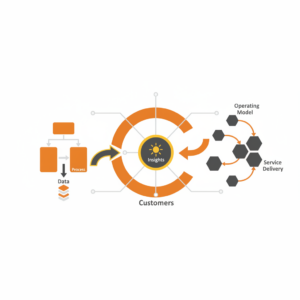
Leaders organise the model around six units: Journey Ownership, Service Design, Knowledge and Guidance, Orchestration and Automation, Operations and Quality, and Measurement and Value. Journey owners hold authority across policy, design, and tech for a small set of high-value journeys. Service designers translate jobs to be done into next-state journeys and service blueprints that expose backstage rules, systems, and handoffs. Knowledge leads maintain short, task-first guidance so agents and customers follow one truth. Orchestration teams manage event triggers and integrations to prevent “just checking” demand. Operations and Quality convert plans into staffing, coaching, and control. Measurement binds every change to outcomes the board accepts. Using this structure keeps decisions close to customer jobs and reduces cross-team latency.²
What roles and rituals keep the model working week to week?
Teams run a simple cadence. A 30-minute weekly journey forum reviews one scorecard per journey and approves the next one or two changes. A biweekly calibration aligns quality judgments and reinforces knowledge accuracy. A monthly governance check reviews privacy, security, and evidence of control. ISO 18295 expects accurate, current information and consistent outcomes, which makes these rituals part of compliance rather than optional hygiene.³ HEART’s goal–signal–metric discipline forces each metric to justify its place by naming the decision it informs and the owner who will act.⁴ This rhythm converts strategy into habit and prevents drift.
Which mechanisms actually create value in digital-first service?
Three mechanisms move outcomes reliably. First, clarity of steps reduces cognitive load and speeds completion because users scan and decide quickly; front-loaded, task-first content improves success.⁵ Second, knowledge at the point of need gives agents and customers the same short, current instructions, which stabilises resolution quality. ISO 18295 anchors this requirement across all channels.³ Third, event-triggered orchestration sends updates when a real state changes and stops messages once completion occurs, which reduces avoidable contacts created by timers and guesswork. Platform patterns such as hold-until and conditional sends show how to prevent contradictory nudges after resolution.⁶ These mechanisms reduce effort rather than masking it.
How do you embed privacy, safety, and trust from day one?
Digital-first must be privacy-first. The Australian Privacy Principles require informed, specific, current, and voluntary consent with purpose limitation and rights to access and correction. Flows need visible consent prompts, purpose checks at collection and at use, and audit logs that prove decisions and access.⁷ When AI assists agents or customers, OWASP’s LLM guidance adds concrete mitigations against prompt injection and data exfiltration, including input sanitisation, retrieval allow-lists, and tool constraints.⁸ Treat these controls as code and process, not policy alone, so reviews are fast and repeatable.
What metrics prove the model works without vanity?
Scorecards pair leading signals with lagging outcomes. Leading signals include time to first useful step, knowledge reuse, event-delivery success, and callback take-up at defined thresholds. Lagging outcomes include completion rate for digital journeys, First Contact Resolution for assisted interactions, repeat-within-seven-days on the same issue, and cost per resolved contact. ICMI’s FCR definition remains the crisp proof that an assisted case resolved the first time.⁹ HEART keeps each metric tied to a goal and a decision so dashboards steer work rather than decorate packs.⁴ This pairing shows mechanism and impact together.
How do you fund and sequence work without boiling the ocean?
Leaders select two to four journeys at the intersection of volume, pain, and value, then publish a “not yet” list to protect focus. Use a value tree that maps abandonment, completion, FCR, and repeats to revenue, churn, and cost so choices are explicit.¹ Fund each journey with a one-page case using Forrester’s Total Economic Impact method that shows low, base, and high benefits with confidence factors and adoption curves. TEI’s structure prices uncertainty responsibly and accelerates board approvals.¹⁰ Sequencing then follows capability readiness and dependency maps from the service blueprint so thin slices ship fast and stack safely.
What technology is “just enough” for digital-first service?
You need four building blocks. A modern engagement layer handles voice and digital and supports warm handoff with context so FCR survives escalation. A knowledge system with lifecycle controls ensures short, scannable, current guidance for agents and customers, which aligns to ISO 18295’s accuracy expectations.³ An orchestration layer evaluates rules, triggers event-based updates, and supports hold-until so messages stop after completion.⁶ A data and measurement layer exports raw interaction and outcome data to your warehouse and powers scorecards tied to HEART so value is visible and auditable.⁴ This stack avoids platform sprawl while covering the work from hello to resolution.
How do you integrate AI without elevating risk?
AI should assist, not distract. Start with retrieval-augmented assistance that drafts answers from approved sources and shows citations so agents reach the first useful step faster with confidence. Retrieval-augmented generation reduces hallucination because outputs are grounded in verifiable content, which makes answers auditable.¹¹ Keep retrieval restricted by role and fail closed when sources are missing to protect trust. Use AI summaries for wrap notes and quality cues to increase coaching frequency without adding review time. These patterns deliver gains quickly while staying within privacy and safety guardrails.⁸
What 120-day plan proves the operating model works?
Days 1–30: Establish spine and baselines.
Appoint journey owners for two high-value journeys. Map current and next state with service blueprints that expose backstage rules and dependencies. Set baselines for completion, FCR, repeats, and cost per resolved contact. Publish HEART maps with goals, signals, metrics, and owners so teams know what will change and how it will be judged.² ³ ⁴
Days 31–60: Ship clarity and routing.
Rewrite top knowledge items into short, front-loaded tasks using customer words. Research shows users succeed more when instructions are concise and scannable.⁵ Introduce simple intent routing with warm handoff and context. Turn on callbacks at defined queue thresholds to protect abandonment and perceived wait. Evidence shows callbacks reduce abandonment when offered at thresholds rather than indiscriminately.¹²
Days 61–90: Orchestrate status and instrument value.
Enable event-triggered updates with hold-until so messages stop after completion and do not generate avoidable demand.⁶ Land raw contact, transcript, and outcome exports in your warehouse to avoid analytics blackout. Update scorecards weekly with leading signals and publish a short “changes shipped and what moved” note to maintain momentum.
Days 91–120: Add assist and prove outcomes.
Launch retrieval-augmented agent assist for one intent with citations and role-limited retrieval. Measure grounded-answer rate, time to first useful step, and FCR for escalated cases. Promote only when completion rises and repeats fall for exposed cohorts, then refresh TEI ranges with observed deltas and confidence.¹¹ ¹⁰
What risks derail digital-first programs and how do we avoid them?
Channel projects without journey ownership create local wins and systemic friction. Fix with named journey owners and blueprints that drive cross-policy and cross-system changes.² Verbose, stale content increases variance and effort. Fix with a task-first style, lifecycle ownership, and a 90-day touch rule for high-reuse articles to meet ISO expectations.³ Timer-based status creates “just checking” contacts. Fix with event-triggered updates that hold until completion.⁶ Ungrounded AI produces fluent errors. Fix with retrieval, citations, and fail-closed behaviour behind OWASP controls.⁸ Single-point business cases erode credibility. Fix with TEI low, base, and high ranges and adoption curves.¹⁰
What outcomes should executives expect by quarter two?
Executives should see earlier movement in time to first useful step and knowledge reuse within weeks as clarity and routing improve. They should see measurable gains in completion and First Contact Resolution and fewer repeats on targeted journeys within one to two cycles as status becomes event-driven and assistance becomes grounded. They should see lower “just checking” contacts and cleaner audit trails for knowledge and privacy controls. These signals indicate that the operating model is reducing effort and converting relief into economic value, which is the point of digital-first service.³ ⁶
FAQ
What is a digital-first operating model in one sentence?
It is a journey-centred way of working that pairs human-centred design, accurate knowledge, event-driven orchestration, and weekly release cadence with a scorecard of completion, FCR, repeats, and cost per resolved contact.² ³ ⁴
Which roles are essential to start?
A journey owner, a service designer, a knowledge lead, an orchestration engineer, an operations and quality lead, and a data lead. This core team can ship thin slices weekly and measure impact credibly.²
How do we avoid creating more contacts while digitising?
Use event-triggered updates with hold-until so messages stop after completion and do not conflict with reality, which prevents “just checking” demand.⁶
Which metrics belong on the monthly executive pack?
Completion rate, First Contact Resolution, repeat-within-seven-days, cost per resolved contact, and time to first useful step as a lead. HEART keeps each number tied to a decision and owner.⁴ ⁹
Where does AI safely help first?
Start with retrieval-augmented agent assist that cites approved sources and fails closed if retrieval is weak. This speeds the first useful step while keeping answers auditable.¹¹
What governance proves reliability and consistency?
ISO 18295 expectations for accurate, current information and consistent outcomes should anchor quality and knowledge controls, with privacy alignment to the Australian Privacy Principles.³ ⁷
How do we build a credible business case for the next wave?
Use TEI to present low, base, and high scenarios with adoption curves and confidence factors, refreshed with real deltas from the first wave.¹⁰
Sources
-
Linking the Customer Experience to Value — Joel Maynes; Alex Rawson; Ewan Duncan; Kevin Neher, 2018, McKinsey & Company. https://www.mckinsey.com/capabilities/growth-marketing-and-sales/our-insights/linking-the-customer-experience-to-value
-
ISO 9241-210:2019 — Human-centred design for interactive systems — International Organization for Standardization, 2019, ISO. https://www.iso.org/standard/77520.html
-
ISO 18295 — Customer Contact Centres (Parts 1 & 2) — International Organization for Standardization, 2017, ISO. https://www.iso.org/standard/63167.html
-
Measuring the User Experience at Scale (HEART Framework) — Kerry Rodden; Hilary Hutchinson; Xin Fu, 2010, Google Research Note. https://research.google/pubs/pub36299/
-
How Users Read on the Web — Jakob Nielsen, 2008 update, Nielsen Norman Group. https://www.nngroup.com/articles/how-users-read-on-the-web/
-
Event-Triggered Journeys: Hold-Until and Experiments — Twilio Segment Documentation, 2024, Twilio. https://www.twilio.com/docs/segment/engage/journeys/v2/event-triggered-journeys-steps
-
Australian Privacy Principles — Office of the Australian Information Commissioner, 2023, OAIC. https://www.oaic.gov.au/privacy/australian-privacy-principles
-
OWASP Top 10 for LLM Applications — OWASP Foundation, 2023, OWASP. https://owasp.org/www-project-top-10-for-large-language-model-applications/
-
First Contact Resolution: Definition and Approach — ICMI, 2008, ICMI Resource. https://www.icmi.com/files/ICMI/members/ccmr/ccmr2008/ccmr03/SI00026.pdf
-
Total Economic Impact (TEI) Methodology — Forrester Research, 2020–2025, Forrester. https://www.forrester.com/teI/methodology
-
Retrieval-Augmented Generation for Knowledge-Intensive NLP — Patrick Lewis; Ethan Perez; Aleksandra Piktus; et al., 2020, NeurIPS. https://proceedings.neurips.cc/paper_files/paper/2020/hash/6b493230205f780e1bc26945df7481e5-Abstract.html
FAQ