






















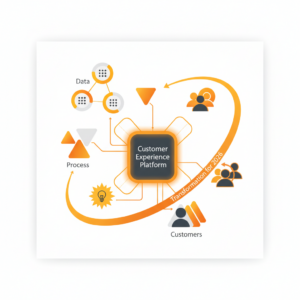
A 2026 CX ecosystem architecture is a business and operating model that connects channels, workflows, data, knowledge, identity, measurement, and AI into one governed service system. Done well, it cuts channel friction, improves consistency, supports safe automation, and gives leaders a clear line from customer journeys to cost, trust, and growth.¹˒²˒⁴˒⁵
What is a CX ecosystem architecture?
A CX ecosystem architecture is the blueprint for how customer experience is designed, delivered, measured, and improved across the whole service estate. It covers customer-facing channels, agent tools, workflow engines, data platforms, identity, content, analytics, and governance. In practical terms, it answers six executive questions: where interactions start, how work moves, where truth sits, how decisions are made, how risk is controlled, and how value is measured.¹˒⁴˒⁶
This matters because experience is no longer produced by a single platform. It is produced by a connected system. ISO 18295 already frames contact centres as multi-channel service environments with defined service requirements and KPIs, while current omnichannel research shows customers judge the whole experience across channels, not isolated moments inside one team or tool.¹˒¹⁰˒¹¹
Why does it matter in 2026?
The 2026 shift is not about adding more channels. It is about making the service system coherent. The OECD’s 2025 Digital Government Index results, published in February 2026, stress that human-centred transformation depends on coherent and trustworthy systems and governance structures.⁵ That is the right test for enterprise CX as well.
At the same time, Australian service design guidance is pushing toward services that are user-friendly, inclusive, adaptable, and measurable.² And bad experiences still carry a measurable financial cost. Qualtrics XM Institute reports that US$3.7 trillion of 2024 global sales were at risk due to poor experiences, and that half of customers cut spending after a bad one.⁹ So the 2026 architecture question is simple enough: can your service model stay consistent, safe, and measurable while AI, automation, and channel volume keep rising? If not, the estate needs redesign.⁵˒⁶˒⁷˒⁹
Context
Most organisations still carry a split stack. The website sits in one team. The contact centre platform sits in another. CRM, case management, correspondence, identity, analytics, and knowledge each have their own owners, budgets, and reporting lines. Customers do not care. They experience the joins.
Research on omnichannel customer experience keeps pointing back to the same issue. Customers respond to consistency, personal relevance, service quality, safe handling of information, and smooth movement between channels.¹⁰˒¹¹˒¹³ A mature customer experience platform design has to treat those as architectural requirements, not soft aspirations.
How should the architecture work?
The best pattern for 2026 is modular but governed. Not one giant suite. Not a loose collection of disconnected apps either. Shared digital building blocks matter. OECD work on digital public infrastructure describes secure, interoperable systems such as identity, data sharing, notifications, and payments as the foundations that support service delivery at scale.⁴ That same logic applies in private sector and mixed service environments.
A practical CX ecosystem architecture usually has seven layers. First, engagement channels such as voice, chat, messaging, email, web, app, and branch. Second, orchestration to route intent, trigger next best actions, and manage workflow. Third, customer and operational data services. Fourth, knowledge and content services. Fifth, decisioning and AI services. Sixth, workforce and partner tools. Seventh, governance, privacy, security, and measurement running across every layer.⁴˒⁶˒⁷˒⁸
Comparison
Older contact centre architecture focused on transactions. Modern CX ecosystem architecture focuses on journeys. Older models measured speed, queue time, and handle time. Those still matter, but they are no longer enough. A 2026 design must also show whether a customer completed the task, whether the answer stayed consistent across channels, whether the interaction was safe and inclusive, and whether the journey lowered cost to serve over time.¹˒³˒¹¹
That is where customer experience platform design often goes wrong. Leaders buy channel tools before they define service principles, canonical data, event models, or ownership for journey outcomes. The result is channel growth without system coherence. Research on omnichannel CX makes this point indirectly but clearly: customer value comes from the combined experience across channels, not from adding channels for their own sake.¹⁰˒¹¹˒¹³
Applications
In 2026, the strongest applications sit where service demand, operational cost, and compliance pressure meet. Think complex claims, public services, health access, regulated utilities, complaints, and high-volume support environments. Here, architecture must join the digital front door to agent assistance, case handling, knowledge, outbound communication, and measurement in one loop.
A good starting point is to create a shared service data layer and live operational insight model so leaders can see demand, failure demand, transfer rates, repeat contacts, and channel shift in near real time. Customer Science Insights is relevant here because it is built to collect and surface real-time contact centre and service data that can feed dashboards, BI, AI, and workforce decisions. This kind of data layer helps turn CX from reporting into active operational control.⁹
The second application is knowledge. Customers want one answer. Agents do too. Digital signal research shows firms now detect and act on customer signals across the journey, which increases the value of a governed knowledge layer tied to customer intent, content freshness, and policy change.¹²
What are the main risks?
The first risk is fragmentation. Teams buy tools that solve local pain and create enterprise inconsistency. The second is weak data and content governance. When identity, consent, knowledge, and business rules drift apart, the customer gets conflicting answers. The third is unmanaged AI. ISO/IEC 42001 and the NIST Generative AI Profile both push organisations toward structured risk management, traceability, and lifecycle controls.⁶˒⁷
The fourth risk is privacy debt. The OAIC is explicit that privacy by design should be built into the design specifications and architecture of new systems and processes, because fixing privacy later is less effective and more costly.⁸ In CX terms, that means consent design, data minimisation, access controls, model inputs, retention rules, and human review need to be set early.
How should leaders measure it?
Measurement should move from isolated channel KPIs to a service value scorecard. Australia’s digital performance guidance states that customer satisfaction is an industry-standard measure of digital service quality and that teams should compile metrics with a holistic approach.³ That is useful, but it is only the base layer.
For executive control, measure five things together: journey completion, avoidable recontact, time to resolution, customer trust or satisfaction, and cost to serve. Then add AI-specific controls such as answer quality, escalation rate, override rate, and risk incidents. When those measures move together, the architecture is working. When speed improves but recontact rises, it is not.
This is also the point where outside design and operating support can pay off. CX Consulting fits naturally in the measurement and roadmap stage because the work usually needs service blueprints, technology roadmaps, value cases, and clear operating ownership before major platform change begins.
Next steps
Start with one priority journey, not a whole-enterprise rewrite. Map the current service path end to end. Identify system joins, duplicate data stores, policy bottlenecks, and knowledge gaps. Define the target state around shared services: identity, customer record, journey events, knowledge, analytics, and governance. Then sequence delivery in increments.
And keep the rule simple. Every architecture decision should improve one of four things: customer clarity, operational flow, trust, or measurable value. If a new tool cannot do that, it is probably adding noise.
Evidentiary layer
The evidence base is steady on three points. First, omnichannel customer experience is multi-dimensional and measurable, not vague.¹⁰˒¹¹ Second, customer journeys are increasingly shaped by digital signals, shared data, and connected decisioning.¹² Third, the governance burden has risen because AI, privacy, and cross-channel consistency now sit inside the architecture itself, not beside it.⁶˒⁷˒⁸
So the design brief for 2026 is tighter than it was even two years ago. You need a CX ecosystem architecture that is composable, measurable, and governed. Not just connected. Actually coherent.⁴˒⁵
FAQ
What is the difference between a CX ecosystem architecture and a CRM strategy?
A CRM strategy focuses on customer records, sales, and service processes. A CX ecosystem architecture is broader. It includes channels, workflow, data, identity, knowledge, analytics, AI, and governance across the full journey.¹˒⁴˒¹¹
Does every organisation need a single customer experience platform?
No. Most do better with a modular stack and strong standards for data, orchestration, knowledge, and measurement. The goal is not one product. It is one governed service system.⁴˒⁵˒⁶
What is the first capability to fix?
Usually shared data and knowledge. Without those, channels and AI produce inconsistent answers and duplicate effort. Knowledge Quest is relevant when the immediate problem is content accuracy, agent guidance, and faster answer delivery across service teams.
How does AI fit into customer experience platform design?
AI should sit inside governed workflows, not outside them. It can support summarisation, guidance, triage, drafting, and decision support, but it needs risk controls, monitoring, and human review paths.⁶˒⁷˒⁸
Which metrics belong at board level?
Use a small set: journey completion, repeat contact reduction, service cost, customer trust or satisfaction, and benefits realised from automation and redesign.³˒⁹
How long should a 2026 architecture roadmap run?
Most organisations need a 12 to 24 month roadmap delivered in stages. Start with one high-volume journey, prove the value, then scale the patterns across adjacent services.⁵˒⁹
Sources
-
ISO. ISO 18295-1:2017 Customer contact centres, Part 1: Requirements for customer contact centres. Current version confirmed in 2023. Stable source: ISO standard page.
-
Australian Government Digital Transformation Agency. Digital Service Standard, updated 24 July 2024. Stable source: digital.gov.au policy page.
-
Australian Government Digital Transformation Agency. Criterion 4: Measure if your digital service is meeting customer needs. Stable source: digital.gov.au Digital Performance Standard page.
-
OECD. Digital Public Infrastructure for Digital Governments. 2024. Stable source: OECD report page.
-
OECD. Digital Government Index and Open, Useful and Re-usable Data Index. 2026. Stable source: OECD report page.
-
ISO/IEC. ISO/IEC 42001:2023 Artificial intelligence management systems. Stable source: ISO standard page.
-
NIST. Artificial Intelligence Risk Management Framework: Generative Artificial Intelligence Profile. NIST AI 600-1, 2024. Stable source: NIST publication page.
-
Office of the Australian Information Commissioner. Privacy by design. Stable source: OAIC guidance page.
-
Qualtrics XM Institute. ROI of Customer Experience, 2025. Stable source: Qualtrics research page.
-
Gerea C, Gonzalez-Lopez F, Herskovic V. Omnichannel Customer Experience and Management: An Integrative Review and Research Agenda. Sustainability. 2021;13(5):2824. DOI: 10.3390/su13052824
-
Rahman SM, Carlson J, Gudergan SP, Wetzels M, Grewal D. Perceived Omnichannel Customer Experience (OCX): Concept, Measurement, and Impact. Journal of Retailing. 2022;98(4):611-632. DOI: 10.1016/j.jretai.2022.03.003
-
Schweidel DA, Bart Y, Inman JJ, et al. How Consumer Digital Signals Are Reshaping the Customer Journey. Journal of the Academy of Marketing Science. 2022;50(6):1257-1276. DOI: 10.1007/s11747-022-00839-w
-
Both A, Steinmann S. Customer Experiences in Omnichannel Retail Environments: A Thematic Literature Review. The International Review of Retail, Distribution and Consumer Research. 2023;33(5):445-478. DOI: 10.1080/09593969.2023.2256491