































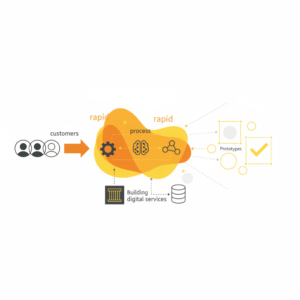
Rapid prototyping helps organisations test a digital service with real users before committing to build. It reduces rework, clarifies requirements, and improves adoption by making customer needs visible early. When paired with structured user testing, prototype evidence supports better investment decisions, faster delivery, and measurable CX outcomes, including lower cost-to-serve and fewer avoidable contacts.
What is rapid prototyping in digital services?
Rapid prototyping is the disciplined creation of simplified service versions to learn what works, what fails, and what customers actually need, before engineering begins. It sits inside human-centred design practice¹, where teams iterate based on observed user behaviour rather than assumptions. The “prototype” can be as light as paper sketches or as complete as a clickable simulation that mirrors real content and journeys.
In digital services, rapid prototyping is not design theatre. It is a decision tool that creates testable hypotheses about tasks, information, and service flows. The core purpose is to validate usability outcomes defined as effectiveness, efficiency, and satisfaction², while also exposing policy, operational, and contact centre impacts that are often missed in requirement documents. This is why “rapid prototyping benefits” show up as both speed and quality in mature delivery organisations.
Why do leaders use prototypes instead of business cases alone?
Business cases explain why a service should exist. Prototypes show whether it will work for real customers under real constraints. Australian government delivery guidance explicitly frames early stages as a place to use prototypes to work out what to build³, which is a useful executive model because it separates learning from scaling.
For executives, the risk is rarely “can we build it.” The risk is “will customers adopt it, and will it reduce friction and cost.” Prototypes make that risk measurable. They also create shared alignment across CX, operations, technology, risk, and communications because everyone can see and test the same artefact. This reduces stakeholder-driven scope creep and lowers the probability of launching a service that increases avoidable demand.
How does rapid prototyping work in practice?
A practical prototype cycle has four repeatable steps: define hypotheses, build the minimum testable artefact, run structured user testing, then decide what to change and what to build. This mirrors human-centred design activities emphasised in international standards¹ and aligns with digital service delivery guidance that positions prototypes as learning instruments before scaling³.
The testing method matters as much as the prototype. Effective sessions are task-based, with success criteria tied to customer outcomes such as completing a transaction, finding a policy answer, or resolving a payment issue. Measures should map to usability constructs² and business goals such as reduced calls, improved completion, and fewer complaints. Evidence from rapid prototyping in applied settings shows it can improve requirements elicitation and produce clearer development specifications when users are engaged through iterations⁵. This keeps prototyping grounded in operational outcomes, not just interface preference.
Do low-fidelity and high-fidelity prototypes produce different insights?
High fidelity can be useful when content, interaction detail, or accessibility behaviours must be tested. However, research comparing low- and high-fidelity prototypes indicates many usability issues can be identified with low-fidelity approaches, including paper and simplified interactive variants⁶. Later work reviewing mixed-fidelity evidence also reports that usability findings are often comparable across fidelity levels, even when participants express a preference for higher fidelity⁷.
This creates a practical executive rule: use the lowest fidelity that can answer the decision question. If the question is “is the journey coherent and does the customer understand the next step,” paper or wireframes may be enough. If the question is “will customers complete the form correctly on mobile with assistive technology,” higher fidelity is justified. Treat fidelity as a cost lever, not a status symbol.
Where do rapid prototyping benefits show up operationally?
Prototyping reduces avoidable build by exposing errors early, when change is cheaper. Empirical software lifecycle work shows error correction costs escalate substantially as projects progress, reinforcing the financial logic of early validationⁱ⁰. Professional usability practice also reports strong cost-benefit ratios from early usability investment, commonly cited as returns in the range of 1:10 to 1:100 in usability-aware environments¹¹.
Operationally, benefits concentrate in three places. First, fewer defects and fewer confusing flows reduce downstream rework. Second, clearer service design reduces customer effort and therefore demand on contact centres. Third, prototype evidence improves governance decisions because it replaces opinion battles with observed behaviour. This is where “user testing prototypes ROI” becomes real: prototype sessions can prevent building the wrong thing at scale.
How can executives apply rapid prototyping to CX and contact centre outcomes?
Rapid prototyping is most valuable when it targets high-cost, high-volume journeys. Typical candidates include identity and authentication, payments and billing, cancellations, complaints, and knowledge-seeking tasks that create repeat contacts. Teams can prototype end-to-end service flows, not just screens, using scripts, service blueprints, and “concierge” service simulations that expose operational dependencies.
A practical application pattern is: prototype the journey, test with customers, then quantify likely impacts on conversion, completion, and contact drivers. For organisations wanting a structured way to connect research, design, and measurable service change, Customer Science Insights can be used to manage customer insight, evidence, and decision traceability across prototypes and iterations: https://customerscience.com.au/csg-product/customer-science-insights/
What risks can rapid prototyping introduce, and how do you control them?
Rapid cycles can create false confidence if the prototype is treated as proof of feasibility rather than proof of customer value. Another risk is sampling bias: testing only internal staff or friendly users can mask accessibility, language, and stress conditions. A third risk is “polish bias,” where stakeholders overvalue a beautiful prototype and underweight operational complexity.
Controls should be explicit. Define what the prototype is not proving, such as performance, security, and integration readiness. Recruit participants that reflect the service population, including accessibility needs, and align testing to real tasks and real content. Where service standards apply, use them as guardrails. Australia’s Digital Service Standard frames services as user-centred and measurable⁴, which is a useful compliance anchor for prototype scope and evaluation criteria. Finally, ensure prototype outputs feed a build backlog with clear acceptance criteria, or learning will not translate into delivery.
What should you measure to prove “user testing prototypes ROI”?
Measurement starts with usability outcomes and then links them to business value. Usability can be measured with standardised instruments like the System Usability Scale, which has extensive validation evidence and practical reliability in industry settings⁸, supported by the original SUS method description⁹. Pair SUS with behavioural metrics: task success rate, time on task, error frequency, and assistance required, which map cleanly to usability constructs².
ROI estimation should be conservative and transparent. Quantify the expected reduction in rework by counting defects, misunderstandings, and content gaps found in prototype testing, then estimating the build and release cost they would have created. Add customer value measures such as reduced contact rate and improved completion. Consultancy evidence suggests redesigns grounded in usability can materially improve outcome metrics, with reported average improvements in desired measures after usability redesign work¹², though leaders should validate applicability to their own context. The strongest ROI case is one tied to your specific cost-to-serve and failure demand baseline.
What are the next steps to operationalise rapid prototyping at enterprise scale?
Enterprise scale requires governance, cadence, and evidence management. Set a standard prototype cycle length, define decision gates, and align responsibilities across CX research, product, engineering, risk, and communications. Embed prototyping inside delivery phases so it is not treated as optional. Government delivery toolkits describe staged approaches where prototypes are used early and then carried forward into build and test phases³.
For teams that need external capability to stand up repeatable CX research, design, and prototyping practices, Customer Science’s CX Research & Design offering provides a structured delivery model that can be embedded into programs and portfolios: https://customerscience.com.au/solution/cx-research-design/
Evidentiary Layer
Standards-based human-centred design emphasises iterative design grounded in user needs¹, supported by usability definitions that anchor measurement in effectiveness, efficiency, and satisfaction². Government digital delivery guidance explicitly positions prototypes as an early-stage mechanism to determine what to build³ and frames modern service delivery as user-centred and measurable⁴. Peer-reviewed evidence indicates rapid prototyping can improve requirements clarity and engagement in real projects⁵, and controlled studies suggest low-fidelity prototypes often surface similar usability issues to high-fidelity alternatives⁶˒⁷. Measurement instruments such as SUS have strong validation support⁸, enabling comparable tracking across prototypes and releases.
FAQ
What is the fastest way to get evidence before building a digital service?
Run a task-based usability test on a low-fidelity prototype first, then increase fidelity only if the decision requires it.
How many users do you need to test a prototype?
Use enough participants to represent key segments and accessibility needs, then iterate. The goal is decision-grade evidence, not statistical certainty.
Which prototype metrics matter most for executives?
Task success, time on task, error rate, assistance required, and a standard usability score such as SUS are the most decision-relevant inputs.
How do prototypes reduce contact centre demand?
They expose confusing language, missing information, and broken journeys that cause repeat calls, complaints, and escalations before those issues are built into production.
What is a practical way to manage knowledge and evidence from multiple prototype cycles?
Use a centralised evidence store to keep hypotheses, findings, decisions, and content aligned across teams. Customer Science’s Knowledge Quest can support this consolidation: https://customerscience.com.au/csg-product/knowledge-quest/
When should you stop prototyping and start building?
Stop when the prototype evidence shows customers can complete the critical tasks and the remaining unknowns are primarily technical feasibility and integration risks.
Sources
International Organization for Standardization. ISO 9241-210:2019 Ergonomics of human-system interaction: Human-centred design for interactive systems. https://www.iso.org/standard/77520.html
International Organization for Standardization. ISO 9241-11:2018 Ergonomics of human-system interaction: Usability definitions and concepts. https://cdn.standards.iteh.ai/samples/63500/33c267a5a7564f298f02bbd65721a181/ISO-9241-11-2018.pdf
Australian Government, Digital.gov.au. Alpha stage: testing hypotheses (using prototypes to work out what to build). https://www.digital.gov.au/policy/digital-experience/toolkit/service-design-and-delivery-process/alpha-stage-testing-hypotheses
Australian Government, Digital.gov.au. Digital Service Standard (requirements for user-centred, measurable services). https://www.digital.gov.au/policy/digital-experience/digital-service-standard
Nelson, S.D., et al. “Software Prototyping: A Case Report of Refining User Requirements for a Health Information Dashboard.” (2016). PubMed Central. https://pmc.ncbi.nlm.nih.gov/articles/PMC4817332/
Walker, M., Takayama, L., Landay, J.A. “High-Fidelity or Low-Fidelity, Paper or Computer? Choosing Attributes When Testing Web Prototypes.” Proceedings (2002). SAGE Journals. https://journals.sagepub.com/doi/10.1177/154193120204600513
Zhou, X., et al. “Determining fidelity of mixed prototypes: Effect of media and fidelity on usability testing.” (2019). ScienceDirect. https://www.sciencedirect.com/science/article/abs/pii/S0003687019300912
Bangor, A., Kortum, P., Miller, J. “An Empirical Evaluation of the System Usability Scale.” International Journal of Human-Computer Interaction (2008). DOI: 10.1080/10447310802205776
Brooke, J. “SUS: A ‘quick and dirty’ usability scale.” (1996) via AHRQ hosted extract. https://digital.ahrq.gov/sites/default/files/docs/survey/systemusabilityscale%2528sus%2529_comp%255B1%255D.pdf
Stecklein, J.M., et al. “Error Cost Escalation Through the Project Life Cycle.” NASA Technical Report (2004). https://ntrs.nasa.gov/api/citations/20100036670/downloads/20100036670.pdf
UXPA. “The ROI of Usability.” (includes cost-benefit ratios and early-change economics citations). https://uxpa.org/the-roi-of-usability/
Nielsen Norman Group. Nielsen, J. “Return on Investment for Usability.” (2003). https://www.nngroup.com/articles/return-on-investment-for-usability/