























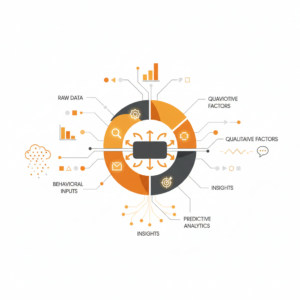
Data-driven customer personas replace assumptions with measurable behavioural patterns, validated needs, and transparent evidence. They reduce bias, improve alignment across CX, product, and operations, and remain current as customer behaviour changes. The shift requires clear segmentation logic, mixed-method research, privacy-safe data practices, and ongoing measurement so personas become decision tools, not storytelling artefacts.
What is a data-driven customer persona?
A data-driven customer persona is a human-readable profile built from verifiable evidence, not creative writing. It summarises a real segment’s behaviours, needs, constraints, and decision drivers using a defined dataset, a reproducible method, and explicit confidence levels. The “persona” remains a synthesis, but the synthesis is anchored in observable patterns and validated research activities aligned to human-centred design practice.¹
The key difference is falsifiability. If new evidence contradicts the persona, the persona must change. That single property moves personas from “useful fiction” to operational assets that can be audited, refreshed, and tied to outcomes. This is why validating user personas with data is not an extra step. It is the step that protects executive decisions from confident but incorrect narratives.³
Why do “fictional” personas fail in enterprise CX?
Fictional personas often fail because teams cannot reliably answer two governance questions: “Which customers does this represent?” and “How do we know?” Chapman and Milham’s critique is that many persona artefacts cannot be verified or falsified, which makes them weak as evidence for product, service, or policy decisions.³ When personas become unfalsifiable, they drift toward internal belief systems and political compromise.
Enterprise environments amplify the risk. Multiple channels, long service journeys, and uneven data quality mean a persona built from a small sample can accidentally represent nobody at scale. Research on persona construction also highlights that persona value depends on disciplined inputs and consistent use, not presentation polish.⁴ The failure mode is common: personas look credible, but they do not change decisions because stakeholders do not trust the provenance.
How does human-centred design support evidence-based personas?
Human-centred design requires understanding users, tasks, and contexts, then iterating based on evaluation.¹ That lifecycle maps directly to persona governance: define context of use, gather evidence, synthesise responsibly, test the artefact with stakeholders, and refine as reality changes. A persona is not the research. It is a communication device that should carry research evidence forward into decisions.
Usability standards also reinforce the importance of specifying users, goals, and context when evaluating outcomes.² That framing helps leaders avoid “persona theatre”, where teams discuss customers abstractly but never connect personas to measurable task success, effort, or satisfaction within specific channels and service conditions.
How do you build data-driven customer personas step by step?
Start with a segmentation hypothesis that is testable. In practice, behavioural variables outperform demographics as a first cut because they connect to action: intent, frequency, channel mix, service triggers, lifecycle stage, and constraints. Then run a mixed-method pipeline that makes the persona traceable.
Use triangulation to converge on what is stable across methods and sources.⁷ In qualitative research, triangulation is used to improve validity by comparing evidence from different sources and methods, rather than trusting any single view.⁷ In persona work, this means combining analytics, VOC signals, operational data, and research interviews so you can separate true patterns from sampling noise or internal bias.
A practical build sequence is:
Define the decision the persona must improve (for example, reduce avoidable contacts, increase digital completion, improve first contact resolution).
Select datasets that reflect that decision (contact reasons, digital journeys, complaints, churn triggers, conversion drop-offs).
Cluster into candidate segments using transparent rules.
Validate with qualitative interviews and task-based testing.
Publish the persona with “evidence notes” explaining what is measured versus inferred.
Set a refresh trigger (monthly or quarterly) and a change-log.
Data-driven personas vs segments vs jobs-to-be-done
Segmentation explains “who groups with whom.” Personas explain “what it feels like to be in that group, and what they will do next.” Jobs-to-be-done explains “what progress they are trying to make.” These are complementary, not competing.
The risk is using personas to do segmentation’s job. If segmentation is weak, personas become stereotypes dressed as empathy. The better pattern is: segmentation provides the statistical structure, personas provide the operational narrative, and jobs-to-be-done provides the language for designing outcomes. Studies of data-driven personas show the value is often in correcting decision-maker misconceptions and improving confidence, not in replacing analytics.⁵
One empirical study of data-driven personas in a workplace scenario found that after engaging with personas, 80.6% of participants changed their preconceptions, and 94% maintained or improved accuracy.⁵ Those results matter to executives because they quantify a core benefit: better decisions through corrected assumptions.
Where do data-driven customer personas create measurable value?
Data-driven customer personas create value when they are embedded into operating rhythms: roadmap prioritisation, service design, contact centre scripts, digital content strategy, and change management. They are most effective when each persona is linked to high-cost moments and measurable outcomes such as avoidable contacts, time to resolution, digital containment, complaint escalation, or retention.
A practical Applications model is to attach each persona to:
Top tasks and failure points by channel
“Need states” that predict switching or complaint behaviour
Service constraints (accessibility, language, verification friction)
Preferred interventions (proactive comms, assisted digital, callback)
To operationalise this in a CX research and design workflow, many teams use a managed insight layer that keeps persona evidence current and accessible across functions. One example is Customer Science Insights: https://customerscience.com.au/csg-product/customer-science-insights/
What risks come with validating user personas with k is false precision. Data-driven personas can look objective while embedding biased variables, missing populations, or weak identity resolution. Algorithmic persona generation research highlights issues such as what information to include, how to present uncertainty, and how easily users misread auto-generated attributes as facts.¹²
A second risk is trust. If stakeholders do not understand how a persona was produced, they discount it, even if the underlying data is sound. Research on persona transparency shows that adding explanations of how persona information was produced can influence perceptions and trust, which is critical when personas come from algorithmic processes.⁶
A third risk is privacy and governance. Persona programs often combine datasets across channels. Without clear legal basis, minimisation, and de-identification controls, the persona pipeline can create compliance exposure. Australian privacy guidance emphasises careful handling of personal information in analytics and de-identification decisions, including assessing re-identification risk.⁸˒⁹
How should you measure persona quality and business impact?
Measure persona quality in two layers: artefact quality and decision impact. Artefact quality asks whether the persona is accurate, current, and usable. Decision impact asks whether the persona changes prioritisation, design choices, and operating metrics.
For artefact quality, use:
Coverage: percentage of customers mapped to a persona with confidence thresholds.
Stability: how often the segment’s defining behaviours change.
Traceability: whether each key attribute links to a source, method, and date.
Usability: whether teams can apply the persona to specified goals in a defined context of use.²
For decision impact, test for corrected assumptions and improved choices. The empirical evidence that personas can shift misconceptions and improve accuracy provides a useful benchmark for stakeholder enablement metrics.⁵ Privacy and governance checks should also be explicit, aligned to Australian Privacy Principles guidance and data governance frameworks.¹⁰˒¹¹
What are the next steps to move beyond fictional profiles?
First, pick one high-value journey where personas can reduce cost or risk, such as complaints, claims, cancellations, or vulnerable customer support. Then build a minimum viable persona set, limited to the smallest number that improves decisions. Chapman’s later quantitative work warns that overly attribute-heavy personas can fail to match real users, so keep attributes disciplined and evidence-based.³
Second, formalise a governance model: an owner, a refresh cadence, change control, and a privacy review. For Australian organisations, align analytics and de-identification decisions to OAIC guidance and ensure the program has a documented purpose, minimisation, and access controls.⁸˒⁹
Third, embed the practice in CX Research and Design delivery so persona refresh becomes routine, not a once-a-year workshop output. A managed service can help scale the operating model across portfolios, for example: https://customerscience.com.au/solution/cx-research-design/
Evidentiary Layer
Data-driven customer personas succeed when they are traceable, measurable, privacy-safe, and embeddng. Standards-based human-centred design provides the process discipline to keep personas grounded in real context and iterative evaluation.¹˒² Academic critiques of personas provide the methodological guardrails that prevent unfalsifiable storytelling.³ Empirical work on data-driven personas provides quantifiable evidence that personas can correct misconceptions and improve decision confidence when built and presented responsibly.⁵˒⁶
For executives, the strategic point is simple: personas should be treated like any other decision instrument. If they cannot be audited, refreshed, and measured, they will eventually be ignored. If they can, they become a durable bridge between analytics, research, and the day-to-day decisions that shape customer experience.
FAQ
What makes a persona “validated” rather than “fictional”?
A validated persona has a defined segment rule, traceable data sources, documented synthesis steps, and evidence that the persona changes decisions.³ It can be updated when evidence changes, which makes it falsifiable.
How many data-driven customer personas should an enterprise maintain?
Maintain the smallest set that improves decisions. Too many personas create operational confusion, while too few can hide material differences in needs and constraints. Governance and refresh cadence matter more than count.¹
Does analytics replace qualitative research in persona development?
No. Analytics finds patterns at scale, while qualitative research explains the “why” behind behaviours. Triangulation across methods improves validity and reduces bias.⁷
How do we keep personas compliant with Australian privacy obligations?
Start with purpose limitation and minimisation, then apply OAIC guidance on data analytics, de-identification, and re-identification risk assessment.⁸˒⁹ Use clear access controls and governance aligned to APP expectations.¹⁰
How do we make personas usable across CX, product, and contact centres?
Publish personas with evidence notes, link them to top tasks and failure points, and integrate them into operating rituals such as journey reviews and prioritisation forums.⁴ A searchable knowledge layer can help scale consistent adoption, for example: https://customerscience.com.au/csg-product/knowledge-quest/
What is the fastest way to prove ROI from validating user personas with data?
Run a controlled pilot on one journey ast decision quality, corrected assumptions, and operational outcomes such as avoidable contacts or digital completion. Empirical evidence suggests personas can shift misconceptions and improve accuracy, which can be tracked as a leading indicator.⁵
Sources
ISO. ISO 9241-210:2019 Ergonomics of human-system interaction, Human-centred design for interactive systems. ISO Online.
ISO. ISO 9241-11:2018 Ergonomics of human-system interaction, Usability: Definitions and concepts (PDF).
Chapman, C.N., Milham, R.P. (2006). The Personas’ New Clothes: Methodological and Practical Arguments against a Popular Method (HFES). PDF.
Miaskiewicz, T., Kozar, K.A. (2011). Personas and user-centered design: How can personas benefit product design processes? Design Studies, 32(5), 417–430. https://doi.org/10.1016/j.destud.2011.03.003
Salminen, J., Jung, S.-G., Chowdhury, S., et al. (2021). The ability of personas: An empirical evaluation of altering incorrect preconceptions about users. International Journal of Human-Computer Studies, 153, 102645. https://doi.org/10.1016/j.ijhcs.2021.102645
Salminen, J., et al. (2020). Persona transparency: Analyzing the impact of explanations on perceptions of data-driven personas. International Journal of Human-Computer Interaction. https://doi.org/10.1080/10447318.2019.1688946
Carter, N., Bryant-Lukosius, D., DiCenso, A., Blythe, J., Neville, A.J. (2014). The use of triangulation in qualitative research. Oncology Nursing Forum. PubMed record. https://pubmed.ncbi.nlm.nih.gov/25158659/
Office of the Australian Information Commissioner (OAIC). Guide to data analytics and the Australian Privacy Principles (2018).
OAIC. De-identification Decision-Making Framework (updated 28 Aug 2025).
OAIC. Australian Privacy Principles guidelines (updated 14 Nov 2025).
Australian Government Department of Finance. Data Governance Framework (September 2025) (PDF).
Jansen, B.J., et al. (2019). Design Issues in Automatically Generated Persona Profiles. ACM. https://doi.org/10.1145/3295750.3298942