














Agile delivery teams integrate research reliably when they run continuous discovery tracks alongside delivery, convert Voice of Customer signals into testable decisions, and close the loop with measurable outcomes. The practical shift is to replace episodic “big research” with small, frequent touchpoints, shared synthesis, and clear decision rules that protect speed while improving customer relevance.
What is the feedback loop between research and agile delivery?
The feedback loop is the operating system that turns customer evidence into delivery decisions, then measures whether the release improved customer outcomes. Human-centred design standards describe this as a lifecycle activity that continues through design, development, and improvement, not as a one-off phase.¹ This matters in agile because sprint cadence can create output velocity without outcome clarity.
A useful definition for executives is simple: the loop starts with an explicit customer or business risk, gathers enough evidence to reduce that risk, ships a change, then validates impact through VoC and product telemetry. When teams treat research as “inputs” and delivery as “outputs,” the loop breaks. When teams treat research as decision support and delivery as hypothesis testing, the loop stays intact and compounds value.
Why does agile delivery often ship faster but learn slower?
Agile methods reduce batch size, but many organisations keep research batched. The result is a timing mismatch: discovery findings arrive after delivery commitments. In practice, delivery teams then optimise for predictability, while research teams optimise for rigour, and neither optimises for learning speed.
The deeper issue is governance. In many enterprises, funding and approval processes reward certainty early, even when uncertainty is highest. Dual-track models emerged to address this by running discovery and delivery in parallel so that learning can keep pace with build.³ The intent is not to “add more meetings,” but to protect decision quality when change is expensive and reputational risk is high.
How do “continuous discovery tracks” work in real teams?
Continuous discovery tracks are a repeating rhythm of small research activities that sit alongside delivery work. A widely adopted baseline is weekly customer touchpoints conducted by the team building the product, using lightweight methods to support a specific outcome.⁴ The most important design choice is not the method. It is the constraint: discovery must be frequent enough to shape priorities before build starts.
Operationally, discovery tracks work when they are designed as a pipeline of decisions. Each week, the team updates assumptions, tests the riskiest one, and either proceeds, pivots, or stops. This turns research from “a report” into a decision service. It also creates a common artefact trail that leaders can audit, which reduces reliance on opinion or the loudest stakeholder.
What changes when teams adopt agile user research?
Agile user research shifts from comprehensive studies to just-in-time learning. The aim is to answer the next decision with the smallest credible evidence set, then iterate. Interaction design literature describes this as integrating research as small, frequent activities throughout the lifecycle, so feedback informs ongoing decisions rather than a single upfront checkpoint.⁵
The biggest organisational change is role design. Teams that succeed typically operate as a trio: product, design, and engineering share discovery responsibilities, while specialist researchers enable quality, ethics, recruitment, and synthesis. This split preserves craft while improving throughput. It also reduces the translation loss that happens when teams only see slide decks rather than customers.
How does dual-track agile compare with traditional “research then build”?
Traditional models separate discovery and delivery, which increases handoffs and delays learning until after launch. Dual-track approaches explicitly coordinate discovery and delivery so discovery reduces uncertainty for delivery without blocking it.³ The model is most valuable when customer risk is high, constraints are complex, or the domain is regulated.
The comparison is not “agile versus waterfall.” It is “parallel learning versus sequential learning.” Sequential learning creates long gaps between insight and action, which increases rework. Parallel learning lets teams test problem framing, solution direction, and usability earlier, so delivery sprints spend less time building the wrong thing. The practical test is simple: if a team cannot point to recent customer evidence that shaped the next backlog decisions, the approach is not working.
Where should the feedback loop live in CX and VoC programs?
For enterprise CX, the feedback loop must connect VoC systems, research practice, and delivery prioritisation. Complaint and feedback handling guidance emphasises trend identification and continual review as mechanisms for improving operations, not just resolving individual cases.⁶ That principle becomes more powerful when it is linked directly to product and service roadmaps.
In regulated environments, complaints handling standards also create an accountability backbone. Australian regulators reference complaint handling standards aligned to AS/ISO guidance, reinforcing expectations that organisations use complaints data to improve systemic issues.⁷˒¹¹ When VoC is treated as operational risk data, not marketing sentiment, it becomes easier to justify the time and tooling required to integrate it into agile planning.
Applications
What is a practical operating model for integrating research into delivery?
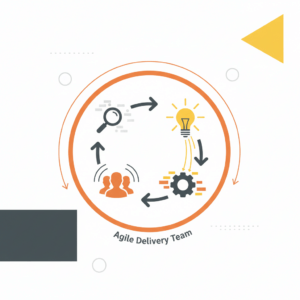
A reliable operating model uses four repeating steps: (1) define the decision, (2) collect lightweight evidence, (3) synthesise into a decision record, (4) validate impact post-release. ISO human-centred design guidance supports iterative activity across the lifecycle, which is the underlying rationale for this cadence.¹
To make this scalable, teams need a shared insight repository, consistent tagging, and governance for “what counts as evidence.” In practice, this is where many programs fail, because findings live in decks and personal notes. A centralised insights capability such as Customer Science Insights can support consistent capture, retrieval, and reuse of VoC and research outputs across squads, reducing duplication and improving traceability (see product link list). https://customerscience.com.au/csg-product/customer-science-insights/
How do you turn VoC into backlog-ready decisions?
Start by translating VoC signals into hypotheses, not feature requests. Complaints handling standards describe using complaint data to identify trends and eliminate causes, which aligns naturally with hypothesis-driven delivery.⁶ A complaint theme becomes a problem statement with measurable outcomes, such as reduced repeat contacts or improved task success.
Next, define a decision rule. For example: “If we see pattern X in complaints and confirm it in five interviews, we will run a prototype test; if task success improves by Y, we will deliver.” This avoids endless discovery while preventing premature build. The point is not to over-measure. The point is to decide with integrity and speed.
Risks
What are the common failure modes in continuous discovery?
The most common failure is performative research: teams run interviews but do not change decisions. Another failure mode is over-indexing on qualitative anecdotes without triangulating with operational data, leading to biased prioritisation. A third failure is treating discovery as a separate “mini project,” which recreates batching and delays.
There are also people risks. Research can become a bottleneck if a single specialist is expected to serve many teams. Conversely, quality can degrade if untrained teams collect data without appropriate safeguards. Market and social research standards emphasise consistent, transparent planning and reporting practices, which is a useful reference point for enterprise governance even when methods are lightweight.⁸
Measurement
What should executives measure to prove the loop is working?
Measurement must connect discovery activity to delivery performance and customer outcomes. Start with leading indicators: weekly customer touchpoints, time from insight to decision, and percentage of roadmap items linked to evidence. Then track outcome indicators: complaint rate trends, task success, conversion, and repeat contact drivers. Complaints handling guidance supports trend analysis as a basis for systemic improvement, reinforcing the need for repeatable measurement, not one-off dashboards.⁶˒⁷
For technology delivery health, use established delivery performance metrics. DORA research popularised a small set of delivery performance measures that remain widely used for tracking throughput and reliability, which helps separate “faster shipping” from “safer shipping.”² The executive lens is to correlate discovery maturity with rework reduction, fewer reversals, and improved customer metrics.
(Second link, service) https://customerscience.com.au/service/cx-consulting-and-professional-services/
Next Steps
How do you implement the feedback loop in 30 to 60 days?
Week 1 to 2: establish decision templates and a single insights taxonomy. Use a simple evidence ladder, such as complaint themes, behavioural analytics, interviews, and usability tests, with clear confidence labels. Human-centred design guidance supports applying user needs and context throughout the lifecycle, which underpins the rationale for these artefacts.¹
Week 3 to 4: pilot one squad with a fixed cadence: weekly touchpoints, a weekly synthesis session, and a fortnightly decision review tied to backlog refinement. Keep the scope narrow. Choose a high-friction journey with measurable VoC signals, so impact is visible.
Week 5 to 8: scale by enabling, not centralising. Train product trios, standardise recruitment and ethics, and build a repeatable “close the loop” reporting pattern that links shipped changes to VoC movement. This is also the point to harden governance using established research and complaint-handling standards, so scale does not compromise quality.⁸˒⁶
Evidentiary Layer
What evidence supports this approach?
Parallel discovery and delivery is supported by documented dual-track agile approaches that describe how discovery and delivery can interact in iterative, cyclical ways.³ Continuous discovery practices are also described in practitioner literature as frequent customer touchpoints that keep evidence current and decision-ready.⁴˒⁵
At the enterprise level, the approach aligns with quality and complaints handling guidance that frames complaints as inputs for continual improvement and trend elimination, not just case resolution.⁶˒⁷ This creates a governance bridge between customer operations and product delivery. Finally, delivery performance measurement benefits from using established DevOps research frameworks to monitor speed and stability while discovery improves decision quality.²
FAQ
What is the difference between agile user research and traditional UX research?
Agile user research prioritises frequent, decision-focused learning that fits sprint cadence, while traditional approaches often batch research into larger studies that arrive after commitments are made.⁵
Do continuous discovery tracks replace a research team?
Continuous discovery tracks change the research team’s role from “doing all studies” to enabling quality, ethics, recruitment, and synthesis so product trios can learn continuously without degrading standards.⁸
How many customer interviews are “enough” per week?
A practical baseline is weekly touchpoints with customers, focused on the next decision, using small research activities rather than large projects.⁴
How does Voice of Customer connect to agile backlogs?
VoC becomes backlog-ready when themes are translated into hypotheses, validated quickly, and linked to measurable outcomes, consistent with guidance that complaint data should drive trend elimination and improvement.⁶
What should we do if VoC and analytics disagree?
Treat disagreement as a signal to refine problem framing. Triangulate with another method, document the decision rule, and validate post-release with outcome measures rather than opinions.¹
What tooling helps keep insights reusable across squads?
Use a shared insights repository with consistent tagging, governance, and retrieval so teams can reuse evidence and avoid duplicated research. A packaged option is Knowledge Quest for structured capture and re-use of organisational knowledge across teams (third link). https://customerscience.com.au/csg-product/knowledge-quest/
Sources
ISO. ISO 9241-210:2019 Ergonomics of human-system interaction. https://www.iso.org/standard/77520.html
DORA. Accelerate State of DevOps Report 2024. https://dora.dev/research/2024/dora-report/
Trieflinger, S., Münch, J., Heisler, B., Lang, D. Essential Approaches to Dual-Track Agile (ICSOB 2020, LNBIP). (Repository entry) https://publikationen.reutlingen-university.de/frontdoor/index/index/searchtype/authorsearch/author/Trieflinger%2C%2BStefan/start/9/rows/1/author_facetfq/M%C3%BCnch%2C%2BJ%C3%BCrgen/nav/next
Torres, T. Continuous Discovery Habits definition (weekly touchpoints). https://www.producttalk.org/getting-started-with-discovery/
Interaction Design Foundation. Continuous discovery overview. https://www.interaction-design.org/literature/topics/continuous-discovery
ISO. ISO 10002:2018 Quality management, customer satisfaction, complaints handling. https://www.iso.org/standard/71580.html
Commonwealth Ombudsman (Australia). Better Practice Complaint Handling Guide (2021). https://www.ombudsman.gov.au/__data/assets/pdf_file/0025/288241/Better-Practice-Complaint-Handling-Guide-2021.pdf
ISO. ISO 20252:2019 Market, opinion and social research, including insights and data analytics. https://www.iso.org/standard/73671.html
NIST. Human factors and human-centred design overview (references ISO 9241-210). https://www.nist.gov/itl/iad/visualization-and-usability-group/human-factors-human-centered-design
Barros, L. et al. Agile software development projects, human factors perspective (2024). https://www.sciencedirect.com/science/article/pii/S0950584924000375
APRA (Australia). Complaints handling standards overview (aligned to AS/ISO 10002). https://www.apra.gov.au/apras-complaints-handling-standards