































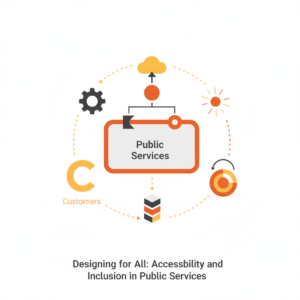
Accessible, inclusive public services require teams to design for disability, ageing, language, literacy, and situational limits from day one. In Australia, that means aligning with the Digital Service Standard and meeting recognised accessibility expectations such as WCAG. The outcome is practical: fewer failed transactions, lower support demand, stronger compliance posture, and better trust in government services.¹²³
Definition
What does accessibility mean in public services?
Accessibility means people can perceive, understand, navigate, and complete a service regardless of disability, assistive technology, or context. In public services, accessibility applies to every touchpoint: websites, forms, PDFs, call-centre scripts, kiosks, and identity-proofing steps. It also applies to internal staff-facing tools that shape citizen outcomes, such as case management and communications templates.¹
How is inclusion different from accessibility?
Inclusion is the service outcome. It means the service works for diverse people, including those who are neurodivergent, have low digital confidence, use older devices, speak languages other than English, or live with intermittent connectivity. Accessibility is a measurable set of requirements and practices. Inclusion is the broader design intent that reduces exclusion across channels and life circumstances.⁴
Context
Why does accessible service design matter for government?
Government services are often “must-use” services. When a service fails for a person, the impact is not just frustration. It can delay payments, health access, housing, compliance obligations, or safety. Australia’s disability prevalence is large and material. The ABS reports 5.5 million Australians (21.4%) had disability in its latest release.⁵ This sits alongside older Australians, temporary impairments, and situational limitations that are not always captured in a single statistic.⁶
How does the Digital Service Standard Australia frame accessibility?
The Australian Government’s Digital Service Standard positions services as inclusive and measurable, with accessibility as a core expectation.⁷ The Digital Inclusion Standard guidance explicitly calls for compliance with relevant legislation, including the Disability Discrimination Act 1992, and for meeting current government accessibility requirements, including WCAG.¹ The policy intent is clear: accessibility is not a retrofit task. It is a design and delivery requirement.¹⁷
Mechanism
What does “designing for all” look like in practice?
Accessible service design government teams can operationalise inclusion through a repeatable mechanism:
Define audiences using real needs, not personas alone. Include disability, ageing, literacy, language, and technology constraints.⁵⁶
Specify accessibility requirements early, including WCAG conformance targets (commonly Level AA) and non-web content expectations for documents and multimedia.³⁸
Design key journeys with assistive technology and keyboard-only use as a baseline, not an exception.³
Create content that is plain, structured, and scannable, then validate it with people who have lived experience.¹
Build with components that encode accessibility patterns so teams do not “relearn” basics on every project.²
Test continuously using automated checks plus manual testing, including screen readers and real users, before release and after each major change.³⁴
This mechanism reduces rework because accessibility defects found late are expensive to remove and hard to prioritise against launch pressures.
How do standards translate into delivery controls?
Standards become delivery controls when teams embed them into governance:
Procurement: include accessibility conformance reporting and remediation obligations in vendor contracts.⁸
Definition of done: treat accessibility checks as release gates for each sprint and each content update.³
Design assurance: review service blueprints for channel consistency so that digital, phone, and in-person pathways remain equivalent.¹⁴
Human-centred design: use a structured HCD lifecycle so research, prototyping, evaluation, and iteration stay funded and scheduled.⁹
ISO-aligned human-centred design practices help teams link accessibility to usability, safety, and satisfaction rather than treating it as compliance-only work.⁹
Comparison
Is WCAG compliance the same as inclusive design?
WCAG helps teams make digital content accessible and testable.³ However, inclusive design extends further. It addresses service choice, failure demand, and cross-channel equivalence. A service can pass many WCAG checks and still exclude people through complex identity steps, unclear eligibility rules, or inaccessible “out-of-band” artefacts such as PDFs and call scripts.¹⁴
What is the difference between universal design and accessibility?
Universal design provides principles for designing for the widest range of people, including equitable use and flexibility in use.¹⁰ Accessibility provides formal criteria that can be audited and verified, such as WCAG success criteria.³ In public services, the strongest approach combines both: universal design principles guide the experience, while accessibility standards define measurable quality thresholds.
Applications
Where should government start to improve accessibility and inclusion?
Start where exclusion creates the highest cost and harm. In public services, that usually means high-volume, high-stakes journeys:
Payments and claims: online forms, evidence upload, status tracking, and notifications.
Identity and consent: verification, delegated access, guardianship, and authority to act.
Appointments and triage: booking, reminders, rescheduling, and urgent escalations.
Regulatory services: compliance reporting, renewals, infringements, and appeals.
A practical program pairs journey analytics with qualitative research to locate where people abandon tasks, then tests fixes with affected cohorts.
For teams that need a structured evidence base to prioritise improvements, Customer Science’s product approach can support insight capture and retrieval across programs, including accessibility and inclusion findings: https://customerscience.com.au/csg-product/customer-science-insights/
How do public services design across digital and contact centre channels?
Digital exclusion often shows up as contact-centre load. When online tasks fail, people call. Inclusive design reduces this failure demand by making pathways equivalent:
Use the same language and eligibility logic across web content, letters, SMS, and scripts.¹
Ensure staff tools surface accessibility needs flags and preferred channels with privacy controls.¹⁴
Offer assisted digital options that preserve dignity, including screen-sharing support, call-backs, and accessible appointment flows.
This approach improves outcomes for citizens and reduces avoidable operating cost.
Risks
What happens when accessibility is treated as a “compliance tick”?
Treating accessibility as a checklist creates four predictable risks:
Legal and policy exposure: Australian guidance ties digital access to obligations under the Disability Discrimination Act and related expectations for equal access.²³
Operational cost: late remediation increases rework and raises the chance of post-launch incidents.
Equity failures: excluded cohorts experience worse outcomes, which can amplify disadvantage.⁶
Reputational damage: public trust declines when services systematically fail for people who need them most.¹²
The Australian Human Rights Commission’s guidance on equal access to digital goods and services reinforces that accessibility obligations are active and evolving as technology changes.²
How do automation and AI change accessibility risk?
Automation can improve accessibility when it reduces complexity and speeds resolution. It can also worsen exclusion when it introduces opaque decisions, inaccessible interfaces, or biased language generation. Inclusive practice requires:
Accessible conversational UI patterns, including clear turn-taking, error recovery, and human handoff.³
Content governance that prevents complex or ambiguous language from scaling across channels.¹
Monitoring for disparate outcomes across cohorts, not just average performance.
Measurement
How should government measure accessible service design success?
Measurement needs to connect standards conformance to service outcomes. A balanced set of measures includes:
Conformance and defects: WCAG 2.2 Level AA results, defect density, and time-to-remediate.³⁴
Task success: completion rates, time on task, and error rates for priority journeys, segmented by assistive technology use where feasible and ethical.⁹
Channel shift and failure demand: call volume attributable to digital failure, repeat contacts, and escalation rate.
Equity indicators: complaint themes, vulnerability flags, and outcomes parity for target cohorts.⁶
Content accessibility: proportion of communications that meet readability and structural accessibility expectations, including PDFs and multimedia.¹
WCAG 2.2 is published as a W3C Recommendation and is actively maintained, so measurement programs should refresh test baselines when standards and guidance change.⁴³
Next Steps
What is a realistic roadmap for public sector teams?
A practical roadmap follows three horizons:
0–90 days: stabilise
Baseline audit for top journeys and top documents.³
Fix high-severity issues that block task completion.
Establish accessibility gates in delivery and content publishing.³
3–9 months: scale
Build or adopt an accessible component library.²
Train product, design, content, engineering, and procurement teams.¹
Introduce cohort-based testing with people with disability and older users.⁹
9–18 months: embed
Integrate accessibility into performance reporting and portfolio governance.⁷
Expand to staff-facing services that shape citizen outcomes.⁷
Maintain continuous monitoring and periodic independent review.³
For agencies that need sustained capability uplift and research-led design governance, a managed approach through Customer Science’s CX Research & Design service line can support discovery, testing, and delivery integration: https://customerscience.com.au/solution/cx-research-design/
Evidentiary Layer
Frequently asked questions
What is the minimum accessibility target most government digital services use?
Many organisations target WCAG Level AA as a practical baseline because it is widely referenced in guidance and is testable in delivery.³²
Does WCAG cover PDFs, Word documents, and video?
WCAG focuses on web content, but accessible service delivery requires accessible documents and multimedia as well. Public-sector guidance often highlights that accessibility must apply to documents, images, audio, and video, not only web pages.¹³
Is accessibility only about disability?
Accessibility addresses disability, but it also improves services for older people, people using mobile devices, low bandwidth, temporary injury, and situational limits. Universal design principles reinforce this broader benefit.¹⁰⁶
How do we avoid accessibility becoming a late-stage audit?
Teams prevent late-stage failure by turning standards into delivery controls: procurement requirements, definition-of-done gates, component libraries, and continuous testing.³⁸
What capability helps teams reuse accessibility decisions across programs?
A searchable knowledge base of research findings, patterns, and tested content helps teams avoid repeating mistakes across portfolios. Customer Science’s Knowledge Quest supports retrieval of validated insights and design decisions at scale: https://customerscience.com.au/csg-product/knowledge-quest/
How should we report progress to executives?
Report both risk reduction and service outcomes. Combine conformance trends with task success, failure demand, and equity indicators so leaders can see operational impact, not just audit scores.³⁵
Sources
Australian Government, Digital Inclusion Standard, Criterion 4: Make it accessible.
Australian Human Rights Commission, Guidelines on equal access to digital goods and services.
W3C, Web Content Accessibility Guidelines (WCAG) 2.2, Recommendation history and specification.
Australian Human Rights Commission, Standards and guidelines on digital accessibility (WCAG 2.2 guidance).
Australian Bureau of Statistics, Disability, Ageing and Carers, Australia: Summary of Findings (latest release key statistics).
World Health Organization, Disability and health fact sheet (global prevalence 1 in 6).
Australian Government, Digital Service Standard and DSS 2.0 updates.
Australian Government Architecture, WCAG as part of the Digital Service Standard v2.0.
ISO 9241-210:2019, Human-centred design for interactive systems (standard overview).
Principles of Universal Design (seven principles) and Universal Design Ireland overview.
ISO/IEC 30071-1:2019, Code of practice for creating accessible ICT products and services (standard overview).
W3C WAI, The Business Case for Digital Accessibility.