





























Customer health scoring gives B2B teams a practical way to detect declining value before churn becomes visible in revenue. It works best when firms define health around adoption, relationship quality, and realised value, then connect scores to clear actions, owners, and review routines rather than treating the score as a dashboard number. (ScienceDirect)
What is customer health scoring?
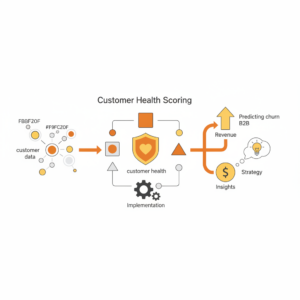
Customer health scoring is a structured method for estimating whether a customer relationship is strengthening, stalling, or slipping into risk. In B2B settings, the score usually combines objective signals such as product usage, support history, renewal timing, and commercial activity with subjective signals such as sponsor confidence, implementation progress, and perceived value. Research on customer success management describes customer health as a formative metric that tracks relationship quality, product usage, and customer value realisation.¹ That definition matters because it keeps the score anchored to business reality, not to one metric that happens to be easy to extract. (ScienceDirect)
A practical customer health scoring model is not the same as churn prediction, though the two are closely related. Health scoring is the operating layer. It gives teams a shared, interpretable signal they can use in account reviews, service decisions, and renewal planning. Predicting churn B2B usually goes one step further by using statistical or machine learning models to estimate which accounts are most likely to leave and, in some cases, which actions are most likely to change the outcome.²˒³ (ScienceDirect)
Why do most health scores fail?
Most health scores fail because they measure activity, not health. Teams often pile together everything they can see: logins, ticket counts, meeting attendance, survey scores, feature usage, executive sentiment. Then they weight those inputs by instinct and call the result a health model. The score looks tidy. But it does not reliably predict renewal, churn, or expansion. A recent systematic review of churn prediction research points to the same underlying issue in another form: model quality depends heavily on feature selection, data quality, and the link between signals and the target outcome.⁴ (MDPI)
Another common failure is organisational. The score exists, but nobody trusts it enough to act on it. Customer success managers keep separate spreadsheets. Sales leaders dispute the thresholds. Product teams do not accept that low usage always signals risk. The fix is not more colour coding. It is sharper design. Good health scores are narrow enough to explain, stable enough to govern, and close enough to commercial outcomes that senior leaders use them in normal operating reviews.¹˒⁵ (ScienceDirect)
How should a B2B firm define customer health?
Define customer health around three questions. Is the customer using the solution in a way that suggests adoption is real? Is the relationship stable enough that problems will be surfaced early? And is the customer realising value in a way that supports renewal or growth? That three-part structure is consistent with the B2B customer success literature and gives you a model that is practical without becoming simplistic.¹ (ScienceDirect)
In practice, that means separating signals into a few clear groups. Adoption signals might include active users, breadth of feature use, time since last meaningful activity, onboarding completion, and workflow penetration. Relationship signals might include sponsor engagement, unresolved escalations, meeting quality, executive contact, or payment friction. Value signals might include outcomes achieved, case resolution quality, usage against contracted goals, or evidence that the customer is expanding internal use. Keep the number of inputs tight. Too many features make the score hard to interpret and hard to maintain.²˒⁴ (ScienceDirect)
Which signals matter most for predicting churn B2B?
Usage data matters more than many firms think, but not in a crude way. Research using 3,959 B2B software subscriptions found that incorporating usage data improved churn prediction, with timing, granularity, and domain expertise all affecting model performance.² That is a strong argument for using behaviour data, but it is also a warning. The right usage signal depends on the product, the buying model, and what “healthy use” actually looks like for that customer. (ScienceDirect)
Because of that, firms should look for signals that are both predictive and actionable. A drop in meaningful usage. A stalled onboarding milestone. Repeated support issues on the same workflow. Lower engagement from the original sponsor. Rising service friction during a renewal window. These patterns are more useful than vanity measures like raw login counts. For teams that need a live operational view across contact, digital, and service data before scoring can mature, Customer Science Insights is one practical way to bring those signals into one place. (ScienceDirect)
How does a practical implementation model work?
Start with one segment, one renewal outcome, and one review cadence. Do not launch an enterprise-wide health score first. Begin where the firm already has account ownership, a clear renewal event, and enough data to test the link between early signals and later outcomes. That could be mid-market subscription accounts, enterprise implementations in year one, or high-value managed service customers. Small scope makes it easier to see whether the score adds signal or noise.³˒⁴ (MDPI)
Then build the model in four passes. First, define the target outcome such as churn, downsell, failed onboarding, or delayed renewal. Second, shortlist candidate signals and test whether they move before the outcome does. Third, convert those signals into a score or risk band that account teams can understand. Fourth, connect each band to a standard action path. No action path, no health model. A red account with no escalation rule is not intelligence. It is decoration.¹˒³ (ScienceDirect)
What is the difference between a rules-based score and a predictive model?
A rules-based score uses defined thresholds and weights. For example, low adoption might subtract points, while executive engagement might add points. This approach is easier to explain, easier to govern, and often better for early-stage implementation. A predictive model uses historical data to estimate the probability of churn or another outcome. It may outperform a manual score, but it also introduces more governance work around feature drift, explainability, bias, and monitoring.⁴˒⁶ (MDPI)
Most B2B firms should not treat this as an either-or decision. A sensible path is to begin with a transparent health score, validate whether it correlates with renewal outcomes, then layer predictive methods on top once the operating model is stable. That sequence usually builds trust faster. It also gives account teams time to learn which signals are genuinely useful. For organisations doing that design work across service, data, and governance, CX Consulting and Professional Services fits the later-stage implementation need well. (ScienceDirect)
Where should customer health scoring be applied first?
The best starting points are onboarding, adoption, renewal-risk reviews, and complex support environments. These areas create visible commercial consequences and usually generate enough behavioural and operational data to support signal testing. They also expose whether the organisation can act on risk once it is identified. That matters because customer health scoring is as much a management discipline as an analytics exercise.¹˒⁵ (ScienceDirect)
A useful practical pattern is to run monthly account health reviews for strategic customers and weekly reviews for the highest-risk cohort. Keep the discussion anchored to movement, not only status. What changed since last period? Which signal moved first? Which intervention is in flight? Which accounts need executive attention? This makes the score part of operating rhythm rather than another report no one owns. (ScienceDirect)
What risks should leaders watch?
The first risk is leakage. Teams sometimes include signals that are too close to the target event, which makes the model look more accurate in testing than it will be in live use. Another risk is fairness. If one customer segment gets flagged as unhealthy more often because the model reflects structural differences in usage or support patterns, the business may treat the signal as objective when it is not. Recent B2B churn research and NIST’s AI risk guidance both support tighter controls around data selection, explainability, and ongoing review.³˒⁶ (ScienceDirect)
There is also a simpler risk. Overreaction. Not every low score needs a rescue campaign. Some accounts are low touch by design. Some are seasonal. Some are healthy despite low activity because their workflow is stable. That is why firms need score context, segment logic, and human review. A health score should improve judgment. It should not replace it.¹˒² (ScienceDirect)
How should you measure success?
Measure whether the score changes decisions and improves outcomes. Start with predictive validity. Do low-scoring accounts churn more often than healthy ones? Then measure action quality. Are risky accounts being reviewed on time, with clear owners and next steps? Then measure business results. Renewal rate. Gross revenue retention. Expansion rate. Time to intervene. Avoided churn. Those are the measures that tell you whether the model is working in the real world.¹˒³˒⁴ (ScienceDirect)
Longer term, the model should also improve organisational learning. Teams should know which signals lose predictive power, which interventions work for which cohorts, and where manual judgment still outperforms automated scoring. For firms building that discipline over time, Business Intelligence Services is relevant where the challenge is not only modelling, but also reporting structure, data quality, and management cadence. (MDPI)
What should happen next?
Begin with a pilot. Pick one segment, define healthy and unhealthy states in plain language, test a small set of signals against actual renewal outcomes, and review the result with the teams who will use it. Keep the first version transparent. Then refine the model only after you have evidence that it improves decisions. That is the fastest way to make customer health scoring practical instead of performative.¹˒²˒⁴ (ScienceDirect)
FAQ
What does customer health scoring include?
It usually includes adoption signals, relationship signals, and value-realisation signals, combined into a score or band that helps teams prioritise account action.¹ (ScienceDirect)
Is customer health scoring the same as churn prediction?
No. Health scoring is the operating signal used by teams. Churn prediction is the analytical estimate of likely account loss. The two should inform each other, but they are not identical.²˒³ (ScienceDirect)
How many variables should a first model use?
Usually fewer than teams expect. Start with a small set of interpretable signals that clearly relate to renewal outcomes, then expand only if extra inputs improve prediction and action quality.⁴ (MDPI)
What is the best first use case in B2B?
Onboarding and renewal-risk management are usually the best starting points because the commercial impact is clear and the signals tend to move early enough to support intervention.¹˒² (ScienceDirect)
How often should health scores be reviewed?
Strategic and at-risk accounts usually need weekly or monthly review, depending on contract value, lifecycle stage, and the speed at which signals can change.¹ (ScienceDirect)
What helps teams trust the score?
Clear definitions, visible links to actual outcomes, a small number of understandable inputs, and a standard action plan for each score band help most. Reliable knowledge also matters when teams need to act quickly and consistently. Knowledge Quest is relevant where customer-facing teams need faster, more reliable answers as part of retention and recovery work. (ScienceDirect)
Evidentiary Layer
The evidence base supports a practical view of customer health scoring. In B2B, health is best understood as a combination of relationship quality, usage, and value realisation. Usage data improves predictive performance when it is structured properly. Churn models become more useful when they are actionable and explainable, not only accurate in testing. And governance matters once models influence retention decisions. That is why the strongest implementations start small, stay transparent, and connect scores to routine management action.¹˒²˒³˒⁶ (ScienceDirect)
Sources
-
Hochstein, B., Voorhees, C. M., Pratt, A. B., et al. Customer success management, customer health, and retention in B2B industries. International Journal of Research in Marketing, 2023. DOI: 10.1016/j.ijresmar.2023.09.002. (ScienceDirect)
-
Ramirez, J. S., den Ouden, B., Verhoef, P. C. Incorporating usage data for B2B churn prediction modeling. Industrial Marketing Management, 2024. DOI: 10.1016/j.indmarman.2024.07.004. (ScienceDirect)
-
Rahman, S., Verbeke, W., Burez, J. Profit-driven pre-processing in B2B customer churn prediction. Journal of Business Research, 2025. DOI: 10.1016/j.jbusres.2024.115177. (ScienceDirect)
-
Imani, M., Joudaki, M., Beikmohammadi, A., Arabnia, H. R. Customer churn prediction: A systematic review of recent advances, trends, and challenges. AI, 2025. DOI: 10.3390/ai7030105. (MDPI)
-
Homburg, C., Tischer, M. Customer journey management capability in business-to-business markets: Its bright and dark sides and overall impact on firm performance. Journal of the Academy of Marketing Science, 2023. DOI: 10.1007/s11747-023-00923-9. (Springer)
-
NIST. Artificial Intelligence Risk Management Framework (AI RMF 1.0). NIST AI 100-1, 2023. Stable PDF. (NIST Publications)
-
De Keyser, A., Antonetti, P., Lemon, K. N., et al. Understanding the B2B customer experience and journey: A convergence-based lens. Journal of Business Research, 2025. DOI: 10.1016/j.jbusres.2025.115481. (ScienceDirect)
-
Guliyev, E., Coussement, K., De Bock, K. W. Improving B2B customer churn through action rule mining. Industrial Marketing Management, 2025. DOI: 10.1016/j.indmarman.2025.04.006. (ScienceDirect)