

















Summary
Customer empathy mapping is a structured workshop method that helps organisations visualise what customers think, feel, say, and do during an experience. It translates research into shared understanding across teams. When run well, empathy mapping improves CX design decisions, aligns stakeholders, and exposes unmet needs that traditional metrics often miss.
Definition: What Is Customer Empathy Mapping?
Customer empathy mapping is a qualitative research synthesis technique used in customer experience design. It converts behavioural and attitudinal research into a visual framework that shows how customers experience a product, service, or process.
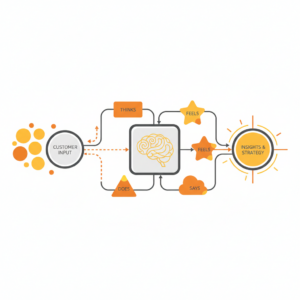
The empathy map typically captures four core dimensions:
• What the customer says
• What the customer thinks
• What the customer does
• What the customer feels
Teams place observations, quotes, and evidence from interviews, surveys, or call recordings into these quadrants. Patterns emerge. Hidden friction becomes visible.
The method originated in design thinking and human-centred design practices, widely used by organisations such as IDEO and Stanford d.school¹. Over time it has become a standard CX research tool used across product, service, and contact centre environments.
Customer empathy mapping shifts discussions away from internal assumptions. The conversation centres on real customer behaviour.
And that change matters.
Research by McKinsey shows organisations that systematically apply customer insight outperform competitors on revenue growth by 10 to 15 percent².
Context: Why Empathy Mapping Matters in CX Research
Customer data exists everywhere. Surveys. Voice analytics. Complaint logs. Operational metrics.
But insight often stalls.
Teams see the numbers but struggle to interpret what the customer actually experiences across a journey.
Empathy mapping addresses that gap.
It translates fragmented research inputs into a human narrative. A team can see what a customer is thinking while they navigate a billing issue. Or how they feel when authentication fails. Or what they say to a contact centre agent during a complex service interaction.
The technique works because human cognition processes stories faster than spreadsheets.
And CX leaders face this problem daily. Analysts deliver reports. Stakeholders skim them. Alignment fades.
A structured empathy map workshop creates a shared mental model of the customer experience. Product teams. CX leaders. Operations managers. Designers. Everyone works from the same evidence.
Because of this, empathy mapping is widely used in service design frameworks such as ISO 9241 human-centred design principles³.
Mechanism: How a Customer Empathy Map Workshop Works
An empathy map workshop normally runs for 60 to 120 minutes. It requires a facilitator, customer research evidence, and cross-functional participants.
The facilitator guides the team through three stages.
Stage 1: Evidence Collection
Participants review research artefacts such as:
• Customer interviews
• Contact centre transcripts
• Survey comments
• Complaint narratives
• Observational research
Evidence is captured as short statements or direct quotes.
No assumptions allowed.
Each statement must be grounded in data.
Stage 2: Map Construction
The facilitator introduces the four empathy quadrants.
Participants place insights into the relevant category:
Says
Verbatim customer language. Statements made during calls, surveys, or interviews.
Thinks
Beliefs or concerns inferred from behaviour or statements.
Does
Observable behaviour. Clicking help pages. Calling support. Abandoning checkout.
Feels
Emotional states such as confusion, frustration, anxiety, or relief.
Patterns begin to appear quickly. Repeated emotions. Recurring workarounds. Hidden pain points.
Sometimes teams discover contradictions. A customer says they are satisfied but still contacts support three times.
That tension reveals unmet needs.
Stage 3: Insight Synthesis
The facilitator then guides the group to identify:
• Key pain points
• Customer motivations
• Behavioural triggers
• Service gaps
These insights feed directly into journey mapping, service design, and experience improvement initiatives.
Many organisations combine empathy mapping outputs with CX analytics platforms such as
https://customerscience.com.au/csg-product/customer-science-insights/ to connect qualitative insight with behavioural data.
Comparison: Empathy Mapping vs Journey Mapping
Both tools appear in CX programmes. They serve different purposes.
Customer Empathy Mapping
Focus: emotional and cognitive perspective of a customer
Input: qualitative research evidence
Output: human understanding of behaviour
Customer Journey Mapping
Focus: stages and touchpoints across an experience
Input: operational data and process analysis
Output: visual representation of service delivery
Empathy mapping explains why behaviour occurs.
Journey mapping explains where it occurs.
High-performing CX teams use both tools together.
Empathy maps inform journey design. Journey maps then highlight operational changes required to improve the experience.
Applications: Where Empathy Mapping Delivers Value
Customer empathy mapping works best in environments where customer interactions involve complexity, uncertainty, or emotion.
Common applications include:
Contact Centre Experience Design
Empathy maps reveal why customers escalate calls, repeat contacts, or struggle with automated channels.
Because transcripts show both emotional signals and behavioural intent.
This insight informs knowledge base design, agent training, and call flow improvements.
Digital Service Design
Online journeys contain hidden friction. Authentication loops. Confusing forms. Payment failures.
Empathy maps reveal the emotional moment where a customer abandons a process.
That moment becomes the design priority.
Product Development
Product teams often build features based on internal assumptions.
Empathy maps expose the real customer context. Goals. anxieties. competing priorities.
That understanding leads to more relevant product decisions.
Empathy mapping is often embedded within broader CX research programmes delivered through services such as
https://customerscience.com.au/solution/cx-research-design/
Risks and Common Mistakes
Empathy mapping works well when evidence guides the discussion.
But several risks appear frequently.
Assumption bias
Participants fill quadrants with guesses instead of real data.
Dominant voices
Senior stakeholders shape the narrative without evidence.
Overgeneralisation
Teams create a single empathy map for all customers.
Different segments experience the service differently.
Workshop theatre
Some organisations run workshops without integrating the results into CX strategy.
Insight without action creates little value.
Facilitation discipline matters.
The workshop must remain anchored in customer evidence.
Measurement: How to Evaluate Empathy Mapping Outcomes
Empathy mapping itself does not generate performance metrics.
Its impact appears in downstream CX outcomes.
Organisations commonly track:
• Reduction in repeat contacts
• Customer effort score improvements
• Task completion rate
• Net Promoter Score movement
• First contact resolution
Academic studies show organisations that systematically apply human-centred design methods achieve higher product adoption and customer satisfaction outcomes⁴.
Empathy mapping improves these metrics because teams make decisions based on actual customer behaviour.
Not internal assumptions.
Platforms that analyse experience signals at scale, such as
https://customerscience.com.au/csg-product/commscore-ai/ help validate insights discovered during empathy workshops.
What Should CX Leaders Do Next?
CX leaders who want to embed empathy mapping into their organisation should take several steps.
First. Build a consistent workshop framework.
Use the same quadrants and facilitation approach across teams. Consistency improves insight comparison.
Second. Integrate empathy maps with journey mapping and CX analytics.
Insight must connect to operational data.
Third. Train facilitators.
Workshops fail when discussions drift into speculation.
Finally. Schedule empathy workshops at key lifecycle stages:
• Product discovery
• Service redesign
• CX programme reviews
• Contact centre transformation initiatives
Empathy mapping should become part of the CX research operating model.
Not a one-off exercise.
Evidentiary Layer: Research Supporting Empathy-Driven Design
Empathy mapping aligns with a broader body of research in human-centred design and service innovation.
Studies show organisations that prioritise customer understanding outperform peers in customer satisfaction, retention, and product success⁵.
Because decisions begin with user needs rather than operational convenience.
Design thinking frameworks also highlight empathy as the first stage of effective innovation processes⁶.
The technique helps teams suspend internal bias and observe the experience through the customer’s perspective.
When organisations repeat this process consistently, insight compounds.
And customer experience improves.
FAQ
What is the purpose of a customer empathy map?
A customer empathy map visualises what customers think, feel, say, and do during an experience. It converts qualitative research into a shared understanding across teams. This helps organisations design services based on real behaviour rather than internal assumptions.
How long does an empathy map workshop take?
Most empathy map workshops run between 60 and 120 minutes. The duration depends on research volume and participant numbers. Complex services or multiple customer segments may require several sessions.
Who should attend an empathy map workshop?
Effective workshops include cross-functional participants:
• CX leaders
• Product managers
• Contact centre operations leaders
• UX designers
• Service designers
• Data analysts
Cross-disciplinary participation helps organisations interpret customer behaviour from multiple perspectives.
What research inputs are required for empathy mapping?
Empathy mapping uses qualitative evidence such as:
• Customer interviews
• Contact centre transcripts
• Survey comments
• Usability testing
• Complaint narratives
Without research inputs, the workshop becomes speculative.
How does empathy mapping improve CX strategy?
Empathy mapping reveals emotional drivers and behavioural triggers in customer journeys. This insight informs service design priorities, automation decisions, and communication strategies.
Many organisations combine empathy workshop findings with structured CX insight platforms such as
https://customerscience.com.au/csg-product/knowledge-quest/
Can empathy mapping work in contact centres?
Yes. Contact centres produce rich qualitative insight through call recordings, transcripts, and complaint data. Empathy maps help CX teams understand why customers call and where service processes create frustration.
Sources
- Brown, T. Design Thinking. Harvard Business Review.
https://hbr.org/2008/06/design-thinking - McKinsey & Company. The Business Value of Design.
https://www.mckinsey.com/capabilities/mckinsey-design/our-insights/the-business-value-of-design - ISO 9241-210:2019 Human-Centred Design for Interactive Systems.
https://www.iso.org/standard/77520.html - Liedtka, J. Why Design Thinking Works. Harvard Business Review.
https://hbr.org/2018/09/why-design-thinking-works - Lemon, K., Verhoef, P. Understanding Customer Experience Throughout the Customer Journey. Journal of Marketing.
https://doi.org/10.1509/jm.15.0420 - Norman, D. The Design of Everyday Things. MIT Press.
- Australian Government Digital Transformation Agency. Service Design and Delivery Process.
https://www.dta.gov.au/help-and-advice/digital-service-standard - Stanford d.school. Empathy Map Canvas Method.
https://dschool.stanford.edu/resources/empathy-map