































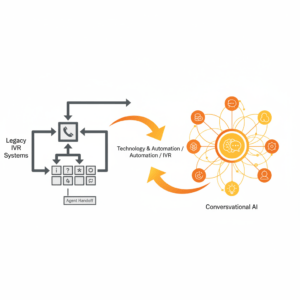
Conversational AI is not simply a better IVR. It is a different service model. Legacy IVR routes customers through fixed menus. Conversational AI can interpret intent, hold context, recover from ambiguity, and support cleaner handoffs. The right upgrade path is usually hybrid, not a full rip-and-replace, with strong controls around knowledge, escalation, privacy, and measurement.¹˒²˒³ (IBM)
What is the difference between conversational AI and IVR?
Legacy IVR is rules-led phone automation. It usually depends on keypad input, fixed call flows, and narrow decision trees. Conversational AI uses speech recognition, natural-language understanding, and increasingly generative or retrieval-based models to interpret what the caller actually means and respond more flexibly. IBM’s 2026 contact-centre trends note that voice-based conversational AI has advanced rapidly on top of earlier IVR foundations, opening new options for automating phone-based service that was once hard to automate well.² (IBM)
That distinction matters because customers do not judge the technology by its label. They judge whether it gets them to the right outcome. A legacy IVR may still work well for stable, low-ambiguity tasks such as balance checks, appointment confirmations, or hours of operation. But once the call requires intent recognition, context retention, error recovery, or a nuanced handoff, conversational AI usually outperforms fixed menu logic.¹˒² (McKinsey & Company)
Why is the conversational AI vs IVR decision more urgent in 2026?
Because many organisations are now caught in the middle. They already have phone self-service, but callers still drop out, press zero, repeat information, or loop through dead-end menus. At the same time, customer service leaders are moving quickly toward conversational GenAI. Gartner said in December 2024 that 85 percent of customer service leaders would explore or pilot customer-facing conversational GenAI in 2025.³ That level of interest means the decision is no longer theoretical for most service operations. (Gartner)
There is also a reputational risk in doing this badly. IBM highlighted in February 2026 that frustrating AI self-service can damage brands, especially when rigid decision paths block callers from reaching a human when they need one.⁴ That warning applies to both old IVR and badly designed AI. The lesson is simple. Upgrading IVR to AI is only worth it if the new experience improves resolution, reduces effort, and keeps trust intact. (IBM)
How does a better phone experience actually work?
A better phone experience combines three things. Early intent capture, accurate context handling, and clean transitions to the next best step. In a legacy IVR, the caller adapts to the menu. In a conversational model, the system adapts more to the caller. It can accept natural speech, ask clarifying questions, and route based on meaning rather than only on button choices. IBM’s current customer-service material describes this as making voice support faster, more intuitive, and less stressful than the classic press-one menu pattern.²˒⁵ (IBM)
But the underlying design still matters more than the interface. McKinsey argued in 2024 that AI-enabled service should be built around the end-to-end service model, not only around a front-end interaction layer.¹ A conversational front door attached to weak knowledge, poor routing, or bad escalation rules still creates failure demand. The call just sounds smarter while the workflow remains broken. (McKinsey & Company)
When should an organisation keep IVR and when should it upgrade IVR to AI?
Keep legacy IVR where the job is narrow, predictable, and low risk. Payment confirmations. Store hours. Simple status checks. Basic identity steps. These use cases often do not need the extra complexity of conversational AI. They need good flow design, short menus, and low failure rates. Customer Science’s recent IVR optimisation article makes exactly that point by tying better self-service to clearer call flows, earlier intent capture, and cleaner handoff rules.⁶ (Customer Science)
Upgrade IVR to AI where callers describe needs in their own words, where the same issue appears in many phrasings, or where menus create obvious friction. Complaint triage, booking changes, policy questions, outage calls, collections support, and blended service journeys are stronger candidates. In those cases, conversational AI can reduce transfers and improve first-time routing because it works from intent and context rather than from a narrow menu tree.¹˒²˒⁶ (IBM)
What should leaders compare in the business case?
Start with outcome, not novelty. Compare containment quality, first contact resolution, transfer rate, abandonment, repeat contact within seven days, and cost to serve. Then compare the less visible costs: flow maintenance, change effort, speech-tuning effort, knowledge upkeep, and supervision. Legacy IVR often looks cheaper because its logic is already in place. But that apparent saving can hide high customer effort and high failure demand.⁶˒⁷ (Customer Science)
A stronger business case also separates channel automation from service design. McKinsey’s 2025 contact-centre analysis points toward blended human and AI service models, not pure automation.⁸ So the right comparison is not “menus versus AI voices.” It is “which architecture gets callers to successful resolution with less waste, lower transfer, and clearer control?” (McKinsey & Company)
Where should organisations start first?
Start with one high-volume call reason where menu friction is already visible and where success can be measured quickly. Good candidates include status enquiries, booking changes, simple service requests, and repeatable triage flows. Avoid beginning with bereavement, vulnerability, hardship, disputed charges, or emotionally loaded service recovery. Those cases usually need more human judgment and stronger trust repair.²˒⁴ (IBM)
A practical first move is to fix the knowledge layer before expanding the voice layer. Knowledge Quest⁷ is relevant here because Customer Science positions it as the real-time answer layer that turns live customer interactions into accurate, helpful answers. If the underlying answer source is weak, conversational AI just scales inconsistency faster. (Customer Science)
What risks should executives watch?
The first risk is replacing a bad IVR with bad conversational AI. Callers may get a more natural interaction, but still end up trapped, misrouted, or forced to repeat themselves. The second risk is weak escalation. Gartner-related reporting in 2025 noted that reassurance about human availability can materially improve willingness to use GenAI for service.⁹ That is an important design signal. Human fallback is not a failure state. It is part of the value proposition. (customerexperiencedive.com)
The third risk is governance. NIST’s Generative AI Profile says organisations should manage risks such as confabulation, information integrity failures, privacy problems, and harmful human-AI interaction patterns across the lifecycle.¹⁰ In practical terms, that means a conversational AI upgrade needs source grounding, confidence rules, auditability, and clear stop conditions before it becomes the main front door for callers. (NIST Publications)
How should success be measured?
Measure the path, not just the call. Useful metrics include self-service completion, containment with successful outcome, transfer rate, average time to successful outcome, abandonment by intent, repeat contact within seven days, and post-handoff resolution. Customer Science’s automation value model is useful here because it argues for measuring containment, AHT, and path success together rather than treating containment alone as the win.¹¹ (Customer Science)
This is also where service design support becomes important. CX Consulting and Professional Services⁸ fits the measurement and rollout stage because most IVR-to-AI programs fail in workflow design, governance, and implementation sequencing rather than in pure technology selection. (Customer Science)
What should happen next?
Map the top five call reasons hitting the current IVR. Identify where callers abandon, zero out, transfer, or repeat. Then sort those journeys into three groups: keep in legacy IVR, redesign for simpler self-service, or upgrade to conversational AI. That step is usually more valuable than a platform demo because it turns the decision into a service-design choice rather than a feature comparison.⁶˒¹¹ (Customer Science)
Then pilot one upgraded flow with a clear handoff model, grounded knowledge, and a weekly review cadence. Keep the scope tight. Prove that callers get to the right outcome faster and with less effort. Expand only after the evidence is there.
FAQ
Is conversational AI replacing IVR completely?
No. In most organisations, conversational AI builds on IVR rather than replacing it all at once. Stable, low-ambiguity tasks can still sit comfortably in traditional self-service flows.²˒⁶ (IBM)
What is the biggest reason legacy IVR underperforms?
Usually friction in menu design, weak intent capture, and poor handoff rules. The problem is often the call flow, not the existence of self-service itself.⁶ (Customer Science)
What is the best first use case for upgrading IVR to AI?
A high-volume, low-to-moderate complexity call type with visible transfer or abandonment is usually best. Booking changes, status requests, and triage for routine service issues are common starting points.²˒⁶ (IBM)
How do you stop conversational AI from frustrating callers?
Ground it in trusted knowledge, make human escalation obvious, and review path outcomes weekly. Knowledge Quest Insights⁹ is useful where teams need better visibility into answer quality, knowledge gaps, and the health of the service knowledge layer behind the voice experience. (Customer Science)
What should leaders measure first?
Start with successful self-service rate, transfer rate, abandonment by intent, and repeat contact after self-service. Those show whether the system is resolving work or just moving callers around.¹¹ (Customer Science)
What if the real problem is unclear customer wording, not the phone technology?
Then the content layer needs work as well. CX Communications¹² is relevant where confusing or compliance-heavy language is creating extra calls, poor recognition, and weak customer trust across voice and written channels. (Customer Science)
Evidentiary Layer
The evidence points in one direction. Legacy IVR is still useful for narrow, stable tasks. Conversational AI is stronger where caller intent is variable, language is messy, and better recovery from ambiguity matters. But the same evidence says the upgrade only pays off when human fallback, grounded knowledge, and governance stay close to the live workflow.¹˒²˒⁴˒⁶˒¹⁰ That is why the right strategic question is not “AI or IVR?” It is “Which parts of the phone journey need fixed logic, and which need real interpretation?” (McKinsey & Company)
Sources
-
McKinsey & Company. How to build AI-enabled services. 2024.
-
IBM. Contact Center Automation Trends. 12 January 2026.
-
Gartner. Gartner Survey Reveals 85% of Customer Service Leaders Will Explore or Pilot Customer-Facing Conversational GenAI in 2025. 9 December 2024.
-
IBM. How to Improve Call Center Customer Service. 4 February 2026.
-
IBM. Top Customer Service Trends. 2026.
-
Customer Science. IVR Optimization to Improve Self-Service in Contact Centres. 2026.
-
Customer Science. Knowledge Quest. Current product page.
-
Customer Science. CX Consulting and Professional Services. Current service page.
-
Gartner reporting via Customer Experience Dive. Want to encourage generative AI use? Reassure customers that humans are available. 9 June 2025.
-
NIST. Artificial Intelligence Risk Management Framework: Generative AI Profile. NIST AI 600-1, July 2024.
-
Customer Science. Automation Value Model: Containment, AHT, NPS. 2025.
-
Customer Science. CX Communications. Current service page.