






























What problem does QA actually solve in a modern contact centre?
Quality Assurance reduces customer effort, improves First Contact Resolution, and protects consistency at scale. QA fails when it becomes a score-hunting ritual rather than an operating system that finds defects, coaches behaviours, and fixes upstream causes. Industry standards require centres to provide accurate, current information and to design processes that deliver consistent customer outcomes.¹ A credible QA framework aligns how you listen, how you judge, and how you improve with outcomes that matter, such as FCR and repeat contacts, not just compliance ticks.²
What does “good QA” look like in practical terms?
Good QA defines what great looks like, samples the right interactions, calibrates judgment across reviewers, and turns findings into coaching and fixes. A structured framework links measures to goals so teams track signals that predict outcomes, not vanity counts. The HEART model’s goal–signal–metric pattern is a useful discipline here because it forces every item on a scorecard to prove its relevance to an outcome.³ Your framework should also show how article use, handoffs, and status clarity contribute to resolution quality, in line with contact centre standards for providing accurate and current information to agents.¹
How should you structure a QA framework end to end?
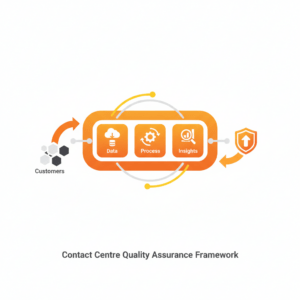
Leaders design QA as a closed loop with four components: Define, Assess, Improve, Prove. Define the behaviours and controls that drive resolution, fairness, and compliance. Assess with calibrated reviewers and reliable samples across channels. Improve with coaching, knowledge updates, and process fixes. Prove value by linking QA improvements to FCR, repeat-within-window, and complaint reduction. FCR is the simplest operational proof that customers received what they needed the first time.² Standards such as COPC’s CX frameworks emphasise this operating rhythm and the linkage to business outcomes, not just to monitoring volume.⁴
What belongs on a modern QA scorecard?
Scorecards should balance four lenses: Outcome, Accuracy, Experience, and Compliance. Outcome checks confirm that the interaction resolved the customer’s job. Accuracy checks confirm policy, product, and knowledge correctness. Experience checks evaluate clarity, empathy, and ownership. Compliance checks cover authentication, disclosures, and mandatory wording. Each rubric item should map to one goal and one signal to prevent bloat.³ Avoid weighting superficial items heavily; top-performing programmes weight resolution and accuracy above talk time because FCR predicts repeat volume more directly.²
How do you calibrate QA so scores are fair and useful?
Calibration is a recurring workshop where reviewers score the same interactions independently, reveal rationales, and converge on the standard. Effective teams run weekly sessions, rotate complex cases, and record decisions that become exemplars. Calibration quality improves when reviewers tie judgments to explicit definitions and to approved knowledge articles, which aligns with ISO expectations for current, accurate information.¹ Calibration that raises reviewer agreement creates credible scores that agents accept and coaches can use.
How much should you sample and how should you target it?
Sampling should be representative and risk-based. Use random sampling to protect fairness and targeted sampling to find defects where risk is high: new hires, complex products, vulnerable-customer flags, or known policy changes. Add “moment of truth” sampling around top contact reasons. Quality teams should also review a small slice of zero-handled or short calls to detect silent failures. COPC-style programmes combine minimum sample sizes with risk-based overlays to keep effort focused where defects hurt outcomes most.⁴
How should QA connect to knowledge, coaching, and process fixes?
QA findings should never end at a score. Each defect routes to one of three fix lanes: Coaching for skill or behaviour, Knowledge for missing or unclear articles, and Process for upstream rules or systems that block resolution. Knowledge-Centered Service defines how knowledge updates happen as a byproduct of solving cases; using QA to identify high-impact article gaps is the fastest way to raise resolution quality without pushing handle time down blindly.⁵ This linkage prevents the “score without change” trap that burns time and does not move outcomes.
What is the agent experience of QA that actually changes behaviour?
Agents engage when QA feels fair, specific, and helpful. Good QA uses SVO leads in feedback: “You confirmed identity, corrected the plan code, and set expectations for delivery.” It links each point to an article or standard so the agent can see and reuse the right pattern next time. QA should include a short self-review step before coaching, because reflecting on the interaction primes behaviour change. When agents can find, trust, and reuse knowledge directly from QA notes, handle-time variance shrinks and FCR rises.¹⁵
How do you measure that QA is working beyond the score?
Measure leading and lagging indicators. Leading indicators include calibration agreement rate, time-to-feedback, and proportion of QA actions that result in a concrete change such as a knowledge update. Lagging indicators include FCR, repeat-within-window, complaint rate, and error-related refunds.² Programs that adopt a goal–signal–metric map keep these threads visible so leaders can show the board that QA lowered repeat contacts and lifted first-time resolution, not just average scores.³
What about AI-assisted QA: help or hype?
AI can summarise long interactions, suggest rubric matches, and flag policy phrases, which speeds human QA. AI should not replace human judgment on fairness, vulnerability cues, or context. Use AI to propose, not to decide, and ground its suggestions in approved knowledge or policies so reviewers see sources. Keep access and privacy controls aligned to local law. The objective is faster, more consistent human QA that still ties to real outcomes. The operating logic stays the same: resolution, accuracy, experience, compliance, then coaching and fixes.
Common failure modes and how to avoid them
Mega scorecards. Too many items dilute coaching. Fix by enforcing goal–signal–metric discipline and pruning low-value checks.³
AHT obsession. Chasing shorter calls harms resolution and drives repeats. Fix by weighting outcome and accuracy higher and using FCR as a guardrail.²
No calibration. Scores drift and credibility collapses. Fix by scheduling weekly calibrations with exemplars and documenting decisions.
No systemic loop. Findings stay in coaching and never change policy or knowledge. Fix by routing QA themes into a backlog with owners and by retiring defects visibly.⁵
Compliance-only culture. Customers get legally correct but practically unhelpful answers. Fix by balancing compliance with resolution and experience on the card.
Implementation blueprint: 60 days to a working QA system
Days 1–15: Define.
Draft your rubric with Outcome, Accuracy, Experience, Compliance. Map each item to a goal and a signal. Write definitions and examples. Align with standards that require accurate and current information for agents.¹
Days 16–30: Calibrate and pilot.
Train reviewers, run two calibration sessions per week, and finalise weights. Start a pilot on two queues with mixed complexity. Track reviewer agreement and time-to-feedback.
Days 31–45: Link and improve.
Route findings to coaching, knowledge, or process backlogs. When a knowledge gap causes repeat errors, publish an article update and tag the rubric item to the article ID.⁵
Days 46–60: Prove and scale.
Publish a one-pager that shows deltas in FCR, repeat-within-window, and complaint rate for the piloted queues. Keep calibration weekly, prune the rubric, and roll out to the next queues with the same operating cadence.²³
What outcomes should executives expect in quarter one and two
Expect higher reviewer agreement, shorter time-to-feedback, and visible reductions in repeated error types. Expect FCR to rise on piloted intents and repeat-within-window to fall as knowledge and process fixes land. Expect fewer compliance escalations because authentication and disclosures become consistent habits. These gains arrive because QA targets the mechanism of resolution rather than the optics of a score.²⁵
FAQ
What is the single most important metric to link QA with business value?
First Contact Resolution. FCR validates that improvements in accuracy and behaviour delivered a one-and-done outcome for customers.²
How many items should a QA scorecard include?
Keep it lean. Focus on Outcome, Accuracy, Experience, and Compliance, and map each item to a clear goal and signal. Trim anything that does not predict resolution or risk.³
How often should we calibrate reviewers?
Weekly. Use shared interactions, record rationales, and maintain exemplars so reviewers converge on the same standard over time. This drives credibility and fair coaching.
Should QA score empathy?
Yes, but only where it contributes to clarity, ownership, or de-escalation. Weight it appropriately under Experience and tie it to outcomes rather than penalising style differences.
How do we use QA to improve self-service?
When QA detects knowledge gaps or unclear steps, route a fix to the knowledge backlog and publish customer-safe variants. This reduces future contacts and raises FCR.⁵
How do we stop QA becoming a compliance-only exercise?
Balance the card, weight resolution and accuracy highest, and report FCR and repeats alongside compliance. This keeps attention on outcomes, not just checklists.²
Sources
-
ISO 18295 — Customer Contact Centres (Parts 1 & 2) — International Organization for Standardization, 2017, ISO. https://www.iso.org/standard/63167.html
-
First Contact Resolution: Definition and Approach — ICMI, 2008, ICMI Resource. https://www.icmi.com/files/ICMI/members/ccmr/ccmr2008/ccmr03/SI00026.pdf
-
Measuring the User Experience at Scale: The HEART Framework — Kerry Rodden, Hilary Hutchinson, Xin Fu, 2010, Google Research Note. https://research.google/pubs/pub36299/
-
COPC CX Standard: Overview of Performance Management Frameworks — COPC Inc., 2024, copc.com. https://www.copc.com/what-we-do/cx-standards/
-
KCS Practices Guide — Consortium for Service Innovation, 2020, CSI. https://www.serviceinnovation.org/kcs-resources