



















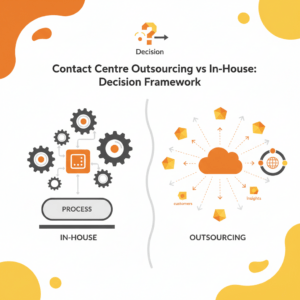
Why this decision matters more than a unit rate
Boards want lower cost to serve, faster speed to competency, and resilient capacity. Customers want first-time resolution, empathy, and continuity. Outsourcing promises elasticity and specialist capabilities; in-house promises tighter control and brand intimacy. The wrong choice locks in structural risk for years. The right choice aligns operating model, risk posture, and customer promise. Treat this as an operating design decision, not a procurement event, and make it with explicit criteria on risk, quality, cost, and change. Australian organisations must also align privacy, security, and supplier obligations to local standards from day one.¹²³⁴
What exactly are you deciding?
You are choosing who owns four things: the people system (hiring, coaching, workforce management), the knowledge system (procedures, permissions, content), the technology fabric (telephony, CCaaS, CRM, QA, analytics), and the compliance perimeter (privacy, infosec, supplier controls). Outsourcers typically supply people, WFM, and some tooling; clients retain channel strategy, policies, product changes, and systems of record. Write this boundary down before commercial talks. Map each responsibility to a control: policy, process, metric, or audit. Australian Privacy Principles (APPs) require you to remain responsible for personal information even when handled by a third party, so allocate purpose, consent, storage, and breach processes clearly.¹
When does outsourcing beat in-house?
Outsourcing is often superior when:
-
Demand is volatile and you need seasonal or campaign elasticity without fixed headcount or long hiring cycles.
-
Scope is standardised and can be taught within weeks with stable procedures and permissions.
-
You need multi-site resilience or 24/7 coverage faster than in-house can stand up.
-
Speed to value depends on established recruiting pipelines, language coverage, or niche skills (e.g., quality ops at scale).
Insourcing wins when:
-
Brand voice and judgment dominate outcomes (complex complaints, retention saves, vulnerable customers).
-
Policy risk is high and live discretion matters (regulated financial advice, health triage).
-
Tight data-perimeter control is non-negotiable or data cannot leave defined jurisdictions.¹²
How to structure the decision: a crisp scoring model
Use a weighted model so emotion does not drive the call. Score each option 1–5 on the criteria below, multiply by weights, and compare totals. Keep weights explicit and approved by the exec sponsor.
Quality & Customer
-
First Contact Resolution potential (weight 3)
-
Brand voice & empathy fit (3)
-
Journey integration & knowledge agility (2)
Risk & Compliance
-
Privacy & purpose control under APPs (3)¹
-
Security controls (ISO 27001, ACSC Essential Eight alignment) (3)²³
-
Jurisdictional/data residency fit (2)
Cost & Productivity
-
Total Cost of Ownership (TCO) including tech, QA, training, attrition (3)
-
Elasticity & time-to-competency (2)
-
WFM leverage & schedule adherence (1)
Change & Governance
-
Contracting flexibility (exit, scale, change) (2)
-
Operating-rhythm alignment (joint QA, calibration, roadmap) (2)
-
Knowledge maintenance cadence (1)
Document assumptions. If the result hinges on two criteria, run a sensitivity test by varying those weights ±1 and see if the decision flips. If it flips, the decision is fragile—seek more evidence.
What due diligence proves “fit for purpose”?
Security & privacy (must-haves)
-
ISO/IEC 27001 certification or mapped controls; review Statement of Applicability.²
-
Control alignment to ACSC Essential Eight: patching, MFA, app hardening, backup.³
-
APPs compliance playbook: consent capture, purpose limitation, overseas disclosure, data breach response.¹
Operations & quality
-
Demonstrable First Contact Resolution methodology, not only AHT.
-
QA framework with double-coding, calibration, and root cause loops.
-
Hiring pipeline, background checks, and speed to competency by role.
-
WFM stack and evidence of forecast accuracy and adherence discipline.
Commercials & governance
-
Outcome-based SLAs (FCR, repeat-within-window, complaints per 1k contacts), not only handle time.
-
Change control, knowledge currency SLA, and joint release calendar.
-
Clear step-in/exit plan and data-return obligations.
-
Transparent rate card: base, supervisors, QA, WFM, training, IT, and overhead—no “misc” buckets.
What operating model prevents “us vs them”?
Design a one-team model with shared artefacts and cadences:
-
Single knowledge base with client control; outsourcer proposes edits; client approves weekly.
-
Unified QA: same scorecard, joint calibration, publish “top three defects” and fixes.
-
Joint WFM: one forecast, adherence targets by interval, shared shrinkage assumptions.
-
Daily run, weekly improve: daily stand-up on volume, SLA, defects; weekly performance and experiment review.
-
Compliance rhythm: quarterly security and privacy attestations mapped to APPs and ISO controls.¹²
What SLAs actually improve outcomes?
Avoid vanity. Tie SLAs to customer-value mechanisms:
-
FCR and repeat-within-window (core outcomes).
-
Effort/Resolution survey item post-contact (predicts loyalty).
-
QA outcome score (correct next action, empathy, policy adherence).
-
Complaint rate and regulatory breach count (risk control).
-
Average speed of answer plus abandon rate (access).
-
Knowledge change latency and release adherence (continuous improvement).
Back these with remedies that fund fixes, not punish people: improvement plans, co-funded training, or tech upgrades rather than blunt fee cuts.
In-house playbook: when to keep and fix
If in-house scores higher, fix the root causes that made outsourcing attractive:
-
Elasticity: add callbacks and asynchronous messaging to flatten peaks without headcount.
-
Productivity: trim after-call work with templates and screen-pops; coach schedule adherence.
-
Quality: introduce guided workflows and intent-based routing to cut transfers.
-
Resilience: dual-site or hybrid arrangements and cross-skilling to protect SLAs.
These mechanics reduce wait and rework so cost falls without outsourcing.
Outsourcing playbook: how to land value quickly
If outsourcing wins, phase it to protect trust:
-
Thin-slice pilot: 1–2 intents, clear FCR baseline, outcome SLAs.
-
Knowledge & permissions hardening: codify exceptions before scale.
-
Security & privacy controls: enforce MFA, logging, DLP; confirm APPs clauses and breach playbook.¹²³
-
Brand & empathy training: use call libraries; calibrate tone and recovery tactics.
-
Scale with “capability gates”: add intents only when QA and FCR hold at target for 4+ weeks.
Commercial models that align incentives
-
FTE/hourly with gainshare on FCR/complaints reduction.
-
Per-resolved-case for defined intents with strict scope and safeguards.
-
Hybrid: base capacity retainer plus outcome kicker.
Avoid pure handle-time bonuses—they create speed-without-resolution behaviour.
Risk controls specific to Australia
-
APPs Third-party processing: include overseas disclosure, sub-processor chain, and audit rights.¹
-
Security: require ISO 27001 certification and annual independent audit summaries; align to ACSC Essential Eight maturity targets.²³
-
Standards: reference ISO 18295 (customer contact centres) for customer, agent, and organisation requirements.⁴
-
Jurisdiction: define data residency, lawful bases, and incident reporting timelines aligned to the Notifiable Data Breaches scheme.¹
What impact should executives expect if the framework is followed?
-
Customer: higher first-contact solves, fewer transfers, faster access.
-
Risk: clear data-handling lines, tested incident response, fewer compliance surprises.
-
Cost: lower repeat volume, predictable unit costs, elasticity without stranded capacity.
-
Change: faster policy and knowledge updates across channels, fewer “lost in translation” errors.
These outcomes flow from mechanism clarity and governance discipline, not from the badge on the agent’s payslip.
FAQ
What is the single clearest signal we should outsource?
Volatile demand with stable, teachable intents—where elasticity and speed to competency outweigh brand-voice complexity—usually favours outsourcing.
Which SLA should anchor the contract?
First Contact Resolution with a defined repeat window, paired with complaint rate and effort/resolution survey, outperforms handle-time-only contracts.
Can we outsource and still comply with Australian Privacy Principles?
Yes. You remain responsible under the APPs. Contracts must define purpose, overseas disclosure, consent handling, security controls, and breach notification with audit rights.¹
Which security bar should we set?
Require ISO/IEC 27001 certification (or mapped controls) and alignment with ACSC Essential Eight; review attestations and remediation cadence annually.²³
What standard governs contact centre practice?
ISO 18295 describes customer contact centre requirements for the organisation, agents, and customers. Use it to benchmark processes and quality.⁴
How do we avoid “us vs them” after go-live?
Run a one-team model: shared knowledge, unified QA, joint WFM, weekly improvement forums, and a single change calendar with clear owners.
Sources
-
Australian Privacy Principles (APPs) — Office of the Australian Information Commissioner (OAIC), 2023. https://www.oaic.gov.au/privacy/australian-privacy-principles
-
ISO/IEC 27001 — Information Security Management — International Organization for Standardization, 2022. https://www.iso.org/standard/27001
-
Essential Eight Explained — Australian Cyber Security Centre (ACSC), 2023. https://www.cyber.gov.au/resources-business-and-government/essential-cyber-security/essential-eight
-
ISO 18295 — Customer Contact Centres (Parts 1 & 2) — International Organization for Standardization, 2017. https://www.iso.org/standard/63167.html