






























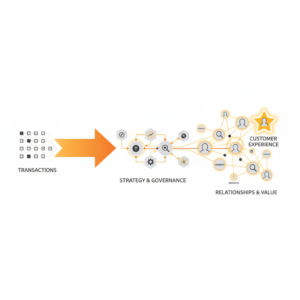
A B2B customer experience strategy shifts the firm from deal completion to value delivery across the whole relationship. It connects buying, onboarding, service, adoption, renewal, and growth so customers experience one joined-up supplier, not a chain of internal silos. That matters because retention, expansion, and customer health are shaped far more by post-sale reality than by the initial transaction. (ScienceDirect)
What is a B2B customer experience strategy?
A B2B customer experience strategy is the plan for how your organisation creates, manages, and improves the experience business customers have across the full commercial relationship. That includes presales interactions, solution design, buying-centre engagement, onboarding, implementation, support, governance, renewal, and expansion. In B2B settings, the experience is rarely owned by one team. Sales, delivery, service, product, finance, and account management all shape what the customer remembers and what they buy next.¹˒² (ScienceDirect)
That is why B2B customer experience strategy is not the same thing as service improvement. Service quality matters, but B2B CX reaches further. It asks how the firm will create value across the whole lifecycle, for multiple stakeholders, with enough consistency that the customer sees one capable partner rather than separate departments with competing priorities.²˒³ (ScienceDirect)
Why is B2B CX different from B2C?
B2B journeys are longer, more political, and more dependent on coordination. A buying decision can involve sponsors, users, procurement, legal, finance, and technical evaluators. Then the harder part begins. After signature, the customer judges the supplier on implementation speed, issue resolution, training, governance, and whether promised value actually appears. Recent B2B research describes this as a convergence problem. Customer experience is formed across multiple actors, levels, and organisations, not in one clean buying path.² (ScienceDirect)
That changes the management task. A business can hit bookings and still weaken retention if onboarding drags, support is fragmented, or account teams cannot prove progress. Transactional thinking hides that risk for a while. Then it shows up in churn, stalled expansion, lower referenceability, and pricing pressure. Customer success research supports the same point. Ongoing value realisation is central to retention in B2B markets.⁴ (ScienceDirect)
What context is pushing firms beyond transactions?
Digitalisation is one driver. More of the B2B relationship now runs through digital touchpoints, portals, workflow, knowledge, and shared data. But digital does not simplify B2B by itself. It adds more touchpoints to coordinate. Research in Industrial Marketing Management identifies seven supplier capabilities needed to manage digitalised touchpoints in B2B journeys, including supporting customer actions, enabling collective actions, and hybridising digital and human environments.⁵ (ScienceDirect)
Another driver is the rise of post-sale management models such as customer success, key account management, and professional services. Firms are putting more weight on time to value, product adoption, health signals, and renewal risk because these measures say more about future revenue than pipeline activity alone. Recent postsales relationship research makes this explicit. B2B firms increasingly need to coordinate several post-sale models rather than treat service as a downstream handoff.⁴˒⁶ (ScienceDirect)
How does a B2B customer experience strategy work?
It works by giving the firm a common design logic across the relationship. Start with the outcomes the customer needs at each stage. Then identify the people involved, the moments where value is won or lost, the signals that predict risk, and the internal owners responsible for action. That sounds obvious. In practice, many firms never define it clearly enough to manage. So teams optimise their own stage and leave the customer to carry the gaps between them.²˒³ (ScienceDirect)
A strong B2B customer experience strategy also creates management routines. Named owners. Shared measures. Escalation rules. Service standards. Account evidence. And a way to act before friction turns into commercial loss. Research on customer journey management capability in B2B markets found that this capability can improve firm performance overall, while also carrying coordination costs if it is built badly or spread too widely.³ That is an important executive lesson. The goal is not more mapping. It is tighter control of the moments that actually move retention and growth. (Emerald Publishing)
Is customer success the same as B2B CX?
No. Customer success is one part of the operating model. A B2B customer experience strategy is broader. It covers how the whole firm shapes the relationship before and after the sale. Customer success usually focuses on adoption, health, retained value, and expansion once the customer is live. That makes it a postsale execution layer inside the wider B2B CX system.⁴˒⁶ (ScienceDirect)
This distinction matters because firms often respond to churn by adding customer success roles without fixing upstream causes. Poor qualification, weak handoffs, unrealistic promises, billing friction, fragmented support, and unclear ownership survive untouched. Then the new function inherits problems it cannot solve alone. A proper B2B customer experience strategy deals with the full chain, not only the last team to see the customer.²˒⁴ (ScienceDirect)
How should leaders compare journey design, account management, and service operations?
Journey design shows where value is created or lost. Account management carries the commercial relationship. Service operations prove whether the promised experience is dependable every day. None of the three is enough on its own. Great account directors cannot compensate forever for broken onboarding. Strong support teams cannot rescue a poor commercial fit. Elegant journey maps do nothing if service teams lack the authority, data, or workflow to act on them.²˒³˒⁷ (ScienceDirect)
The smarter comparison is by role. Journey design defines the target state. Account management turns that into account-level plans and governance. Service operations make it true in live delivery. This is where many B2B CX consulting engagements either become useful or decorative. The useful ones connect research, service design, operating controls, and implementation. The decorative ones stop at principles. (Customer Science)
Where should you apply a B2B customer experience strategy first?
Start where commercial exposure and operational friction meet. In many B2B firms, that means onboarding, implementation, complex support, renewal-risk management, partner handoffs, and high-value service recovery. These are the moments where customers decide whether the relationship feels easy, safe, and worth extending. They are also the places where internal misalignment is hardest to hide.²˒⁵ (ScienceDirect)
A practical first move is to create one evidence layer across service, CRM, digital, workflow, and account data. Customer Science Insights fits that use case because it is designed to connect real-time contact centre and service data so leaders can spot friction patterns early and manage them with context, not guesswork. (Customer Science)
Customer Science Case Evidence
MYOB used Customer Science analytics and reporting to overhaul contact centre visibility across calls, emails, SMS, and chatbot interactions for a service environment with more than 500 agents across Australia and New Zealand. The point is not the reporting tool by itself. The value is better journey visibility across a large customer base, which supports better planning, prioritisation, and service decisions. (Customer Science)
Customer Science’s partner-led channel expansion case is also relevant to B2B firms moving beyond direct-sales logic. The case frames growth around specialised implementations, clearer partner roles, faster time to value, and more resilient routes to market. That is useful in B2B because the customer experience is often shaped by ecosystem partners, not only by the supplier’s internal teams. (Customer Science)
What risks should leaders watch?
One risk is mistaking relationship depth for experience quality. Long contracts, switching costs, and technical dependency can hide poor experience for years. That does not make the relationship healthy. It makes the risk slower to surface. Once alternatives improve, friction that used to be tolerated becomes a reason to leave or cut scope.²˒³ (ScienceDirect)
Another risk is overextending journey work. Homburg and Tischer’s research is useful here because it shows a bright side and a dark side. Journey capability can improve performance, but it can also increase coordination cost if leaders try to manage everything at once or create too many interfaces.³ So keep the scope tight. Begin with the stages that matter most commercially. Build discipline there first. (Emerald Publishing)
There is also a channel risk. Digital touchpoints matter more in B2B than they used to, but the answer is not digital only. The research points to hybrid environments, where human and digital interactions need to reinforce each other.⁵ Firms that over-digitalise sensitive or complex moments often make the relationship feel cheaper, not easier. (ScienceDirect)
How should you measure a B2B customer experience strategy?
Measure it across the relationship, not only in support and not only at quarter end. Useful measures include onboarding cycle time, time to first value, adoption depth, issue recurrence, service recovery quality, renewal rate, expansion rate, account health, and referenceability. Customer success research supports this wider measurement view because retained value and proactive attention are strongly tied to B2B retention outcomes.⁴ (ScienceDirect)
For many firms, the next step is to baseline the current relationship, map the highest-value journeys, and define ownership across sales, implementation, support, and account teams. CX Consulting and Professional Services is the right fit at that stage because the work usually spans strategy, service design, governance, and implementation, not just research or reporting. (Customer Science)
What should happen next?
Begin with one segment and one renewal-critical journey. Map the buying stakeholders, the users, the handoffs, the value milestones, and the points where customers most often lose momentum. Then define a small set of shared measures and review them in normal management forums. Not a side project. Not a one-off workshop. Regular commercial and service governance.²˒⁴ (ScienceDirect)
That approach works because B2B customer relationships are too variable for a single transformation template. You need enough structure to coordinate the experience and enough flexibility to reflect account context, commercial model, product complexity, and service risk. Done well, the firm stops reacting to issues transaction by transaction and starts managing the relationship as a designed system.³˒⁶ (Emerald Publishing)
FAQ
What does a B2B customer experience strategy include?
It usually includes journey stages, stakeholder needs, ownership, handoffs, service standards, account governance, measurement, and a clear plan for how value will be delivered after the sale.¹˒² (ScienceDirect)
Why is B2B CX harder than improving customer service?
Because B2B CX goes beyond support. It spans promises made in sales, how implementation is handled, how issues are resolved, how value is proven, and whether the customer sees one joined-up partner over time.²˒⁵ (ScienceDirect)
Is customer success the same as B2B CX?
No. Customer success is a key postsale discipline, but B2B customer experience strategy covers the full relationship from buying through renewal and expansion.⁴˒⁶ (ScienceDirect)
Where should a firm start first?
Most firms should start with onboarding, implementation, renewal-risk journeys, or complex support because those areas combine commercial exposure with visible operating friction.²˒⁴ (ScienceDirect)
What does B2B CX consulting actually help with?
It helps define the target journey, the operating model, the measures, the ownership model, and the change path so the strategy affects how teams work, not just how they describe the customer. (Customer Science)
What if inconsistent answers and fragmented communications are weakening trust?
Then the knowledge layer needs work as part of the strategy. Knowledge Quest is relevant where teams need faster, more reliable, brand-aligned answers across customer-facing channels.
Evidentiary Layer
The evidence points in one direction. B2B customer experience strategy creates more value when firms manage the full relationship, not just the sale. Recent research shows B2B journeys are multi-actor and relationship-embedded, digital touchpoints require specific supplier capabilities, customer success practices support retention, and journey management capability can improve firm performance when coordination is controlled carefully.²˒³˒⁴˒⁵ This is why moving beyond transactions is not branding language. It is a management choice about how the firm will create value after the deal as well as before it. (ScienceDirect)
Sources
-
Purmonen, A., Jaakkola, E., Terho, H., et al. B2B customer journeys: Conceptualization and an integrative framework. Industrial Marketing Management, 2023. DOI: 10.1016/j.indmarman.2023.06.010.
-
De Keyser, A., Antonetti, P., Lemon, K.N., et al. Understanding the B2B customer experience and journey: A convergence-based lens. Journal of Business Research, 2025. DOI: 10.1016/j.jbusres.2025.115481.
-
Homburg, C., Tischer, M. Customer journey management capability in business-to-business markets: Its bright and dark sides and overall impact on firm performance. Journal of the Academy of Marketing Science, 2023. DOI: 10.1007/s11747-023-00923-9.
-
Hochstein, B., Voorhees, C.M., Pratt, A.B., et al. Customer success management, customer health, and retention in B2B industries. International Journal of Research in Marketing, 2023. DOI: 10.1016/j.ijresmar.2023.09.002.
-
Lundin, L., Kindström, D., Kowalkowski, C. Managing digitalized touchpoints in B2B customer journeys. Industrial Marketing Management, 2024. DOI: 10.1016/j.indmarman.2024.07.013.
-
Voorhees, C.M., Hochstein, B., Hodge, M., et al. Conceptualizing post-sales relationship management in business markets. Journal of Business Research, 2025. Stable article record.
-
ISO. ISO 18295-1:2017 Customer contact centres, Part 1: Requirements for customer contact centres. Stable ISO record.
-
Wirtz, J., Kowalkowski, C., Gustafsson, A. Customer experience management in B2B markets: CXM strategy archetypes and guide. Journal of Business Research, 2025. Stable article record.