


















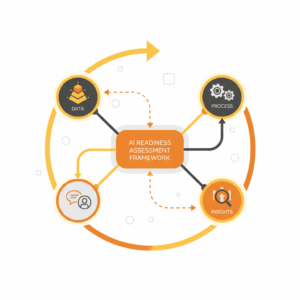
An AI readiness assessment framework helps an enterprise decide whether it can adopt AI safely, scale it sensibly, and prove business value. The strongest frameworks test six things together: strategy, data, operating model, skills, governance, and measurement. That matters because most organisations are already using AI somewhere, yet only a small minority believe they have reached real maturity.⁸˒⁹ (McKinsey & Company)
What is an AI readiness assessment framework?
An AI readiness assessment framework is a structured way to test whether your organisation can move from AI interest to repeatable, governed, business-led execution. It is not a vendor scorecard. It is not a prompt workshop. It is the management system that checks whether you have the conditions needed to select the right use cases, control risk, connect data, support teams, and measure value after deployment. ISO/IEC 42001 frames this from a management-systems perspective, while NIST’s AI RMF and GenAI Profile frame it through trustworthiness and risk management.¹˒³ (ISO)
A practical framework also needs to answer the question behind the keyword “are we ready for AI”. Readiness is not a yes-or-no state. It is a set of capabilities at different levels of maturity. Recent research proposing a Technology-Organization-Environment-Human model reaches a similar conclusion. AI readiness is multidimensional, not purely technical.¹⁰ (sciencedirect.com)
Why are enterprises asking “are we ready for AI” now?
Because adoption has moved ahead of operating discipline. McKinsey’s 2025 State of AI says the practices linked to value span strategy, talent, operating model, technology, data, and adoption and scaling.⁸ Its separate workplace research found almost all companies invest in AI, but only 1% believe they are at maturity.⁹ Those two findings belong together. They suggest the gap is no longer awareness. It is execution quality.⁸˒⁹ (McKinsey & Company)
The governance climate has tightened too. NIST released its Generative AI Profile in July 2024. OECD issued its Due Diligence Guidance for Responsible AI on 19 February 2026. Australia’s OAIC guidance makes clear that the Privacy Act applies to uses of AI involving personal information, and APRA-regulated entities now operate under CPS 230, in force from 1 July 2025.³˒⁴˒⁶˒⁷ So readiness now means more than technical ambition. It means being able to explain decisions, manage providers, handle incidents, and keep controls standing once AI touches live operations. (NIST)
How should an enterprise AI readiness framework work?
A useful framework works in layers. Start with business intent. Then test data and integration. Then test operating model and skills. Then test governance and risk. End with measurement and delivery cadence. If any layer is missing, AI usually stalls in pilot mode or scales in a brittle way. ISO/IEC 42001 and ISO/IEC 23894 both support this logic by treating AI as something that needs formal management, risk treatment, and integration into existing business functions.¹˒² (ISO)
That sequence matters. Because many enterprises still begin with tooling. But tool choice is rarely the first problem. Weak data definitions. Unclear ownership. No model-monitoring plan. No human override. No agreed success metric. Those are the issues that usually break scale. NIST and OECD both push organisations toward continuous monitoring, prioritised risk treatment, stakeholder engagement, and resource allocation rather than one-off assessments.³˒⁴ (NIST Publications)
Which dimensions should the framework assess?
The cleanest model uses seven dimensions.
Strategy and value
This checks whether the enterprise knows where AI should create value and where it should stay out. The question is not “Where can we use AI?” It is “Which decisions, journeys, or workflows should improve, and how will we prove it?” McKinsey’s 2025 survey ties value capture to a coherent management system rather than isolated experimentation.⁸ (McKinsey & Company)
Data and identity
This tests whether the enterprise has trusted, accessible, legally usable data with enough context to support the target use case. It also checks identity, access, lineage, and data quality. Without that, AI outputs become polished guesses. OAIC’s guidance is relevant here because it explicitly links privacy obligations to the use of commercially available AI products involving personal information.⁶ (OAIC)
Use-case design
This checks whether proposed use cases are specific, bounded, reversible, and matched to the real task. Customer Science’s own AI-readiness article for CX describes readiness across strategy and value, data and identity, use-case design, platform and integration, operating model and skills, governance and risk, and measurement and ROI. That is a strong applied version of the broader enterprise problem. Customer Science Insights is relevant in this stage because a lot of readiness work fails before AI build starts, simply because leaders cannot see the cross-channel or cross-workflow signals needed to choose and instrument the right use case. (Customer Science)
Platform and integration
This tests whether the organisation can connect models, data, workflows, security, and business systems without creating shadow processes. It also checks whether the stack supports monitoring, rollback, and provider control. ISO/IEC 42001 and APRA CPS 230 both make this more than an IT hygiene issue. It is an operational control issue.¹˒⁷ (ISO)
Operating model and skills
This checks who owns what. Business owner. Model owner. Platform owner. Risk owner. It also checks whether supervisors, managers, and frontline teams have enough AI literacy to use the system properly. McKinsey’s 2025 workplace report argues that leadership, not workforce willingness, is the bigger blocker to scaling AI.⁹ (McKinsey & Company)
Governance and risk
This checks policy, assurance, incident response, privacy, fairness, model monitoring, vendor risk, and human oversight. OECD’s 2026 due-diligence guidance and NIST’s GenAI Profile both expect enterprises to identify, prevent, mitigate, and monitor adverse impacts across the lifecycle.³˒⁴ OECD’s AI Principles, updated in 2024, add the values layer: trustworthy AI should respect human rights, democratic values, transparency, robustness, and accountability.⁴˒⁵ (OECD)
Measurement and ROI
This checks whether the enterprise can measure changed outcomes rather than activity. Not “How many pilots ran?” but “Which business decision improved, and what happened next?” Customer Science’s AI Readiness Review frames this as measurable business impact and sustainable value, which is the right commercial standard. AI Readiness & Opportunity Review belongs here because many organisations do not need more AI ideation. They need a disciplined gap analysis tied to value and next steps. (Customer Science)
What is the difference between AI readiness, AI maturity, and AI governance?
AI readiness is about current capability to start and scale well. AI maturity is the broader stage of development over time. AI governance is the control system that shapes acceptable use, accountability, and oversight. They overlap, but they are not interchangeable. A company may be active in AI and still not be ready to scale responsibly. Another may have formal governance and still lack usable data or delivery skills.⁸˒⁹ (McKinsey & Company)
That distinction helps with executive conversations. Readiness answers whether the next move is safe and practical. Maturity answers where the enterprise sits on a longer capability curve. Governance answers how risk and accountability are controlled while the work happens. When these ideas are blurred, assessment exercises become vague and action plans become generic.¹˒³˒⁸ (ISO)
Where should enterprises apply the framework first?
Start with a narrow domain where value, risk, and data are all visible. Common first candidates are customer service, knowledge management, forecasting, document-heavy operations, workforce support, and internal search. These areas tend to have enough volume and repetition to show measurable impact without handing AI the most sensitive decisions on day one.³˒⁸ (NIST Publications)
The better sequence is simple. Choose one domain. Baseline today’s performance. Identify the decision or workflow that should improve. Test readiness gaps against the seven dimensions. Then decide whether the answer is pilot, redesign, governance uplift, or no-go. This is where CX Consulting and Professional Services is relevant, because enterprise AI readiness usually spans strategy, service design, operating model, risk, and delivery rather than a single technical workstream. (Customer Science)
What risks should leaders watch?
The first risk is false readiness. A team may have a model, a vendor, and an executive sponsor, but still lack data quality, provider controls, or measurement discipline. The second risk is governance theatre. Policies exist, but nobody can explain who approves use cases, who monitors drift, or how incidents are handled. The third risk is local optimisation. One team deploys AI successfully, while the enterprise still lacks repeatable standards for privacy, oversight, and integration.³˒⁴˒⁶ (NIST Publications)
For Australian enterprises, privacy and operational resilience deserve special attention. OAIC’s 2024 guidance says the Privacy Act applies to all uses of AI involving personal information.⁶ APRA’s CPS 230 requires regulated entities to manage operational risk, maintain critical operations through disruptions, and manage risks arising from service providers.⁷ That means AI readiness in regulated contexts is partly a resilience question, not just an innovation question. (OAIC)
How should enterprises score readiness?
Score each dimension on a maturity scale, but keep the model practical. A five-level scale works well: ad hoc, emerging, defined, managed, and scaled. Then weight dimensions differently by use case. A customer-facing GenAI use case should score governance, data, and human oversight more heavily than an internal summarisation use case. Recent readiness research using the TOEH model supports this kind of multidimensional assessment rather than a flat checklist.¹⁰ (sciencedirect.com)
The score should also separate capability from evidence. A team saying “we have governance” is not enough. The assessment should ask for proof: approved policy, model register, data classification, incident path, training completion, risk owner, baseline KPI, or provider contract control. That keeps the framework grounded and makes the output useful in investment decisions.³˒⁴ (NIST Publications)
What should be measured after the assessment?
Measure whether the assessment changed execution quality. The best post-assessment metrics are not maturity slogans. They are concrete signs of improvement: fewer stalled pilots, faster approved use-case selection, clearer ownership, lower privacy and control gaps, quicker delivery lead time, and stronger business-case quality. Then, at use-case level, track outcome measures like resolution, time saved, quality, cost avoided, error reduction, or risk reduction.⁸˒⁹ (McKinsey & Company)
A good next step is to turn the assessment into a 90-day roadmap. Fix the blockers that stop scale. Prioritise two or three use cases. Assign owners. Set governance controls. Review results in normal operating forums. That is usually where programs stop drifting and start compounding.
FAQ
What does an AI readiness assessment framework include?
It should include strategy and value, data and identity, use-case design, platform and integration, operating model and skills, governance and risk, and measurement and ROI.¹˒³˒¹⁰ (ISO)
Are we ready for AI if we already use ChatGPT or copilots?
Not necessarily. Tool use is not the same as enterprise readiness. Readiness means the organisation can govern, integrate, measure, and scale AI in a controlled way.³˒⁸˒⁹ (NIST Publications)
What usually blocks enterprise AI readiness?
Weak data foundations, unclear ownership, poor measurement, shallow governance, and low leadership capability block readiness more often than lack of model access.⁶˒⁸˒⁹ (OAIC)
How long should an AI readiness assessment take?
A focused enterprise assessment can often be done in weeks, not months, if the scope is clear and the evidence is accessible. The hard part is usually not scoring the framework. It is acting on the gaps.
Should readiness be assessed once or continuously?
Continuously. NIST and OECD both point toward ongoing monitoring, risk treatment, and review rather than one-off assurance.³˒⁴ (NIST Publications)
What helps an enterprise move from readiness scoring to action?
A structured delivery and governance pathway helps. AI Readiness Assessment for Customer Experience is useful because it translates the abstract readiness question into concrete capability gaps, use-case choices, and ROI logic that leaders can act on. (Customer Science)
Evidentiary Layer
The evidence is consistent enough to support a practical framework. Standards bodies and public institutions now converge on the same core themes: formal management systems, AI-specific risk treatment, privacy and provider controls, stakeholder accountability, and continuous monitoring.¹˒²˒³˒⁴˒⁵˒⁶˒⁷ Enterprise research adds the execution pattern: strategy, talent, data, operating model, and scaling discipline correlate with higher value, while leadership and management quality remain common bottlenecks.⁸˒⁹ Recent academic work on AI readiness supports a multidimensional model rather than a narrow technology checklist.¹⁰ That is why a serious AI readiness assessment framework should be treated as a management instrument, not a marketing quiz. (ISO)
Sources
-
ISO/IEC 42001:2023. Artificial intelligence management system requirements. ISO. Stable record: ISO standard page.
-
ISO/IEC 23894:2023. Artificial intelligence, guidance on risk management. ISO. Stable record: ISO standard page.
-
NIST. Artificial Intelligence Risk Management Framework: Generative AI Profile. NIST AI 600-1, July 2024. Stable NIST publication.
-
OECD. OECD Due Diligence Guidance for Responsible AI. 19 February 2026. Stable OECD report.
-
OECD. OECD AI Principles. Updated in 2024. Stable OECD policy page.
-
Office of the Australian Information Commissioner. Guidance on privacy and the use of commercially available AI products. 21 October 2024. Stable OAIC guidance page.
-
APRA. Prudential Standard CPS 230 Operational Risk Management. In force from 1 July 2025. Stable APRA handbook and standard.
-
McKinsey. The State of AI: Global Survey 2025. Published 5 November 2025. Stable McKinsey report page.
-
McKinsey. Superagency in the workplace: Empowering people to unlock AI’s full potential at work. 28 January 2025. Stable McKinsey report page.
-
Naheed, S. et al. A preliminary multidimensional AI readiness assessment framework using a Technology-Organization-Environment-Human model. Procedia Computer Science, 2025. Stable article record.