




















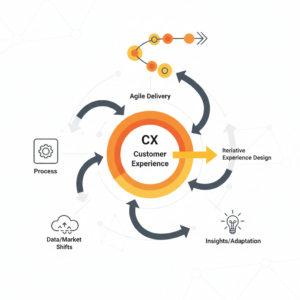
Agile delivery for CX helps organisations respond to market shifts by releasing smaller changes faster, testing them against real customer behaviour, and improving continuously. It works best when journey design, service operations, data, and governance move together. In 2026, the goal is not speed alone. It is faster learning with lower customer risk and clearer business value.¹˒²˒⁴˒⁵
What is agile delivery for CX?
Agile delivery for CX is the use of short, iterative cycles to design, test, release, and improve customer experience changes across channels and service moments. It applies agile thinking to journeys, content, workflow, digital touchpoints, assisted service, and measurement. The point is not to run more stand-ups. The point is to reduce the gap between customer insight and service improvement.¹˒²
Australia’s Digital Service Standard is a useful anchor because it frames digital services as user-friendly, inclusive, adaptable, and measurable, and its service-delivery guidance explicitly calls for an agile and user-centred approach.¹˒² In CX terms, that means teams should learn from real users, update journey assumptions quickly, and release improvements in manageable increments rather than wait for one large launch.
Why does it matter more now?
Market conditions move faster than most annual CX roadmaps. Pricing changes, channel shifts, policy updates, AI features, and service demand spikes can alter customer expectations within weeks. OECD guidance on digital government in Australia argues that growing digital investment needs agile investment strategies and more agile project delivery.⁴ That logic translates directly to CX transformation.
The delivery challenge has also changed. A modern CX change rarely affects one channel only. It can touch knowledge, workflow, identity, consent, analytics, and AI at the same time. NIST’s Generative AI Profile adds another layer by stating that organisations should identify and manage unique generative AI risks in line with their goals and priorities.⁵ So agile delivery for CX now means adapting quickly without creating governance debt.
How should iterative customer experience design actually work?
Iterative customer experience design should move through a repeated loop of hypothesis, prototype, release, evidence, and refinement. In the Australian service-delivery process, teams are expected to work in an agile and iterative way, update the journey map as knowledge grows, and use beta-stage practices such as continuous iteration and delivery, automation, and incremental design.²˒³
In practice, the loop works best when each cycle answers one operational question. Did the change reduce avoidable recontact? Did customers complete the task more easily? Did the knowledge article reduce agent effort? Did the new handoff logic improve continuity between digital and assisted service? Agile is useful here because it turns CX from a design event into a learning system. Research on managing user experience in agile software development supports this by showing that UX work in agile settings depends on structured ways to integrate user insight continuously rather than treat design as a one-off upfront phase.⁸
What is the difference between agile activity and agile value?
Agile activity is fast movement. Agile value is fast learning that improves the customer outcome.
Many CX teams confuse the two. They run sprints, demos, and backlog sessions, but still release changes that add friction because the team is measuring delivery throughput instead of customer effect. PMI’s 2025 Pulse of the Profession report found that project professionals with stronger business acumen take a more comprehensive approach to measuring success and achieve better outcomes than peers focused more narrowly on execution.⁶ That is highly relevant to managing digital CX projects.
A good agile CX model therefore measures learning quality as much as release velocity. If the team ships quickly but cannot show a better journey result, the process is active but not adaptive. True agile delivery for CX links iteration speed to customer value.
How does this compare with traditional CX delivery?
Traditional CX delivery usually aims for a larger, more controlled release after a long planning cycle. That model can work for stable environments or tightly bounded changes. It works less well when customer behaviour, service demand, and technology options keep shifting. Agile delivery accepts uncertainty earlier and uses smaller releases to reduce the cost of being wrong.²˒⁴
That does not mean planning disappears. It means planning changes shape. Instead of one heavy business case for one large release, the team works to a clear north star, a sequenced roadmap, and a set of measurable assumptions. Research on agile-based digital transformation projects found that digital transformation often unfolds under uncertainty and that agile methods are widely adopted to address its iterative and cross-functional nature.⁹ For CX leaders, that is the main advantage. Agile gives you a way to adapt while the market is still moving.
Applications
The strongest use cases are journeys where customer needs change quickly or where service friction is already visible. Good examples include onboarding, complaints, service recovery, appointment changes, claims, and high-volume support journeys. In these areas, small changes to content, workflow, queue logic, or channel guidance can create measurable gains without waiting for a major platform programme.
The first practical requirement is shared operational visibility. Customer Science Insights is relevant here because agile delivery for CX depends on seeing what changed in the live service system, not just what was delivered in the sprint. When leaders can track demand, repeat contacts, transfer patterns, containment, and resolution in near real time, they can decide which iteration to scale, stop, or redesign.³˒⁷
What are the main risks?
The first risk is local optimisation. A team improves one touchpoint and makes the wider journey worse. Omnichannel research keeps showing that customers judge the experience across connected touchpoints, not isolated channels.⁷ That means agile CX teams need journey-level guardrails, not channel-only backlogs.
The second risk is design handoff failure. Research on service design handover shows that information flow between service creation and UX work is a real challenge in live projects.¹⁰ If customer insight, business rules, and technical constraints are not carried cleanly into delivery, iteration quality drops quickly.
The third risk is unmanaged AI and privacy exposure. When teams iterate quickly on AI-assisted search, summarisation, routing, or guidance, the control model has to keep pace. NIST highlights GenAI risk management needs, and public-sector privacy guidance in Australia emphasises user-centred monitoring and continuous improvement from the user perspective.³˒⁵ Agile without governance is just faster risk.
How should leaders measure agile CX delivery?
Start with a baseline. Australia’s Digital Performance Standard says agencies should implement a monitoring framework focused on digital service outcomes based on user experience and feedback, choose relevant metrics, and develop processes for continuous improvement.³ That is exactly the discipline agile CX needs.
Then measure in three layers. First, customer outcomes such as journey completion, time to resolution, avoidable recontact, and satisfaction. Second, operational outcomes such as backlog movement, agent effort, knowledge reuse, and release quality. Third, control outcomes such as defect escape, AI overrides, privacy exceptions, and rollback frequency. This is where CX Consulting and Professional Services fits naturally, because many organisations need stronger target-state design, governance, and KPI logic before agile methods produce reliable value.⁵˒⁶
What should leaders do next?
Start with one journey, one measurable problem, and one cross-functional team. Define the customer problem in plain language, set a baseline, and identify the smallest changes that could improve the outcome within one or two delivery cycles. Keep architecture and governance involved early so iteration does not outrun control.
Then change the management rhythm. Review live evidence every cycle, not just delivery status. Ask what the team learned, what changed in the customer outcome, what risks increased, and what should happen next. OECD guidance points toward more agile project delivery, but it also assumes disciplined investment and delivery oversight.⁴ That is the right balance for CX as well: smaller moves, faster learning, and stronger control.
Evidentiary layer
The evidence base supports a clear pattern. Official Australian guidance explicitly promotes agile, iterative, user-centred service design and continuous improvement based on meaningful metrics.¹˒²˒³ OECD work supports more agile delivery as digital investment rises.⁴ NIST reinforces that faster iteration has to be matched by managed AI risk.⁵ PMI’s 2025 research shows better project outcomes come from measuring value more holistically, not just delivery mechanics.⁶ Peer-reviewed work also shows that omnichannel CX, UX management in agile development, and agile digital transformation all depend on cross-functional integration and structured learning.⁷˒⁸˒⁹˒¹⁰
FAQ
Is agile delivery for CX just a digital product method?
No. It is broader than digital product delivery. It also applies to service journeys, assisted channels, content, workflow, and operating rules, as long as the team can test changes against real customer outcomes.¹˒²
What makes iterative customer experience design succeed?
It succeeds when teams connect user insight, service operations, technical delivery, and measurement in one loop. Without that connection, iteration becomes motion without learning.²˒⁸˒¹⁰
Should every CX programme use agile delivery?
Not every task needs the same cadence. Stable compliance work may need more formal change control. But most customer-facing improvements benefit from smaller releases, faster evidence, and continuous refinement.⁴˒⁹
What usually fails first?
Measurement usually fails first. Teams track story completion or release counts instead of journey outcomes, so they cannot tell whether the iteration helped the customer.³˒⁶
How does AI change agile CX delivery?
AI increases the need for controls. Teams can iterate faster on guidance, search, summaries, and recommendations, but they also need review paths, risk checks, and clear accountability for model behaviour.⁵
Where does knowledge management fit?
Knowledge is often the fastest lever in agile CX because many service failures start with inconsistent answers rather than broken platforms. Knowledge Quest is relevant when the main barrier to faster iteration is poor content quality, weak governance, or slow update cycles across channels and teams.
Sources
-
Australian Government Digital Transformation Agency. Digital Service Standard. Updated 24 July 2024. (Digital Government Australia)
-
Australian Government Digital Transformation Agency. Beta stage: building and testing the service. Agile delivery practices include continuous iteration and delivery, automation, and incremental design. (Digital Government Australia)
-
Australian Government Digital Transformation Agency. Digital Performance Standard, Criterion 1: Implement a monitoring framework. Emphasises user-focused metrics, baselines, and continuous improvement. (Digital Government Australia)
-
OECD. Digital Government in Australia. 2025. Notes projected growth in digital and ICT spending and recommends agile investment strategies and more agile project delivery. (OECD)
-
NIST. Artificial Intelligence Risk Management Framework: Generative Artificial Intelligence Profile, NIST AI 600-1. July 2024. (NIST)
-
PMI. Pulse of the Profession 2025. Based on research with almost 3,000 professionals and 25 expert interviews, it argues for broader value-based measures of project success.
-
Gerea C, Gonzalez-Lopez F, Herskovic V. Omnichannel Customer Experience and Management: An Integrative Review and Research Agenda. Sustainability. 2021;13(5):2824. DOI: 10.3390/su13052824. (DOI)
-
Hinderks A, et al. Approaches to manage the user experience process in agile software development: A systematic literature review. Information and Software Technology. 2022. DOI: 10.1016/j.infsof.2022.106957. (DOI)
-
Chen M, et al. Critical Success Factors in Agile-Based Digital Transformation Projects. Systems. 2025;13(8):694. DOI: 10.3390/systems13080694. (DOI)
-
Leinonen A, et al. Service Design Handover to User Experience Design. Information and Software Technology. 2023. DOI: 10.1016/j.infsof.2022.107087. (DOI)