































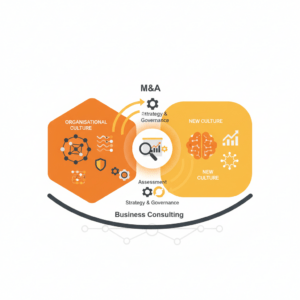
Organisational culture assessment has become a core component of successful mergers and acquisitions. Financial, legal, and operational due diligence reveal what an organisation owns and how it performs. Cultural due diligence reveals how people make decisions, respond to change, manage risk, and work together. Organisations that assess culture before integration are better positioned to reduce disruption, retain talent, and preserve deal value. Research consistently shows that cultural misalignment remains one of the leading causes of M&A underperformance.¹˒²
What Is an Organisational Culture Assessment?
An organisational culture assessment is a structured evaluation of the shared behaviours, beliefs, leadership practices, decision-making norms, and workplace expectations that shape how an organisation operates. In mergers and acquisitions, the assessment seeks to identify cultural strengths, potential points of friction, and areas where integration may require active management.
Culture is often described as “how work gets done around here.” Yet that simple description masks a wide range of operational realities. One organisation may value rapid decision-making and experimentation. Another may emphasise governance, hierarchy, and risk control. Neither approach is inherently better. Problems emerge when leaders assume cultural compatibility without evidence.
A formal assessment provides that evidence. It translates subjective observations into measurable insights that can inform transaction strategy, integration planning, leadership alignment, and workforce communication.
Why Does Cultural Due Diligence Matter in M&A?
Multiple studies have linked cultural incompatibility with merger failure. Research published in the Journal of Organizational Behavior found that cultural integration challenges directly affect employee commitment, retention, and performance following acquisition events.³ McKinsey research has also identified culture as a significant contributor to transaction outcomes and value creation.⁴
Financial due diligence identifies balance sheet risk.
Legal due diligence identifies compliance risk.
Cultural due diligence identifies people risk.
And people risk often becomes operational risk.
When cultures clash, organisations frequently experience:
- Leadership conflict
- Increased employee turnover
- Reduced engagement
- Customer service inconsistency
- Delayed transformation initiatives
- Lower productivity during integration
These issues rarely appear in acquisition models. Yet they can materially affect expected synergies and investment returns.
How Is Organisational Culture Assessed During an Acquisition?
Establishing a Cultural Baseline
The first step involves understanding the existing culture of both organisations independently. This includes examining leadership behaviour, organisational structure, communication patterns, customer focus, governance approaches, and employee experience.
Data collection methods commonly include:
- Executive interviews
- Employee surveys
- Focus groups
- Organisational network analysis
- Policy and governance reviews
- Customer experience metrics
- Workforce demographic analysis
Modern platforms such as <a href=”https://customerscience.com.au/csg-product/customer-science-insights/”>Customer Science Insights</a> can help organisations consolidate workforce, customer, and operational feedback into a unified evidence base for cultural analysis.
Identifying Cultural Distance
Cultural distance refers to the degree of difference between organisations across key behavioural dimensions.
Areas commonly assessed include:
- Leadership style
- Decision-making authority
- Risk appetite
- Customer orientation
- Accountability expectations
- Innovation practices
- Communication norms
- Change readiness
Some differences are manageable.
Others create significant integration challenges.
The objective is not to eliminate differences. It is to understand where differences may affect execution.
Evaluating Integration Readiness
Readiness assessments examine whether employees and leaders possess the capability and willingness to adapt to future operating models.
Key indicators include:
- Trust in leadership
- Organisational resilience
- Change fatigue levels
- Communication effectiveness
- Workforce engagement
- Leadership credibility
These measures help organisations estimate integration risk before integration begins.
What Does Effective Cultural Due Diligence Look Like?
Effective cultural due diligence moves beyond employee sentiment surveys.
A comprehensive framework typically examines five dimensions.
Leadership and Governance
Leadership behaviour often sets the tone for organisational culture. Assessment should examine how leaders communicate, make decisions, manage accountability, and respond to uncertainty.
Governance structures also matter. A highly regulated organisation may operate comfortably within formal approval processes, while an entrepreneurial business may prioritise speed and autonomy.
Workforce Experience
Employee experience provides insight into how culture is experienced rather than how it is described.
Areas examined include:
- Psychological safety
- Career development
- Recognition systems
- Collaboration patterns
- Inclusion practices
- Manager effectiveness
Customer Orientation
Customer expectations frequently reveal hidden cultural differences.
One organisation may prioritise operational consistency.
Another may focus on personalised service and flexibility.
Understanding these distinctions helps reduce customer disruption following integration.
Operational Behaviours
Operational culture influences execution.
Assessment examines:
- Process discipline
- Cross-functional collaboration
- Performance management
- Knowledge sharing
- Continuous improvement practices
Change Capability
Past transformation performance often predicts future integration success.
Organisations with strong change capability adapt faster and recover more quickly from disruption.⁵
How Does Organisational Culture Affect Deal Value?
Deal models often assume synergy realisation will occur according to plan.
Reality is messier.
Employee turnover among high performers can delay integration programs. Leadership departures may disrupt strategic priorities. Cultural resistance can slow technology adoption and process standardisation.
Deloitte research has reported that organisations that actively manage culture during M&A activity are more likely to achieve intended transaction outcomes.⁶
Cultural due diligence helps organisations quantify these risks before they become costly surprises.
What Are the Common Risks of Ignoring Culture?
Talent Loss
Employees often leave when organisational expectations become unclear. High-performing staff are particularly mobile during periods of uncertainty.
Leadership Misalignment
Acquired leadership teams may hold fundamentally different assumptions regarding accountability, authority, and organisational priorities.
Customer Experience Decline
Customers notice operational inconsistency quickly. Service quality can deteriorate when merged organisations operate under competing cultural expectations.
Delayed Synergy Realisation
Expected savings and growth opportunities may take longer to achieve when teams struggle to align around common objectives.
Reputation Damage
Poorly managed integrations can affect employer brand, customer trust, and investor confidence.
How Should Organisations Measure Cultural Integration Success?
Measurement should extend beyond engagement surveys.
A balanced scorecard typically includes:
Workforce Metrics
- Employee engagement
- Voluntary turnover
- Leadership retention
- Internal mobility
- Change readiness scores
Customer Metrics
- Customer satisfaction
- Net Promoter Score (NPS)
- Complaint rates
- Customer retention
Operational Metrics
- Integration milestone completion
- Productivity indicators
- Process adoption rates
- Collaboration measures
Organisations seeking ongoing integration monitoring often combine these indicators with specialist consulting support such as <a href=”https://customerscience.com.au/service/cx-consulting-and-professional-services/”>CX Consulting and Professional Services</a> to maintain visibility across workforce and customer outcomes.
What Are the Next Steps for Building a Strong Cultural Due Diligence Program?
Successful organisations begin cultural assessment before transaction completion.
Recommended actions include:
- Define cultural success criteria.
- Assess both organisations independently.
- Identify cultural gaps and strengths.
- Quantify integration risks.
- Develop targeted integration plans.
- Establish cultural measurement frameworks.
- Monitor outcomes throughout integration.
Waiting until post-merger integration begins is often too late.
Culture should be evaluated alongside financial, legal, operational, and technology considerations.
Evidentiary Layer
Research from KPMG found that culture remains one of the most underestimated drivers of transaction performance.⁷ Academic studies have repeatedly demonstrated links between cultural compatibility, employee retention, integration effectiveness, and long-term value creation.³˒⁸
The International Organization for Standardization (ISO) also recognises culture as a significant influence on governance, risk management, and organisational performance.⁹˒¹⁰
Taken together, the evidence points to a clear conclusion. Organisations that systematically assess culture before integration make better-informed decisions, identify hidden risks earlier, and improve their chances of delivering the value anticipated when the transaction was first approved.
FAQ
What is organisational culture assessment?
Organisational culture assessment is a structured evaluation of behaviours, leadership practices, decision-making norms, and employee experiences that influence organisational performance and integration outcomes.
What is cultural due diligence in mergers and acquisitions?
Cultural due diligence is the process of identifying cultural risks, strengths, and compatibility issues before an acquisition or merger is completed.
When should cultural due diligence be conducted?
The strongest results occur when cultural assessments begin during pre-acquisition due diligence rather than after integration planning has started.
How does culture affect M&A success?
Culture influences employee retention, leadership alignment, customer experience, operational execution, and the achievement of expected transaction synergies.
What data is used in an organisational culture assessment?
Assessments commonly use surveys, interviews, focus groups, governance reviews, customer feedback, workforce analytics, and operational performance data.
How can organisations continuously monitor cultural integration?
Platforms such as <a href=”https://customerscience.com.au/csg-product/commscore-ai/”>CommScore AI</a> can help organisations track communication effectiveness, workforce sentiment, and integration progress over time.
Sources
- Harvard Business Review. The New M&A Playbook. https://hbr.org
- Bain & Company. The Role of Culture in Mergers and Acquisitions. https://www.bain.com
- Weber, Y., Tarba, S. Journal of Organizational Behavior. DOI: 10.1002/job.1875
- McKinsey & Company. Culture for a Digital Age. https://www.mckinsey.com
- Prosci Change Management Research Reports. https://www.prosci.com
- Deloitte. The Culture Factor in M&A. https://www2.deloitte.com
- KPMG. Cultural Due Diligence in Mergers and Acquisitions. https://kpmg.com
- Stahl, G.K., Voigt, A. Do Cultural Differences Matter in Mergers and Acquisitions? Journal of International Business Studies. DOI: 10.1057/jibs.2007.24
- ISO 30414:2018 Human Capital Reporting. https://www.iso.org/standard/69338.html
- ISO 37301:2021 Compliance Management Systems. https://www.iso.org/standard/75080.html
- Australian Public Service Commission. Organisational Culture Guidance. https://www.apsc.gov.au
- OECD Corporate Governance Factbook. https://www.oecd.org
- Australian Institute of Company Directors Governance Resources. https://www.aicd.com.au
- Australian Prudential Regulation Authority Prudential Standards. https://www.apra.gov.au