




















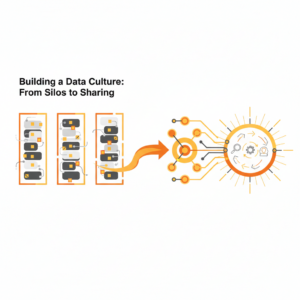
A strong data culture shapes how people work, not just how systems store information. Many organisations still operate in silos where teams guard data or interpret it differently. Moving toward shared understanding depends on trust, shared language, and practical data literacy programs that help people read, question, and use information in everyday decisions.
Definition: What does “building a data culture” actually mean?
Building a data culture means people across an organisation use data as part of daily decision-making without needing constant specialist support. It shows up in small habits. Someone checks evidence before approving spend. A team aligns on shared metrics instead of personal spreadsheets.
It is not about installing new tools. Tools help, but behaviour matters more.
Data literacy programs often sit at the centre of this shift. They teach people how to interpret dashboards, question data sources, and spot inconsistencies. Over time, this reduces dependence on a small group of analysts.
When done well, information stops feeling “owned” by one team. It becomes shared ground for decisions.
Context: Why do data silos still exist in most organisations?
Silos rarely appear by accident. They grow from structure. Finance tracks numbers one way, marketing another, operations another again. Each group builds its own version of truth because it needs speed and control.
There is also a trust gap. Teams hesitate to rely on data they did not create. So they rebuild it.
Legacy systems add friction. Older platforms do not always connect cleanly, which pushes teams into local workarounds. Those workarounds harden into habits.
And then there is language. “Revenue,” “active customer,” or “churn” can mean slightly different things across departments. Small differences, repeated often, create separation.
Silos feel efficient at first. But they slowly increase rework, confusion, and disagreement in meetings.
Mechanism: How does a data culture actually form in practice?
Culture shift starts when data stops being treated as a specialist output and becomes part of normal conversation.
Three mechanisms usually show up:
First, shared definitions. Teams agree on what key metrics mean. Not in theory, but in dashboards everyone actually uses.
Second, access. People can reach the data they need without waiting days for a report. This is where governance and permission structures matter.
Third, repetition. Leaders ask for evidence in meetings. Not in a strict way. More like a habit. “What are we seeing in the numbers?” becomes normal language.
Data literacy programs support all three. They reduce hesitation. People start to feel comfortable questioning numbers instead of accepting them blindly.
Small shift. Big ripple effect.
Comparison: What changes when silos break down?
In siloed environments, each team defends its own version of truth. Decisions slow down because people argue about data instead of outcomes.
In shared environments, discussion moves differently. Teams might still disagree, but they argue from the same base set of facts.
The difference shows up in three places:
Speed of decision-making improves because less time is spent reconciling reports.
Confidence increases because leaders can trace numbers back to agreed sources.
Collaboration improves because teams stop “checking each other’s maths” and start solving the same problem.
Silos feel safe for local optimisation. Sharing supports system-wide clarity.
Neither is perfect. But one reduces friction across the organisation.
Applications: Where does data culture actually show impact?
Data culture becomes visible in everyday workflows.
In customer support, agents use shared dashboards instead of personal notes. That reduces inconsistent responses.
In marketing, campaign decisions rely on agreed attribution models instead of parallel spreadsheets.
In operations, teams use the same performance indicators when planning capacity or staffing.
And in leadership meetings, discussions shift from “whose report is correct” to “what action should we take.”
This is where building a data culture connects with platforms like Customer Science Insights, which help organisations centralise visibility and improve shared understanding of customer and operational data.
But tools alone do not fix silos. They only support behaviour change already in motion.
Risks: What slows down or breaks data culture efforts?
One common risk is over-focus on technology. Organisations invest heavily in platforms but do not invest in how people use them. The tools sit underused.
Another risk is uneven literacy. If only analysts understand data properly, others disengage. That creates a new kind of silo.
There is also governance overload. Too many controls slow access, which pushes people back into spreadsheets.
And then there is fatigue. If data initiatives feel like extra work instead of part of daily decisions, adoption drops.
Cultural change fails quietly. Not with resistance. With indifference.
Measurement: How do you know a data culture is working?
You can see signals in behaviour before you see them in reports.
Fewer “which number is correct” debates in meetings.
More decisions referenced directly from shared dashboards.
Shorter time between question and insight.
Higher reuse of common metrics across teams.
Training participation from data literacy programs also matters, but it is not the only signal.
Measurement should include system and human behaviour together.
Services like CX Consulting and Professional Services often support organisations in tracking these shifts through structured assessment and governance review.
The goal is not just adoption. It is consistency of use across teams.
Next Steps: How do organisations move from silos to sharing?
Start small. Pick one high-impact metric used by multiple teams. Agree on its definition. Make it visible in one shared space.
Then build from there.
Introduce data literacy programs that focus on real tasks, not abstract training. People learn faster when they apply concepts to their own work.
Reduce friction in access, but keep governance simple enough that it does not slow decisions.
And keep leadership involved. Not as enforcers, but as users of the same data.
Over time, habits replace effort. That is when culture shifts.
Evidentiary Layer: What research supports this shift?
Research on data-driven organisations consistently shows improved performance when decision-making is supported by shared data practices¹. Studies in organisational behaviour also highlight the role of literacy and trust in adoption².
Governance frameworks from ISO standards emphasise clarity of roles and controlled access as foundational to information management³.
Industry reports from Gartner note that poor data quality and inconsistent definitions remain primary barriers to analytics adoption⁴.
Academic work on knowledge sharing shows that cross-team visibility improves coordination outcomes in complex systems⁵.
These findings align on one point. Technology alone does not shift behaviour. People and process must move together.
FAQ: Building a Data Culture and Data Literacy Programs
What is the first step in building a data culture?
Start with shared definitions for a small set of key metrics. Keep it practical and tied to daily decisions.
Why do data silos happen in organisations?
They form from separate systems, different team goals, and inconsistent definitions of the same data.
How do data literacy programs help?
They teach people how to interpret, question, and apply data in real tasks, reducing reliance on specialists.
Can tools alone fix data silos?
No. Tools support access, but behaviour and shared understanding drive real change.
How long does cultural change take?
It varies, but most organisations see early signals within months, not years, when adoption is consistent.
Learn more through Customer Science Knowledge Quest:
https://customerscience.com.au/csg-product/knowledge-quest/
Sources
- Davenport, T. H. (2013). Analytics 3.0. Harvard Business Review. https://hbr.org/2013/12/analytics-3-0
- McAfee, A., Brynjolfsson, E. (2012). Big Data: The Management Revolution. Harvard Business Review. https://hbr.org/2012/10/big-data-the-management-revolution
- ISO 38505-1:2017 Governance of data. https://www.iso.org/standard/62816.html
- Gartner (2024). Data and Analytics Governance Overview. https://www.gartner.com/en
- Nonaka, I., Takeuchi, H. (1995). The Knowledge-Creating Company. Oxford University Press. https://global.oup.com
- Australian Government Data Capability Framework. https://www.data.gov.au
- DAMA International. Data Management Body of Knowledge (DMBOK2). https://www.dama.org
- OECD (2019). Enhancing Access to and Sharing of Data. https://www.oecd.org
- KPMG (2023). Data-driven enterprise insights report. https://kpmg.com
- MIT Sloan Management Review (2018). The Data-Driven Organization. https://sloanreview.mit.edu