



























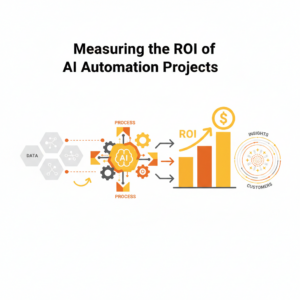
Artificial intelligence automation projects can reduce operating costs, shorten response times, and improve customer outcomes. Yet many organisations struggle to prove measurable business value after deployment. A strong AI automation business case depends on baseline measurement, financial modelling, operational tracking, and governance. Organisations that connect automation outcomes to labour productivity, service quality, risk reduction, and customer retention are more likely to secure executive support and long-term investment.
What Does Measuring ROI of AI Automation Mean?
Measuring ROI of AI automation refers to the process of comparing the financial and operational gains from automation against the total implementation and ownership costs. The calculation often extends beyond direct labour savings. Mature organisations also measure quality improvements, customer experience outcomes, compliance reduction, and employee productivity.¹
Traditional automation focused on repetitive tasks. AI automation changes that equation because machine learning systems can support judgement-based work, predictive decisions, and customer interactions at scale. Contact centres, financial services teams, logistics operations, and digital service environments increasingly use AI-driven workflows to reduce manual handling time while maintaining consistency.²
The challenge sits in attribution. Many AI projects fail to separate measurable operational improvements from broader organisational change. Some teams deploy automation without defining a baseline. Others rely on vendor assumptions that do not reflect local operating conditions. And that creates weak reporting later.
Clear ROI measurement starts before implementation begins.
Why Do AI Automation Projects Often Fail to Show ROI?
Many automation programs produce technical success but weak commercial evidence. A process may run faster, but executives still ask whether the investment delivered strategic value.
Research from McKinsey & Company found that organisations adopting AI at scale frequently struggle with value capture because operational metrics are disconnected from financial reporting.³ Teams often focus on deployment milestones instead of measurable business outcomes.
Common causes include:
- No agreed baseline before implementation
- Poor process documentation
- Limited executive sponsorship
- Underestimated change management costs
- Inconsistent customer experience measurement
- Weak governance around model accuracy
- Automation of low-value processes
And sometimes the wrong metric gets prioritised. Average handling time reductions may look positive while customer satisfaction declines. That creates hidden operational costs later through churn, complaints, or rework.
A stronger automation business case connects financial performance with operational quality indicators.
How Is ROI Calculated for AI Automation?
Most organisations begin with a standard ROI formula:
ROI=Total CostsNet Benefits−Total Costs×100
But AI automation projects need broader measurement dimensions than standard capital investment models.
Direct benefits may include:
- Reduced labour costs
- Lower processing times
- Fewer manual errors
- Reduced outsourcing spend
- Increased service availability
- Faster onboarding or fulfilment
Indirect benefits may include:
- Higher customer retention
- Lower employee turnover
- Improved compliance
- Better forecasting accuracy
- Reduced operational risk
Costs should include:
- Software licensing
- Integration costs
- Data preparation
- Model training
- Governance controls
- Internal labour
- Ongoing monitoring
- Vendor support
- Change management
According to the National Institute of Standards and Technology AI Risk Management Framework, governance and monitoring costs are often underestimated during initial business case development.⁴ Those omissions distort ROI reporting after implementation.
What Metrics Matter Most in an Automation Business Case?
Different industries measure automation performance differently. Still, several metrics consistently appear in successful AI automation programs.
Financial Metrics
Financial indicators remain central because executive teams require measurable commercial outcomes.
Typical measures include:
- Return on investment
- Payback period
- Net present value
- Cost-to-serve reduction
- Revenue uplift
- Margin improvement
Payback periods under 24 months are commonly used as investment thresholds in enterprise automation initiatives.⁵
Operational Metrics
Operational measures track workflow performance changes.
Examples include:
- Average handling time
- First contact resolution
- Throughput volume
- Error rates
- Queue reduction
- Escalation frequency
- Downtime reduction
These measures become particularly important in contact centres and service operations where automation affects customer interactions directly.
Customer Metrics
Customer impact should not sit outside ROI analysis. Poor automation experiences can erase operational savings through churn and reputational damage.
Key customer indicators include:
- Customer satisfaction
- Net Promoter Score
- Digital containment rates
- Complaint volumes
- Resolution speed
- Abandonment rates
Organisations implementing conversational AI frequently track containment alongside satisfaction scores to avoid false efficiency gains.⁶
How Can Organisations Establish a Reliable Baseline?
Baseline measurement is often overlooked. That creates reporting problems later because teams cannot demonstrate change accurately.
A reliable baseline requires:
- Historical operational data
- Consistent measurement windows
- Defined process ownership
- Standard reporting methodology
- Workforce activity mapping
- Customer outcome tracking
Three to six months of historical performance data is commonly recommended before automation deployment.⁷ Shorter periods may distort seasonality patterns.
And context matters. A customer support team during peak demand conditions produces different operational behaviour than a stable off-peak environment. Without normalisation, ROI calculations become unreliable.
This is where structured operational analytics platforms become useful. Solutions such as Customer Science Insights help organisations establish measurable operational baselines before automation programs begin.
What Is the Difference Between Automation ROI and Productivity Gains?
The two concepts overlap, but they are not identical.
Productivity gains measure output improvement. ROI measures financial return relative to investment.
A process may become faster without generating financial value. For example, automation may reduce handling time while increasing infrastructure costs or customer escalations. In that case, productivity rises but ROI weakens.
This distinction matters because executive stakeholders evaluate commercial sustainability, not just operational speed.
The Organisation for Economic Co-operation and Development has noted that AI-related productivity improvements do not always translate into broad financial gains without organisational redesign and workforce adaptation.⁸
So successful automation programs usually combine:
- Process redesign
- Workforce enablement
- Governance
- Data quality controls
- Continuous optimisation
Technology alone rarely produces sustained returns.
Applications of ROI Measurement in AI Automation
AI automation ROI measurement appears across many operational environments.
Contact Centres
Contact centres use AI automation for:
- Intelligent routing
- Agent assist
- Speech analytics
- Chatbots
- Quality assurance automation
ROI often comes from reduced call handling time and improved workforce utilisation. But customer satisfaction measurement remains critical because aggressive containment strategies can increase frustration.
Solutions such as CommsCore AI support communication analytics and operational performance measurement for service environments where customer interaction quality directly affects commercial outcomes.
Back-Office Operations
Finance, HR, and procurement teams use AI automation for:
- Document classification
- Invoice matching
- Compliance monitoring
- Workflow orchestration
- Predictive processing
Operational consistency often improves alongside labour reduction.
Knowledge Management
AI systems increasingly support enterprise knowledge retrieval and decision support. Poor knowledge quality creates major inefficiencies across customer operations and internal service teams.
Platforms such as Knowledge Quest assist organisations in structuring enterprise knowledge environments to support scalable AI-assisted operations.
What Risks Can Distort AI ROI Reporting?
Several factors distort automation ROI reporting after deployment.
Hidden Operational Costs
AI systems require ongoing tuning, governance, and monitoring. Those costs continue after launch.
Hidden expenses often include:
- Model retraining
- Compliance reviews
- Data remediation
- Escalation handling
- Cybersecurity controls
- Human oversight
Without full lifecycle accounting, ROI calculations become inflated.
Poor Adoption
Employees may avoid automation tools if workflows become harder to manage. Low adoption rates reduce realised value significantly.
Change management plays a large role here.⁹
Weak Data Quality
AI systems depend heavily on reliable data structures. Inconsistent data reduces model accuracy and operational reliability.
Garbage in. Garbage out.
How Should Organisations Measure AI Automation Over Time?
ROI measurement should continue after implementation.
High-performing organisations typically establish quarterly or monthly review cycles covering:
- Financial outcomes
- Customer impact
- Operational trends
- Risk indicators
- Workforce impacts
- Governance compliance
This creates a continuous optimisation model rather than a one-time implementation review.
Operational maturity also changes over time. Early ROI may appear modest while process adoption stabilises. Longer-term benefits often emerge through workflow redesign and behavioural change.
Managed advisory services such as CX Consulting and Professional Services can support ongoing governance, optimisation, and operational measurement across enterprise automation programs.
Customer Science Case Evidence
Organisations implementing AI automation frequently report the strongest ROI outcomes when operational measurement, customer analytics, and governance are embedded from the beginning.
Examples across customer operations environments include:
- Reduced customer handling time through conversational analytics
- Improved service consistency using automated quality frameworks
- Lower operational waste through workflow redesign
- Higher customer retention linked to faster issue resolution
These outcomes depend less on automation volume and more on implementation discipline.
Frequently Asked Questions
How long does it take to measure ROI from AI automation?
Many organisations begin seeing operational improvements within three to six months. Full ROI measurement may take 12 to 24 months depending on implementation scale, adoption, and process redesign requirements.
What is the biggest mistake in an automation business case?
The most common issue is failing to establish operational baselines before deployment. Without baseline data, organisations cannot prove measurable improvement later.
Should customer experience metrics be included in AI ROI?
Yes. Customer satisfaction, complaint rates, retention, and service quality all affect long-term commercial outcomes. Ignoring customer metrics creates incomplete ROI reporting.
What industries benefit most from AI automation?
Contact centres, financial services, healthcare administration, logistics, retail operations, and government service environments commonly report measurable gains from AI automation.
How can organisations improve automation adoption?
Clear workflow design, employee training, governance, and transparent communication all improve adoption outcomes. Automation should support employees rather than create additional process friction.
What tools help measure AI automation performance?
Operational analytics, workflow intelligence, speech analytics, and enterprise reporting systems are commonly used. Solutions such as CX Research and Design can support measurement framework development and operational benchmarking.
Sources
- ISO/IEC 23894:2023 Artificial Intelligence Risk Management
https://www.iso.org/standard/77304.html - Australian Government Digital Transformation Agency, Artificial Intelligence Guidance
https://www.digital.gov.au/policy/artificial-intelligence - McKinsey Global Survey on AI, 2024
https://www.mckinsey.com/capabilities/quantumblack/our-insights/the-state-of-ai - NIST AI Risk Management Framework 1.0
https://www.nist.gov/itl/ai-risk-management-framework - Gartner, Automation ROI Benchmarks Report, 2024
https://www.gartner.com/en - MIT Sloan Management Review, Measuring AI Customer Experience Outcomes, 2023
https://sloanreview.mit.edu - Australian Public Service Commission, Data Capability Framework
https://www.apsc.gov.au - OECD Artificial Intelligence and Productivity Report, 2024
https://www.oecd.org/digital/artificial-intelligence/ - Harvard Business Review, Why AI Projects Fail, 2023
https://hbr.org - Deloitte State of Generative AI in the Enterprise, 2024
https://www2.deloitte.com - ACCC Digital Platform Services Inquiry Report, 2024
https://www.accc.gov.au - CSIRO Responsible AI Network
https://www.csiro.au/en/work-with-us/industries/technology/responsible-ai-network