































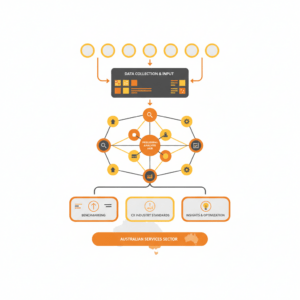
Customer experience benchmarking in Australian services works best when it compares three things at once: your service against customer needs, your performance against sector norms, and your operating model against recognised standards. In 2026, the strongest approach is not one league table. It is a benchmarking system that combines service outcomes, contact-centre benchmarks, privacy and AI controls, and practical journey evidence.¹˒²˒³˒⁴ (Digital Australia)
What is customer experience benchmarking?
Customer experience benchmarking is the disciplined comparison of your customer outcomes, service performance, and operating practices against relevant reference points. In Australian services, those reference points usually come from government digital-service standards, contact-centre industry benchmarks, sector studies, and your own internal trend line over time.¹˒²˒⁴ (Digital Australia)
That distinction matters. A benchmark is not just a score. It should tell you whether customers are completing tasks, whether service is getting easier or harder to use, and whether your operating model is improving in ways leaders can trust. The Digital Service Standard and Digital Performance Standard already push in that direction by requiring services to be user-friendly, inclusive, adaptable, measurable, and monitored with a holistic approach.¹˒² (Digital Australia)
Why does benchmarking matter more in Australia now?
Because Australia does not have one universal CX scoreboard that fits every service environment. What organisations actually use is a mix of government standards, sector-specific operational benchmarks, and proprietary cross-industry studies. That mix can be useful, but only if leaders know what each source is good for.¹˒²˒⁵˒⁶˒⁷ (Digital Australia)
The pressure to get this right is rising. OECD’s 2025 review of digital government in Australia says digital and ICT spending is projected to grow by 8.4% annually between 2024 and 2027, which raises the need to prove value and avoid waste.³ That pushes CX benchmarking away from vanity ranking and toward board-level questions about service quality, cost to serve, and risk. (Digital Australia)
Which benchmarks should Australian service leaders actually use?
Start with three benchmark layers.
The first is standards-based benchmarking. This asks whether the service meets recognised requirements for accessibility, service quality, measurement, privacy, and customer handling. In Australia, the Digital Service Standard and Digital Performance Standard are the clearest public anchors, and ISO 18295 gives a service-requirements framework for customer contact centres.¹˒²˒⁴ (Digital Australia)
The second is sector benchmarking. This compares your organisation against relevant peers. In practice, that can mean contact-centre benchmarking from ACXPA, broader CX benchmarking from CSBA, or market studies such as KPMG Australia’s customer experience research and CPM Australia’s State of CX report.⁵˒⁶˒⁷˒⁸ (acxpa.com.au)
The third is internal benchmarking. This is the layer many teams skip. Yet it is often the most useful one. Compare your current state with your own baseline across journey completion, repeat contact, complaint recurrence, transfer rate, and satisfaction. Because if a sector benchmark looks good while your own trend is getting worse, the public comparison is flattering but not useful.¹˒² (Digital Australia)
What should be benchmarked first?
Begin with customer task success. The Digital Performance Standard says teams should monitor how well users finish the tasks they start, and it treats customer satisfaction as an industry-standard measure of digital service quality.¹˒² That makes task completion, satisfaction, and friction a better starting point than raw channel volumes. (Digital Australia)
Then add operational signals that explain the result. In Australian service environments, the most practical second layer is repeat contact, time to resolution, transfer rate, abandonment, and knowledge quality. ACXPA’s current benchmarking material shows that the local contact-centre market already tracks operational measures such as average handle time and abandonment rate, which makes those metrics useful comparators when your service model includes assisted channels.⁵ (acxpa.com.au)
How should leaders handle cross-industry benchmark reports?
Use them carefully. Cross-industry reports are good for context, not for absolute management decisions.
KPMG’s 2025 Australia customer experience research says the national CX score rose to 7.30 and was based on more than 80,000 evaluations across 16 countries, including more than 5,000 in Australia.⁶ CPM Australia’s 2025 report says its CSX score benchmarked customer service performance across 14 industries and found the average Australian score remained at 26, rated as “Good,” with no industry reaching “Great” or “Excellent.”⁷ Those are useful signals. But they do not replace journey-level measurement inside your own service environment. (KPMG)
So. Use national studies to see where the market is moving. Use operational benchmarks to compare service mechanics. Use your own journey data to decide what to fix next.
Where should this show up in practice?
The best place to start is one high-volume journey with visible failure demand. Complaints, appointment changes, claims updates, onboarding, and identity changes are usually good candidates because they expose both customer friction and operational waste.
This is where Customer Science Insights belongs in the model. A benchmark becomes useful only when leaders can connect survey results and service standards to live operational data across voice, digital, bots, CRM, and workflow. That is the gap between benchmarking as reporting and benchmarking as control. (Digital Australia)
What are the main risks?
The first risk is false comparison. Teams compare themselves with sectors that do not share the same service mix, policy burden, or customer intent.
The second risk is metric distortion. A service can post acceptable satisfaction while still forcing high customer effort. Or it can look operationally lean while generating avoidable repeat contact.
The third risk is governance blindness. OAIC says privacy by design means building privacy into the design specifications and architecture of new systems and processes, and OAIC also published guidance in October 2024 on privacy and commercially available AI products.⁹˒¹⁰ In 2026, any benchmark set that ignores privacy, AI controls, and data handling is incomplete. (OAIC)
How should success be measured?
A strong Australian benchmarking model uses four layers: customer outcomes, operational outcomes, financial outcomes, and control outcomes.
Customer outcomes should include task completion, satisfaction, and effort. Operational outcomes should include repeat contact, resolution time, transfer rate, and abandonment. Financial outcomes should show cost to serve and benefits realised. Control outcomes should include privacy exceptions, AI override or review rates, and major complaint risk.¹˒²˒³˒⁹˒¹⁰ (Digital Australia)
That is also where CX Consulting and Professional Services fits. Most organisations do not fail because they lack benchmark data. They fail because they lack a measurement design that ties standards, sector comparisons, and live service data into one decision model.
What should leaders do next?
Pick one benchmark set from each layer. One standards anchor. One sector comparison. One internal baseline. Then review them together every month against a priority journey.
Keep the rule simple. Benchmark only what can change a decision. Because once a benchmark stops shaping funding, governance, or service design, it has turned into decoration.
Evidentiary layer
The evidence base supports a blended model. Australian government guidance gives clear measurement and service-design anchors.¹˒² ISO provides a service-requirements baseline for contact centres.⁴ Local benchmarking bodies and sector studies show that Australian services already use multiple comparison systems rather than one national CX index.⁵˒⁶˒⁷˒⁸ OAIC guidance makes clear that privacy and AI controls now belong inside service evaluation, not outside it.⁹˒¹⁰ The practical conclusion is plain enough: in Australia, customer experience benchmarking is strongest when it combines standards, sector comparisons, and live operational evidence. (Digital Australia)
FAQ
Is there one official CX industry standard in Australia?
No. Australia has strong public standards for digital service quality and measurement, but most CX benchmarking in services uses a mix of government standards, contact-centre benchmarks, and commercial cross-industry studies.¹˒²˒⁵˒⁶˒⁷ (Digital Australia)
What should be benchmarked first in a service organisation?
Start with task completion, satisfaction, and repeat contact. Those measures show whether customers are succeeding and whether the service is quietly generating extra work.¹˒² (Digital Australia)
Are contact-centre benchmarks enough on their own?
No. They are useful for operational comparison, but they should sit beside customer outcome measures and standards-based checks.⁴˒⁵ (ISO)
Which Australian benchmark sources are most useful?
For most teams, the most useful mix is DTA standards for measurement discipline, ISO 18295 for service requirements, ACXPA or CSBA for operational or service benchmarking, and one broader market study such as KPMG or CPM for cross-industry context.¹˒²˒⁴˒⁵˒⁶˒⁷˒⁸ (Digital Australia)
How should boards see benchmark data?
Boards should see a short view that combines customer outcomes, operating movement, benefits, and control risks. Not a long pack of disconnected benchmark charts.¹˒²˒³ (Digital Australia)
Where does quality assurance fit?
It fits underneath the benchmark system. If your answers are inconsistent, your benchmark scores will wobble before the reports tell you why. Commscore AI is relevant when the main gap is call and interaction quality at scale, because benchmarking is only as strong as the quality signals feeding it.
Sources
-
Australian Government Digital Transformation Agency. Digital Performance Standard, including Criteria 3 and 4 on service success and customer needs. 2024. (Digital Australia)
-
Australian Government Digital Transformation Agency. Digital Service Standard. 24 July 2024. (Digital Australia)
-
OECD. Digital Government in Australia. 2025. (OAIC)
-
ISO. ISO 18295-1:2017 Customer contact centres, Part 1: Requirements for customer contact centres. (ISO)
-
Australian Customer Experience Professionals Association. 2025 Australian Contact Centre Industry Best Practice Report and related benchmark resources. 2025. (acxpa.com.au)
-
KPMG Australia. Australia’s best customer experience according to KPMG research. 19 November 2025. (KPMG)
-
CPM Australia and Swinburne University CXI Research Group. The State of CX in Australia Report. 2025. (Symbos)
-
CSBA. Customer Experience Benchmarking Performance. Current service description. (CSBA | CSBA Website)
-
Office of the Australian Information Commissioner. Privacy by design guidance. (OAIC)
-
Office of the Australian Information Commissioner. Guidance on privacy and the use of commercially available AI products. 21 October 2024. (OAIC)