





















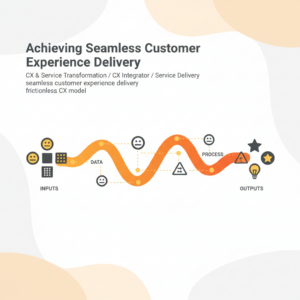
Seamless customer experience delivery in 2026 comes from one thing above all else: continuity. Customers should be able to move across channels, teams, and fulfilment steps without losing context, repeating information, or getting a different answer. That only happens when data, workflow, knowledge, identity, and governance work as one service system.¹˒²˒³˒⁴
What is seamless customer experience delivery?
Seamless customer experience delivery is the consistent execution of a customer journey from first contact to final resolution across every channel and handoff. It does not mean every interaction is digital. It does not mean every customer follows the same path. It means the service system preserves context, intent, policy, and progress wherever the customer goes next. Research on omnichannel customer experience shows that customers judge the connected experience across touchpoints, not isolated channel moments.⁵˒⁶
In practice, this is what a frictionless CX model looks like. A person starts online, checks details in an app, calls for help, then completes the task in a branch, store, field visit, or service queue. The organisation still knows who they are, what they were trying to do, what has already happened, and what should happen next. When that chain breaks, the experience feels disjointed even if each touchpoint performs well on its own.¹˒⁵˒⁷
Why is this still hard in 2026?
Most organisations still run experience delivery through separate systems and separate budgets. Digital teams focus on traffic, containment, and conversion. Contact centres focus on queue performance and handling time. Operations teams focus on throughput, staffing, and exception management. The customer crosses all of those boundaries in a single journey.
That split is now harder to manage because service delivery also carries privacy controls, AI features, identity rules, case workflows, and content updates. OECD work on digital public infrastructure describes shared, secure, interoperable systems such as identity, data sharing, and notifications as common building blocks for broad access to services.³ The same logic applies in enterprise CX. If those foundations are weak, the service model becomes fragile. Australia’s Digital Performance Standard also points teams toward a holistic approach to monitoring service performance rather than judging quality through one metric alone.¹
How does a frictionless CX model work?
A frictionless CX model depends on five connected layers.
The first layer is identity and consent. The system needs a dependable way to recognise the customer, apply preferences, and carry access rules across channels. The second layer is shared customer and operational data. This includes service history, transaction state, open cases, unresolved intent, and status events. The third layer is workflow and orchestration. Work has to move with the customer, not restart in every channel. The fourth layer is knowledge and policy control. Customers and staff need one current answer. The fifth layer is governance. Privacy, AI controls, service ownership, and performance measurement sit across the whole model, not beside it.²˒³˒⁴˒⁸
NIST’s Generative AI Profile is useful here because it makes clear that AI risks can arise during design, development, deployment, operation, and decommissioning.² That matters for customer experience delivery because many service environments now use AI for summarisation, guidance, drafting, routing, or recommendations. If those controls are missing, speed can improve while trust and consistency fall.
What is the difference between fast service and connected service?
Fast service is local. Connected service is systemic.
A channel can answer quickly and still create friction if the next team cannot see the interaction. A chatbot can contain demand and still fail if the case reopens in voice without context. A branch can handle a customer politely and still damage the journey if it cannot access digital history, appointment changes, or current policy. Research on omnichannel experience consistently finds that consistency, coordination, and touchpoint continuity shape the overall experience and downstream engagement.⁵˒⁶˒⁷
That is why seamless customer experience delivery should not be defined by speed alone. It should be defined by continuity, resolution, and confidence. Customers should feel that the organisation remembers them, understands the task, and can complete it without sending them back to the start.
Applications
The best place to apply this model is where demand, complexity, and handoffs are already hurting the experience. Good candidates include complaints, claims, onboarding, appointment changes, high-volume support, field service, regulated approvals, and any journey that moves between digital entry and assisted completion.
The first practical move is to create a shared operating view of the journey. Customer Science Insights fits here because service leaders need a neutral view of demand, transfer points, repeat contact, containment, and resolution before they can improve delivery. Without that visibility, teams usually optimise the channel they own rather than the journey the customer lives through.¹˒⁴˒⁹
A second application is knowledge control. A connected delivery model breaks quickly when web content, agent guidance, and operational policy drift apart. Customers then hear one answer online, another on the phone, and a third in person. That is not a channel problem. It is a service-system problem.
What are the main risks?
The first risk is fragmented ownership. When each team has its own tools, KPIs, and funding model, nobody owns the full journey. The second is privacy debt. The OAIC says privacy by design means embedding good privacy practices into the design specifications and architecture of new systems and processes.⁴ If journey data flows across channels and teams, privacy controls need to be designed early.
The third risk is weak knowledge governance. Service environments change fast. Policy updates, campaign offers, operational exceptions, and regulatory notices can all alter what the right answer should be. If content is not governed, the organisation starts to contradict itself. The fourth risk is unmanaged AI. AI can help agents and customers move faster, but unmanaged AI can also create incorrect recommendations, inconsistent explanations, or risky handling of personal information.²˒⁴
The fifth risk is poor measurement. Qualtrics reported at the end of 2025 that US$3.7 trillion of 2024 global sales were at risk due to bad customer experiences, and that half of customers cut spending after a poor one.⁹ That is the financial consequence of friction at scale.
How should leaders measure it?
Measure the journey, not just the queue. Australia’s Digital Performance Standard says customer satisfaction is an industry-standard measure of digital service quality and that teams should compile metrics and monitor the service with a holistic approach.¹ That gives leaders a strong baseline.
But a frictionless CX model needs more than satisfaction. Track journey completion, avoidable recontact, time to resolution, transfer rate, channel-switch failure, and customer trust or satisfaction. Then add operating measures such as agent effort, knowledge reuse, workflow automation rate, and exception handling. If AI is involved, also track escalation rate, override rate, answer quality, and review incidents.²
This is where design and operating support often matters. CX Consulting and Professional Services belongs naturally in the measurement and target-state phase because the hard work is usually service blueprinting, governance design, KPI logic, and phased execution rather than buying another platform.
Next steps
Start with one journey that customers already find frustrating. Map it from first signal to final outcome. Identify where identity breaks, where cases restart, where customers repeat information, where policy becomes inconsistent, and where the work sits idle between teams. Then define a target state built around shared services, not disconnected channels.
Keep the decision rule simple. Every change should improve one of four things: customer clarity, service continuity, operational control, or measurable value. If a tool or process change does not improve one of those outcomes, it is probably adding noise rather than reducing friction.³˒⁸
Evidentiary layer
The evidence is consistent on the main point. Customer experience quality is shaped by continuity across touchpoints, not by any single channel in isolation.⁵˒⁶ OECD work supports the value of interoperable shared service foundations.³ NIST and OAIC guidance show that AI and privacy controls now need to be designed into the service model itself.²˒⁴ Australia’s digital performance guidance reinforces the need for holistic measurement.¹ And the commercial case remains strong because poor experiences still create measurable spending risk.⁹
So the operating question for 2026 is not whether you offer enough channels. It is whether those channels, teams, and systems behave like one organisation from the customer’s point of view.
FAQ
What is the first sign that customer experience delivery is not connected?
The clearest sign is repetition. Customers repeat details, restart tasks, or receive different answers as they move between channels or teams.⁵˒⁶
Does seamless customer experience delivery require one platform?
No. It usually requires one governed service model built on shared identity, data, workflow, knowledge, and measurement.³˒⁸ One platform can help, but it is not the core requirement.
What matters more, speed or continuity?
Continuity matters more because speed without continuity still creates friction. A fast first touch that leads to recontact or transfer failure does not feel easy to the customer.¹˒⁵
Where should organisations start?
Start with one high-friction journey that crosses at least two channels and one internal handoff. Knowledge Quest is relevant when the recurring failure is inconsistent answers across teams, channels, or service moments.
How much governance does AI need in a frictionless CX model?
A lot. AI used for routing, drafting, guidance, or summaries should sit inside documented controls for quality, privacy, escalation, and review.²˒⁴
Which board-level measures should be reported?
Use a compact set: journey completion, repeat contact reduction, service cost, customer trust or satisfaction, and benefits delivered from workflow or automation improvements.¹˒⁹
Sources
-
Australian Government Digital Transformation Agency. Measure if your digital service is meeting customer needs. Stable government guidance page.
-
NIST. Artificial Intelligence Risk Management Framework: Generative Artificial Intelligence Profile, NIST AI 600-1, 2024. Stable primary publication.
-
OECD. Digital Public Infrastructure for Digital Governments. OECD Public Governance Policy Papers No. 68, 2024. Stable report.
-
Office of the Australian Information Commissioner. Privacy by design. Stable government guidance page.
-
Gerea C, Gonzalez-Lopez F, Herskovic V. Omnichannel Customer Experience and Management: An Integrative Review and Research Agenda. Sustainability. 2021;13(5):2824. DOI: 10.3390/su13052824
-
Rahman SM, Carlson J, Gudergan SP, Wetzels M, Grewal D. Perceived Omnichannel Customer Experience: Concept, Measurement, and Impact. Journal of Retailing. 2022;98(4):611-632. DOI: 10.1016/j.jretai.2022.03.003
-
Rahman SM, Carlson J, Gudergan SP, et al. How do omnichannel customer experiences affect customer engagement intentions? Journal of Business Research. 2025;181:115196. DOI: 10.1016/j.jbusres.2025.115196
-
Schweidel DA, Bart Y, Inman JJ, et al. How consumer digital signals are reshaping the customer journey. Journal of the Academy of Marketing Science. 2022;50(6):1257-1276. DOI: 10.1007/s11747-022-00839-w
-
Qualtrics XM Institute. Understanding Customer Experience ROI. 31 December 2025. Stable research page.