


























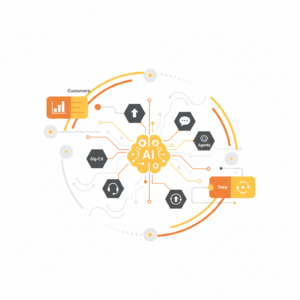
Outsourcing is shifting from large, fixed teams to flexible Gig-CX pools supported by AI-augmented agents. The winning model blends elastic labour, real-time guidance, and strong governance so service remains compliant, secure, and on-brand. Leaders who treat AI as a quality system, not a cost lever, can improve responsiveness and resilience while reducing risk across vendors and workforce models.
Definition
What is Gig-CX in the future of BPO?
Gig-CX is a service delivery model where customer interactions are handled by on-demand contractors, often working remotely and scheduled dynamically to match demand peaks. It is a specific form of “gig economy customer service” that applies platform-style labour allocation to contact centre work. In the future of BPO, Gig-CX typically sits alongside traditional outsourced teams and in-house specialists, allowing organisations to flex capacity without permanently increasing headcount.¹˒²
What are AI-augmented agents?
AI-augmented agents are human service agents supported by AI that listens, reads, or observes an interaction and provides guidance in real time. This guidance can include knowledge retrieval, suggested responses, summarisation, next-best action, and quality checks. The intent is improved consistency and speed while keeping a human accountable for decisions that affect customers.³˒⁴
Context
Why is outsourcing changing now?
Three pressures are converging. First, demand volatility is rising across digital and voice channels, and businesses need elastic staffing without degrading service levels. Second, knowledge has become the main constraint, not labour. Product complexity, policy nuance, and compliance requirements make ramp time expensive. Third, AI is now good enough to reduce cognitive load during interactions, so the limiting factor shifts to governance and operating design.²˒³
What does “future of BPO” mean for service buyers?
For buyers, “future of BPO” increasingly means buying an operating system, not just seats. That operating system includes workforce orchestration, knowledge governance, security controls, and measurement. It also changes contracting. Outcomes, quality, and risk controls become more valuable than raw capacity.²˒⁵
Mechanism
How do Gig-CX and AI-augmented agents work together in practice?
The combined model usually has four layers:
Demand sensing and workforce orchestration: forecasting, micro-shifts, and skills-based routing allocate work to the right pool at the right time.²
Knowledge layer: a governed knowledge base provides approved answers, escalation rules, and policy boundaries.⁶
Real-time agent assistance: AI surfaces relevant articles, drafts responses, and flags compliance risks during the interaction.³˒⁴
Continuous quality and improvement: interaction analytics and complaint signals feed coaching, content updates, and process fixes.⁶˒⁷
The critical design point is accountability. AI can recommend, but a named human or role must own decisions, especially for refunds, hardship, safety, identity checks, and regulated disclosures.³˒⁸
Comparison
How does Gig-CX compare to traditional BPO delivery?
Traditional BPO optimises stability, scale, and standardisation. It performs best for high-volume, predictable work with mature processes and strong training. Gig-CX optimises elasticity and niche skills. It performs best for spikes, new product launches, seasonal demand, and multilingual coverage, but requires more deliberate controls for quality, security, and brand consistency.¹˒²
When does AI change the economics?
AI changes economics when it reduces three costs: training time, handle time variability, and quality failure rates. If AI only reduces handle time but increases rework, escalations, or complaints, the total cost rises. Complaint handling standards and contact centre service requirements provide a useful baseline for measuring whether “efficiency” is truly improving customer outcomes.⁶˒⁷
Applications
Where should enterprises apply Gig-CX first?
Start where risk is lowest and variability is highest. Common entry points include overflow queues, outbound confirmations, appointment reminders, delivery exceptions, simple billing queries, and post-interaction follow-ups. These use cases benefit from elastic staffing and AI guidance, while limiting exposure to complex hardship decisions or high-risk identity actions.²˒⁶
How do you keep Gig-CX “on brand” at scale?
Treat brand voice and policy compliance as product assets. Build a governed knowledge layer with short, approved response patterns and clear escalation triggers. Use AI-augmented agents to enforce those patterns through real-time prompts, mandatory disclosures, and dynamic checklists. A practical way to operationalise this is to consolidate “single source of truth” content and measure article usage, deflection, and error rates across all delivery partners.
For organisations that need an enterprise knowledge and insight layer that supports consistent assisted service, Customer Science Insights can be used as the governed foundation for service performance and customer understanding: https://customerscience.com.au/csg-product/customer-science-insights/
Risks
What are the biggest risks in the gig economy customer service model?
Workforce risk: variable experience levels and weaker attachment to a single brand can reduce consistency.¹
Security risk: distributed endpoints and contractor access increase exposure if identity, device, and data controls are weak.⁹
Regulatory and fairness risk: AI guidance can amplify bias or push “optimised” outcomes that conflict with fairness expectations.³˒⁸
Customer trust risk: hidden automation, accent modification, or unclear disclosures can create reputational damage if customers perceive manipulation or cultural erasure.¹⁰˒¹¹
How do leaders reduce risk without killing flexibility?
Use three “non-negotiables”:
Service requirements: define minimum contact centre service controls aligned to recognised requirements for customer contact centres.⁶
Trustworthy AI controls: apply an AI risk management framework with documented risk assessments, testing, monitoring, and human oversight.³˒⁴
Data protection: enforce an information security management system and breach response readiness across all vendors and contractors, with clear notification processes.⁹˒¹²
Measurement
What metrics prove Gig-CX and AI augmentation are working?
Use a balanced scorecard that links speed, quality, and risk:
Operational: service level, average speed of answer, abandon rate, and forecast accuracy.
Customer outcomes: first contact resolution, complaint rate by reason, repeat contact within 7 days, and customer effort indicators.⁷
Quality: critical error rate, policy breach rate, and QA calibration variance across delivery pools.⁶
AI controls: suggestion acceptance rate, hallucination rate (verified wrong answers), and “AI-driven rework” volume.³˒⁴
Risk: security exceptions, access violations, and time-to-detect for potential data incidents.⁹˒¹²
The most important measurement discipline is linking AI usage to downstream outcomes, not just productivity. If AI raises speed but increases complaints, it is degrading service.
Next Steps
How should a CX leader sequence a transformation?
Phase 1, stabilise: define service standards, knowledge governance, and escalation boundaries using recognised contact centre and complaint guidelines.⁶˒⁷
Phase 2, pilot: launch Gig-CX for overflow with AI assistance, tight QA, and clear customer disclosures for assisted workflows.³˒⁴
Phase 3, scale: expand to new languages, extended hours, and specialist pools, while enforcing security and contracting controls across suppliers.⁹˒¹²
Phase 4, optimise: shift from cost-per-contact to outcome-based commercial models tied to quality and complaint reduction.
For structured operating-model design, vendor governance, and implementation support across outsourcing and AI-enabled service, CX consulting and professional services can be used to run the transformation as a managed program: https://customerscience.com.au/service/cx-consulting-and-professional-services/
Evidentiary Layer
What does the evidence say about where this is heading?
Research and industry analysis show platform-mediated work is expanding and creating new requirements for worker protections, governance, and transparent practices.¹˒² At the same time, AI risk management guidance is converging on consistent themes: defined accountability, monitoring, and human oversight.³˒⁴ Regulation is also moving from principles to enforcement, especially for higher-risk AI uses and transparency expectations, which will affect how global service operations deploy AI at scale.⁸ Finally, contact centre and complaint handling standards provide practical, auditable controls that map well to multi-vendor and Gig-CX environments where consistency is otherwise difficult to maintain.⁶˒⁷
FAQ
What is the simplest way to explain Gig-CX to a board?
Gig-CX is an elastic customer service workforce model that scales capacity up and down quickly, often using contractors, while governance and quality systems ensure service stays compliant and consistent.¹˒⁶
Does AI reduce the need for outsourcing?
AI changes what is outsourced. Routine work may shrink, but demand for flexible, supervised human support and specialist escalation often remains, especially where trust, judgement, and compliance matter.³˒⁴
What is the biggest failure mode with AI-augmented agents?
Treating AI outputs as correct by default. Without verification loops, knowledge governance, and monitoring, error rates and compliance failures can rise even as handle time falls.³˒⁴
How do we prevent “two-tier” quality between gig workers and core teams?
Standardise the knowledge base, enforce QA calibration across all pools, and use real-time guidance to reduce variability. Measure critical error rate and complaint reasons by workforce segment.⁶˒⁷
What governance artefacts should procurement demand from vendors?
Require service requirement alignment, AI risk management documentation, and security controls including breach preparedness and notification processes.³˒⁶˒⁹˒¹²
What Customer Science capability helps maintain consistent answers across hybrid workforces?
A governed enterprise knowledge system that supports accurate retrieval, controlled updates, and measurable adoption. Knowledge Quest is one option for operationalising this in assisted service environments: https://customerscience.com.au/csg-product/knowledge-quest/
Sources
International Labour Organization. World Employment and Social Outlook 2021: The role of digital labour platforms in transforming the world of work. ILO, 2021. ISBN 978-92-2-031941-3 (web PDF). https://www.ilo.org/publications/flagship-reports/role-digital-labour-platforms-transforming-world-work
McKinsey & Company. An on-demand revolution in customer-experience operations. 2021. https://www.mckinsey.com/capabilities/operations/our-insights/an-on-demand-revolution-in-customer-experience-operations
NIST. Artificial Intelligence Risk Management Framework (AI RMF 1.0). January 2023. DOI: 10.6028/NIST.AI.100-1. https://www.nist.gov/publications/artificial-intelligence-risk-management-framework-ai-rmf-10
NIST. Artificial Intelligence Risk Management Framework: Generative AI Profile (NIST-AI-600-1). 2024. https://www.nist.gov/itl/ai-risk-management-framework
Forbes Business Council. A Look Ahead: 2025 Outsourcing Trends. 2025. https://www.forbes.com/councils/forbesbusinesscouncil/2025/04/07/a-look-ahead-2025-outsourcing-trends/
ISO. ISO 18295-1:2017 Customer contact centres — Requirements for service provision. https://www.iso.org/standard/64739.html
ISO. ISO 10002:2018 Quality management — Customer satisfaction — Guidelines for complaints handling in organizations. https://www.iso.org/standard/71580.html
European Union. Regulation (EU) 2024/1689 (Artificial Intelligence Act). Official Journal, 12 July 2024. https://eur-lex.europa.eu/eli/reg/2024/1689/oj/eng
ISO/IEC. ISO/IEC 27001:2022 Information security management systems — Requirements. https://www.iso.org/standard/27001
TP (Teleperformance). Strategic partnership with Sanas to accelerate AI and reinvent CX. 19 Feb 2025. https://www.tp.com/en-us/insights-list/press-releases/teleperformance-forms-strategic-partnership-with-real-time-speech-understanding-provider-sanas-as-part-its-growth-strategy-to-accelerate-ai-development-and-reinvent-customer-experience/
The Washington Post. AI is transforming Indian call centers. What does it mean for workers? 21 Jun 2025. https://www.washingtonpost.com/world/2025/06/21/india-ai-bpo-call-centers/
Office of the Australian Information Commissioner (OAIC). Notifiable Data Breaches scheme guidance. https://www.oaic.gov.au/privacy/notifiable-data-breaches/about-the-notifiable-data-breaches-scheme