




























Portfolio optimisation is a governance discipline that prevents value leakage by ensuring major programs remain aligned to strategic intent, economic value, and delivery capacity. When applied rigorously, it improves investment decisions, stops low-value initiatives early, and protects benefits through execution. For large organisations, portfolio optimisation is a primary control for capital efficiency, risk reduction, and sustained program value.
What is portfolio optimisation in major programs?
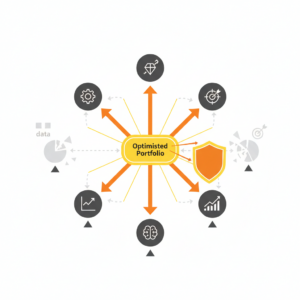
Portfolio optimisation is the structured process of selecting, prioritising, governing, and adjusting programs and initiatives to maximise total enterprise value under real constraints. These constraints include funding, capability, risk appetite, and time.
In major programs, portfolio optimisation operates above individual projects. It evaluates the combined performance of investments rather than isolated business cases. This approach recognises that value is lost most often through misalignment, duplication, and poor sequencing rather than delivery failure alone¹.
The discipline integrates strategy, value management, and governance. It establishes a single view of demand, investment, and benefits. This view enables executives to make explicit trade-offs and redirect funding before value leakage becomes irreversible.
Why does value leakage persist in large portfolios?
Value leakage occurs when expected benefits erode between approval and realisation. In major programs, this erosion is usually structural rather than accidental.
Common causes include weak benefit ownership, scope drift, unmanaged dependencies, and delayed decision-making. Many organisations approve initiatives based on optimistic assumptions, then fail to revisit those assumptions as conditions change².
Another contributor is fragmented governance. When programs report through multiple committees with different success measures, accountability diffuses. Decisions default to momentum rather than value. Over time, low-return initiatives continue to consume capital, while higher-value opportunities are constrained.
Portfolio optimisation addresses these issues by making value explicit, comparable, and continuously reviewable.
How does portfolio optimisation prevent value leakage?
Portfolio optimisation prevents value leakage through three reinforcing mechanisms: transparency, comparability, and control.
First, it creates transparency by establishing a consistent value framework. Financial, customer, risk, and strategic benefits are defined in measurable terms. Assumptions are documented and reviewed. This reduces ambiguity and exposes early signs of underperformance³.
Second, it enables comparability across initiatives. Programs are assessed using the same value metrics, risk lenses, and dependency models. This allows executives to prioritise based on relative contribution rather than political sponsorship.
Third, it strengthens control through active portfolio governance. Funding is staged. Benefits are tracked. Initiatives that no longer justify investment are paused, reshaped, or stopped. This disciplined intervention is the primary mechanism for preventing value leakage in-flight.
Portfolio optimisation versus project management
Project management focuses on delivering agreed scope on time and budget. Portfolio optimisation focuses on whether the work should exist at all, and whether it still deserves investment.
Both are necessary, but they operate at different decision layers. Strong project delivery does not compensate for poor portfolio choices. Studies consistently show that organisations with mature portfolio management achieve higher returns on investment even when delivery performance is comparable⁴.
Portfolio optimisation also manages interdependencies. It sequences initiatives to avoid bottlenecks and benefit delays. This system-level perspective is essential in large transformation programs where value depends on coordinated outcomes rather than individual deliverables.
Where does portfolio optimisation deliver the most impact?
Portfolio optimisation delivers the greatest impact in environments with high investment complexity and constrained capacity. This includes digital transformation, regulatory change, and multi-year customer experience programs.
In these contexts, the first practical step is establishing a central portfolio view supported by decision-grade data. Platforms such as Customer Science Insights enable organisations to consolidate initiative data, model value scenarios, and support executive trade-off decisions in real time.
https://customerscience.com.au/csg-product/customer-science-insights/
When combined with formal value management consulting, portfolio optimisation becomes embedded rather than episodic. Governance forums shift from status reporting to value-based decisions. Over time, this reduces sunk-cost bias and improves capital recycling.
What risks arise from poor portfolio optimisation?
The primary risk is silent value erosion. Programs continue to report progress while benefits decline. By the time issues surface, options are limited and politically costly.
Other risks include overcommitment of scarce capability, conflicting priorities, and delayed benefit realisation. These risks compound in large portfolios, where small inefficiencies scale rapidly.
There is also reputational risk. Repeated investment underperformance reduces executive confidence in transformation programs and increases risk aversion, even when change is strategically necessary⁵.
Effective portfolio optimisation mitigates these risks by making trade-offs explicit and defensible.
How should portfolio value be measured and governed?
Measurement begins with clear benefit definitions linked to strategic objectives. Financial value should be complemented by customer, risk, and capability measures where relevant.
Benefits must have named owners accountable beyond delivery completion. Tracking should continue through realisation, not stop at go-live⁶.
Independent review and cadence-based portfolio resets are critical. Many organisations engage external value management or CX consulting partners to establish governance models, benefit frameworks, and executive decision rhythms that endure beyond a single program.
https://customerscience.com.au/solution/value-management-consulting/
What are the next steps for executives?
Executives should start by assessing portfolio visibility and decision quality. Key questions include whether all major initiatives are evaluated on the same value basis, and whether stopping rules are actively used.
The next step is capability enablement. This includes tools, governance structures, and skills in value-based decision-making. Portfolio optimisation is not a one-off exercise. It is an operating discipline.
When embedded effectively, it becomes a strategic asset that protects investment value across economic cycles and organisational change.
Evidentiary layer
Portfolio management standards emphasise continuous alignment between strategy, investment, and benefits as the core determinant of portfolio value¹⁷. Empirical studies link mature portfolio governance with improved return on capital and reduced failure rates in large programs⁴⁸. Public sector guidance similarly identifies early termination and reprioritisation as primary controls for preventing benefit erosion⁶⁹.
FAQ
What is the difference between portfolio optimisation and value management?
Portfolio optimisation focuses on selecting and prioritising investments. Value management focuses on defining, tracking, and realising benefits. Effective organisations integrate both disciplines.
Can portfolio optimisation stop programs already in delivery?
Yes. A core function of portfolio optimisation is reassessing in-flight initiatives against current value and constraints.
Is portfolio optimisation only relevant for very large organisations?
No. It is most critical where investment demand exceeds delivery capacity, which applies to many mid-sized enterprises.
How often should a portfolio be re-optimised?
At minimum, quarterly. High-volatility environments may require monthly or event-driven reviews.
What tools support portfolio optimisation?
Decision-support platforms, benefit tracking systems, and integrated dashboards are essential. Knowledge Quest supports structured decision frameworks and executive alignment.
https://customerscience.com.au/csg-product/knowledge-quest/
Sources
- ISO 21504:2015 Guidance on portfolio management.
- Flyvbjerg, B. Survival of the Unfittest. Oxford University Press.
- PMI. Pulse of the Profession 2023.
- Young, R., Grant, J. Examining the project strategy relationship. Int J Project Management. DOI: 10.1016/j.ijproman.2015.04.003
- OECD. Public Governance of Infrastructure Investment, 2020.
- UK National Audit Office. Delivering Successful IT-Enabled Change, 2019.
- AS/NZS ISO 21508:2019 Earned value management.