



















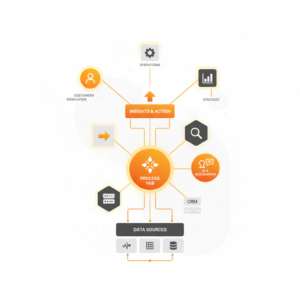
What problem does the stack actually solve today?
Executives need a reliable, compliant, and adaptable platform that resolves customer jobs quickly at a sustainable cost. Operations need tools that turn forecasts into staffed minutes, route to the first capable resolver, and keep knowledge current at the desktop. Customers want simple paths that finish the task with clear status and clean escalation. The modern stack solves these needs by centering on a cloud Contact Center as a Service platform, then adding a few critical services for workforce, quality, knowledge, data, compliance, and automation. Cloud CCaaS improves agility and reduces upgrade debt compared with on-premise stacks when evaluated against common enterprise requirements.¹ ISO 18295 sets expectations for consistent outcomes and accurate, current information for agents, which elevates knowledge and quality from optional add-ons to core capabilities.²
What is the minimal viable contact centre stack?
Leaders should start with eight units that cover the work from hello to resolution.
-
CCaaS core. Voice, digital channels, IVR or IVA, and intent or skills-based routing with callbacks and warm handoff. CCaaS is the operating system for contact handling and is the first decision you must get right.¹
-
Workforce management. Forecasting, scheduling, adherence, and intraday control to keep waits predictable under variability. Queueing results show waits rise sharply near full utilisation, which makes WFM essential.³
-
Quality and coaching. Calibrated evaluations, coaching flows, and links to knowledge so feedback changes behavior and lifts First Contact Resolution.⁴
-
Knowledge and guidance. Agent knowledge with lifecycle control and guided workflows at the desktop so resolvers apply the right steps the first time. ISO 18295 expects this accuracy.²
-
Customer data and CRM. Screen pop, case creation, and history so agents see context and the stack avoids repeated questions.
-
Analytics and export. Real time and historical reporting with open APIs or direct export to a warehouse to prevent data lock-in.¹
-
Security and compliance controls. Role-based access, encryption, audit trails, and evidence for SOC 2, APPs, and PCI scope decisions.²⁵⁶
-
Payments and redaction. PCI compliant capture that keeps PAN out of recordings and transcripts using DTMF suppression or out-of-band forms.⁶
This minimal set delivers stable service levels, consistent answers, and auditable controls without chasing gadgets.
Which capabilities actually move First Contact Resolution and cost to serve?
Three capabilities punch above their weight. First, intent-based routing reduces transfers by sending customers to the first capable resolver, which raises FCR and lowers repeats.⁷ Second, agent knowledge with guided steps shortens diagnosis and standardises outcomes, a requirement embedded in ISO 18295.² Third, callbacks and virtual hold cut abandonment and perceived wait when peaks hit. Research shows callbacks at defined thresholds smooth peaks and reduce abandons.⁸ Together, these units reduce effort for customers and agents, which is the mechanism behind lower cost to serve.
How should you think about AI in the stack without buying hype?
Use AI where it speeds correct work. Retrieval-augmented agent assist drafts answers grounded in approved articles and shows citations so resolvers can trust and reuse them. RAG reduces hallucination risk by anchoring outputs to sources, which creates auditability for regulated environments.⁹ Keep AI behind policy and security guardrails that block prompt injection and data exfiltration, and restrict retrieval to content a user can already access.¹⁰ This design improves time to the first useful step while keeping risk controlled.
What does good reliability and resilience look like for CCaaS?
Reliability is architectural, not aspirational. Vendors should show multi Availability Zone or multi region designs, clear Recovery Time and Recovery Point Objectives, and evidence of failover in practice. Cloud reliability guidance recommends fault isolation, health checks, and chaos testing to prove continuity for voice and messaging under failure.¹¹ Your plan should also define degraded modes and callback thresholds so customers get safe options during incidents. These practices prevent one outage from turning into a reputational event.
What governance and compliance are non negotiable in Australia?
Governance must match local law and enterprise controls. The Australian Privacy Principles require informed, specific, current, and voluntary consent with purpose limitation. Flows should check purpose at entry and at send, not only at onboarding.⁵ SOC 2 Type II reports provide assurance on a vendor’s security, availability, and confidentiality controls; review scope and sub processors.¹² PCI DSS v4.0 introduces targeted risk analyses and stronger authentication patterns; payment capture should keep PAN out of your CCaaS scope with DTMF masking or out of band forms and must be verified with current attestation.⁶ These controls protect customers and accelerate approvals.
How do you grow from minimal viable to robust without bloat?
Scale by maturity, not by gadget.
-
Stage 1: Foundation. CCaaS, WFM, QA, knowledge, CRM screen pop, basic analytics, PCI capture.
-
Stage 2: Orchestration. Event triggered journeys with hold until confirmations so status messages stop after completion and do not create “just checking” contacts.¹³
-
Stage 3: AI Assist and automation. RAG for agent answers with citations, summarisation into wrap notes, and attended automations that prefill forms and kick off unattended updates after the call.⁹
-
Stage 4: Data products. Conversation intelligence and export to a warehouse or lake with documented schemas. Use Forrester style TEI value cases to prioritise investments by low, base, and high scenarios with confidence ranges.¹⁴
This sequence avoids overlapping tools and concentrates budget where outcomes change.
What should you measure to keep the stack honest?
Measure leading signals you can steer weekly and lagging outcomes that prove value. Leading signals include time to first useful step, agent assist grounded answer rate and citation coverage, WFM adherence, and callback take up. Lagging outcomes include First Contact Resolution, repeat within seven days, abandon rate, and cost per resolved contact. ICMI’s FCR definition provides a crisp proof that the interaction resolved in one go when escalation was needed.⁴ Pair these with privacy and security controls such as redaction success and prompt injection blocks so risk is visible with value.¹⁰
How do you run selection and migration without drama?
Run a controlled pilot that proves outcomes, not features. Scope two journeys, enable routing, knowledge with agent assist, quality, and WFM, and measure FCR, repeats, and time to first useful step against matched controls. Require reliability drills and export of raw contact and transcript data to your warehouse during the pilot, not after. Use a TEI style model with low, base, and high cases to price uncertainty and set staged gates.¹¹ ¹⁴ Organisations that apply these rules choose faster and migrate with fewer surprises.
What are the common pitfalls and how do you avoid them?
Teams often purchase to a feature checklist instead of a journey outcome. Fix by weighting routing quality, knowledge use, and WFM results over exotic add ons. Teams overemphasise average handle time and harm FCR. Fix by weighting resolution and repeat reduction higher and by coaching against a lean QA card.⁴ Teams enable generative features without grounding and citations. Fix by enforcing RAG patterns or failing closed when sources are missing.⁹ Teams treat privacy and PCI as afterthoughts. Fix by instrumenting consent and purpose checks and by validating payment capture before go live.⁵⁶ Teams move without resilience proof. Fix by requiring live failover exercises and runbooks for degraded modes.¹¹
What does a pragmatic 90 day plan look like?
Days 1–30: Prove the spine. Stand up a pilot tenant. Integrate CRM for screen pop and case creation. Enable knowledge with agent assist and citations. Land contact and transcript exports in your data store. Validate SOC 2 scope, APP consent logging, and PCI payment flows in a sandbox.¹² ⁵ ⁶
Days 31–60: Test two journeys. Rebuild two flows with simple menus and intent based routing. Turn on callbacks at queue thresholds. Measure FCR, repeats, and time to first useful step against matched queues. Run a live failover drill.⁷ ⁸ ¹¹
Days 61–90: Stabilise and decide. Add event triggered status messages with hold until confirmation. Refresh the TEI model with observed deltas and confidence ranges. Decide to scale or iterate.¹³ ¹⁴
What impact should executives expect when the right stack is in place?
You should see earlier movement in time to first useful step and callback take up within weeks, followed by measurable improvements in First Contact Resolution and reductions in repeat within seven days on targeted journeys. You should see fewer “just checking” contacts as event led messages replace timers. You should see cleaner audit trails and faster change windows due to SOC 2 aligned controls, APP consent logging, and PCI safe payment flows. Over time you should see lower cost per resolved contact because the system routes correctly, agents find and apply the right answer, and automation removes rework.¹ ² ⁶ ¹³
FAQ
Which components are truly essential in a modern contact centre stack?
You need CCaaS core, WFM, QA and coaching, agent knowledge with guidance, CRM context, analytics with open export, security and compliance controls, and PCI compliant payment capture.¹²⁶
How should we use AI without increasing risk?
Adopt retrieval augmented agent assist that cites approved sources and restricts retrieval by role. Enforce prompt injection defenses and log citations for audit.⁹ ¹⁰
What is the quickest proof that a new stack improves outcomes?
Run a two journey pilot and measure First Contact Resolution, repeat within seven days, and time to first useful step with matched controls. Promote only when lagging outcomes move.⁴
How do we keep customers informed without creating more contacts?
Use event triggered orchestration with hold until confirmation so messages stop once the task is complete. This reduces “just checking” contacts.¹³
What compliance artifacts should vendors provide up front?
A current SOC 2 Type II report, APP aligned data practices and logging, and PCI DSS attestation for payment capture that keeps PAN out of your environment.¹²⁵⁶
What metrics belong on the board pack each month?
FCR and repeats for top journeys, abandon rate, time to first useful step, callback take up, grounded answer rate and citation coverage, redaction success, and prompt injection blocks.⁴ ¹⁰
When should we replace RPA bridges with APIs?
Replace when stable APIs are available for core flows. Use RPA as a tactical bridge and validate gains with TEI style ranges before refactoring.¹⁴
Sources
-
Contact Center as a Service (CCaaS): Market Overview and Benefits — Gartner, 2024, Research note. https://www.gartner.com/en/articles/what-is-ccaas
-
ISO 18295 — Customer Contact Centres (Parts 1 & 2) — International Organization for Standardization, 2017, ISO. https://www.iso.org/standard/63167.html
-
Queueing theory and service variability (Kingman’s result overview) — Wikipedia contributors, 2025, Wikipedia. https://en.wikipedia.org/wiki/Kingman%27s_formula
-
First Contact Resolution: Definition and Approach — ICMI, 2008, ICMI Resource. https://www.icmi.com/files/ICMI/members/ccmr/ccmr2008/ccmr03/SI00026.pdf
-
Australian Privacy Principles (APPs) — Office of the Australian Information Commissioner, 2023, OAIC. https://www.oaic.gov.au/privacy/australian-privacy-principles
-
PCI DSS v4.0 Summary of Changes — PCI Security Standards Council, 2022, PCI SSC. https://www.pcisecuritystandards.org/document_library
-
Intent-Based Routing in the Contact Center — Genesys, 2024, Vendor article. https://www.genesys.com/blog/post/intent-based-routing
-
Optimal Scheduling in Call Centers with a Callback Option — Benoît Legros, 2016, European Journal of Operational Research. https://www.sciencedirect.com/science/article/abs/pii/S0166531615000930
-
Retrieval-Augmented Generation for Knowledge-Intensive NLP — Patrick Lewis, Ethan Perez, Aleksandra Piktus, et al., 2020, NeurIPS. https://proceedings.neurips.cc/paper_files/paper/2020/hash/6b493230205f780e1bc26945df7481e5-Abstract.html
-
OWASP Top 10 for LLM Applications — OWASP Foundation, 2023, OWASP. https://owasp.org/www-project-top-10-for-large-language-model-applications/
-
AWS Well-Architected Framework: Reliability Pillar — AWS, 2023, Whitepaper. https://docs.aws.amazon.com/wellarchitected/latest/reliability-pillar/wellarchitected-reliability-pillar.pdf
-
SOC 2 Overview — AICPA, 2023, American Institute of CPAs. https://us.aicpa.org/interestareas/frc/assuranceadvisoryservices/soc2
-
Event-Triggered Journeys: Hold-Until and Experiments — Twilio Segment Docs, 2024, Twilio. https://www.twilio.com/docs/segment/engage/journeys/v2/event-triggered-journeys-steps
-
Total Economic Impact (TEI) Methodology — Forrester, 2020–2025, Forrester Research. https://www.forrester.com/teI/methodology
FAQ