





























What problem did the bank actually face?
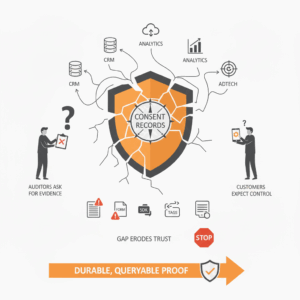
The regional bank faced an erosion of customer trust, fragmented consent records, and rising compliance exposure across open banking and core channels. Leaders saw duplicated consents across mobile, branch, and partner APIs. Risk teams saw audit gaps that made internal assurance slow and costly. Product teams struggled to launch new data-driven features because consent provenance was unclear. The bank operated in a regulatory context that requires valid, demonstrable consent and robust information security controls, including Australian Privacy Principles, the Consumer Data Right standards, and APRA CPS 234 expectations for incident resilience and control assurance.¹²³⁴⁵ The executive team set a clear objective. The bank would implement a consent governance program that unifies definitions, centralises evidence, and operationalises privacy by design across the product lifecycle. The bank aligned the initiative to measurable outcomes: reduce privacy incidents, speed internal audits, and increase customer retention and digital opt-ins.¹²
What is “consent governance” in a bank context?
Consent governance describes the policies, processes, data structures, and controls that ensure every use, disclosure, and sharing of personal data is authorised, recorded, testable, and revocable. It binds a legal definition of consent to operational evidence. Australian guidance defines consent with elements such as voluntary, informed, current, and specific, and links consent to permitted use and disclosure under APP 6.⁵⁶ The GDPR defines consent as a freely given, specific, informed, and unambiguous indication, and requires controllers to demonstrate that consent was obtained and is withdrawable.⁷⁸ Consent governance translates these definitions into artefacts that product and engineering teams can implement. The discipline requires consistent taxonomies, clear processing purposes, and a single source of truth for consent state that downstream systems can enforce.⁷⁸
Why did customer experience and risk both depend on this?
The bank needed to improve customer control and reduce friction without weakening security. The Consumer Data Right regime expects accredited data recipients and data holders to follow data standards, CX guidelines, and fine-grained consent controls that customers can review and manage via dashboards.⁴⁹¹⁴¹⁹ Customers expect simple permissioning while regulators expect testable evidence. APRA CPS 234 pushes boards to maintain information security capability and to test controls, including those operated by third parties.²⁶¹¹ These expectations meet in consent journeys. If consent flows are unclear, customers withhold permission and product adoption stalls. If evidence is incomplete, audits fail and incident response slows. Strong consent governance therefore becomes a CX lever and a control-strength lever at the same time. The team framed consent as a design primitive and as a board-reportable control so that product momentum and risk assurance could move together.²⁶
How did the bank design the target consent model?
The architecture team drew a simple statement. A single consent service must capture every consent event, attach it to a clear processing purpose, and issue enforceable tokens to downstream systems. The model adopted privacy by design principles articulated in ISO 31700-1 and embedded them into the product lifecycle.³¹³ The team defined canonical purposes, data clusters, and lawful bases, then mapped them to API scopes used in open banking and internal analytics. CX designers aligned consent prompts to CDR CX Standards, giving customers plain-language controls, granular data clusters, and clear expiry mechanics.⁹¹⁴ Engineers exposed revocation, expiry, and audit retrieval via APIs to ensure access, use, and disclosure checks occur at runtime.⁶⁹ To satisfy CPS 234 expectations, security and internal audit teams defined a test plan to validate control effectiveness quarterly and after material changes, including third-party interfaces.²¹¹
What changed in day-to-day customer journeys?
Product owners simplified consent prompts and grouped permissions by purpose. Customers could approve account balances for personal finance tools while declining marketing analytics. The mobile app displayed a live consent dashboard showing who can access what, for which purpose, and until when.⁴⁹¹⁴ Contact centre agents used the same consent service to confirm permissions before fulfilling data-related requests. Data platforms consumed consent tokens and filtered datasets accordingly. Customers withdrew consent from the dashboard, which triggered propagation to downstream systems and partners in near real time.⁴¹⁴ The service logged every grant, refresh, and revocation with timestamp, channel, and purpose to create a defensible audit trail.⁷⁸ Security teams integrated consent logs with incident response playbooks to quickly identify whether a data use was authorised during an event.²
How did the bank enforce controls and demonstrate evidence?
Risk and security leaders set a control library that binds regulation to technical tests. APP 6 use and disclosure rules linked to consent purpose checks at API gateways and data pipelines.⁶ CPS 234 control assurance required periodic testing of consent enforcement in both first party and third party contexts.²¹¹ Internal audit scheduled scenario-based evidence reviews that pulled log samples from the consent service and validated alignment with lawful bases.² The program also formalised board reporting. Dashboards summarised consent coverage, revocation rates, exception rates, and audit readiness metrics. GDPR-aligned artefacts ensured that the bank could demonstrate consent on demand and that withdrawal is as easy as giving consent.⁷⁸ ISO 31700-1 principles kept privacy requirements visible in design reviews, backlog grooming, and release gates across the lifecycle.³¹³
What measurable impact did the bank realise in 2025?
The bank reduced privacy incident investigations tied to ambiguous permissions because frontline teams could verify lawful basis and purpose within seconds. Internal audits completed evidence tests faster as the consent service provided centralised, immutable logs. CPS 234 assurance activities reported higher control effectiveness for third party data exchanges due to tokenized scope checks.²¹¹ Customer adoption of data-powered features increased after consent prompts matched CX standards for clarity and granularity.⁹¹⁴ Open banking revocations processed instantly, improving trust and reducing complaint volumes.⁴¹⁴ The institution shortened incident response triage because responders assessed authorisation status via consent logs during the first review.² The combined effect improved risk posture and customer experience while reducing the total cost of compliance operations. Executives kept momentum by treating consent governance as an enterprise product, not a one-off policy project.³⁴⁶⁷
Which design choices matter most for sustained outcomes?
Leaders prioritised five choices. First, they defined a single consent ontology that maps purposes to data clusters and scopes, so every system speaks the same language.⁹¹⁴ Second, they placed the consent service on the critical path for all data access flows to make enforcement automatic rather than advisory.⁶ Third, they built CX journeys that explain value, make choices simple, and expose controls in context to align with Consumer Data Right expectations and GDPR principles.⁴⁷⁹ Fourth, they embedded ISO 31700-1 privacy by design requirements into definition of done for product teams.³ Fifth, they operationalised CPS 234 control testing, including third parties, so assurance keeps pace with change.²¹¹ These choices create a durable system where product innovation and regulatory evidence reinforce each other instead of competing.
How should a bank start and sequence the work?
Executives should begin with a diagnostic that inventories consents, purposes, storage locations, and enforcement points across channels and partners. Teams should then write a simple purpose taxonomy mapped to legal bases and CDR data clusters.⁹¹⁴ Architects should deliver a consent service that issues verifiable tokens, records immutable events, and exposes self-service dashboards.⁴ Security should integrate consent checks at API gateways and data pipelines to meet APP 6 and CPS 234 expectations.²⁶ Audit and risk should define evidence packs and test plans that cover internal and third party scenarios.²¹¹ CX should iterate prompts and journeys using clarity guidelines from regulators and standards bodies.⁴⁵⁷ Product should treat consent as a reusable capability, not a feature inside one app. This sequence creates early wins in customer control and fast evidence retrieval while building toward enterprise-wide enforcement.³⁴⁶
What does “good” look like twelve months in?
A mature program shows strong customer comprehension, low exception rates, rapid evidence retrieval, and consistent enforcement across systems and partners. The bank’s board receives quarterly reports that connect consent coverage and revocation patterns to product adoption and incident trends. Security can demonstrate CPS 234 control effectiveness and show that consent enforcement applies to related parties and service providers.²¹¹ Privacy teams can retrieve consent evidence that meets APP 6 and GDPR expectations without manual reconstruction.⁶⁷ CX teams can iterate on value propositions while providing simple controls aligned to CDR CX standards.⁹¹⁴ Product teams can launch new analytics features faster because lawful basis and permission scope are clear. ISO 31700-1 practices remain visible in design reviews, ensuring privacy is a standing design constraint rather than an afterthought.³
FAQ
How does consent governance reduce APRA CPS 234 risk for banks?
Consent governance centralises consent evidence and enforces purpose-based access at gateways and pipelines. This control design aligns with CPS 234 expectations to maintain capability, escalate incidents, and test third party controls, which strengthens board-level assurance.²¹¹
What is valid consent under GDPR and how does it affect Australian banks with EU customers?
GDPR defines consent as freely given, specific, informed, and unambiguous, and requires controllers to demonstrate consent and allow easy withdrawal. Banks serving EU data subjects must meet these conditions and maintain auditable records of consent events.⁷⁸
Which Consumer Data Right components shape banking consent UX?
Consumer Data Standards and CX guidelines require clear consent prompts, granular data clusters, dashboards for review, and straightforward revocation. Data holders and accredited recipients must implement these requirements in apps and APIs.⁴⁹¹⁴¹⁹
What does APP 6 require for use and disclosure of personal information?
APP 6 permits use or disclosure for the primary purpose of collection or with the individual’s consent, with defined exceptions. Consent governance links this rule to runtime purpose checks and audit evidence.⁶
Which ISO standard should product teams use for privacy by design?
ISO 31700-1:2023 provides high-level requirements for embedding privacy by design through the product lifecycle for consumer goods and services, which banks can adapt to digital services and consent models.³¹³
Who should own consent governance in a bank?
A cross-functional group should own it. Product and CX define experiences, architecture delivers the consent service, security enforces runtime checks, privacy ensures legal alignment, and internal audit validates design and operating effectiveness, including third parties.²¹¹
Which first steps help a bank show evidence quickly?
Start with a consent inventory, implement a central consent service with immutable logs and dashboards, align prompts to CDR CX Standards, and connect enforcement to API gateways. This sequence enables rapid retrieval of demonstrable consent and improves customer control.⁴⁶⁹¹⁴
Sources
-
Office of the Australian Information Commissioner, “Consent to the handling of personal information,” 2022, OAIC. https://www.oaic.gov.au/privacy/your-privacy-rights/your-personal-information/consent-to-the-handling-of-personal-information
-
Australian Prudential Regulation Authority, “Prudential Standard CPS 234 Information Security,” 2019, APRA. https://www.apra.gov.au/sites/default/files/cps_234_july_2019_for_public_release.pdf
-
International Organization for Standardization, “ISO 31700-1:2023 — Consumer protection: Privacy by design for consumer goods and services,” 2023, ISO. https://www.iso.org/standard/84977.html
-
Office of the Australian Information Commissioner, “Consumer consent, authorisation and dashboards,” 2022, OAIC. https://www.oaic.gov.au/consumer-data-right/consumer-data-right-guidance-for-business/privacy-obligations/consumer-consent%2C-authorisation-and-dashboards
-
Office of the Australian Information Commissioner, “Australian Privacy Principles guidelines, Chapter B: Key concepts,” 2022, OAIC. https://www.oaic.gov.au/privacy/australian-privacy-principles/australian-privacy-principles-guidelines/chapter-b-key-concepts
-
Office of the Australian Information Commissioner, “Chapter 6: APP 6 Use or disclosure of personal information,” 2019, OAIC. https://www.oaic.gov.au/privacy/australian-privacy-principles/australian-privacy-principles-guidelines/chapter-6-app-6-use-or-disclosure-of-personal-information
-
GDPR.eu, “Art. 4 GDPR — Definitions,” 2016, GDPR legal text. https://gdpr-info.eu/art-4-gdpr/
-
GDPR.eu, “Art. 7 GDPR — Conditions for consent,” 2016, GDPR legal text. https://gdpr-info.eu/art-7-gdpr/
-
Data Standards Body, “Consumer Experience Standards v1.3.0,” 2020, Australian Government. https://dsb.gov.au/sites/consumerdatastandards.gov.au/files/uploads/2020/05/CX-Standards-v1.3.0.pdf
-
Australian Government, “CDR Data Standards,” 2025, Consumer Data Right. https://consumerdatastandardsaustralia.github.io/standards/
-
Australian Prudential Regulation Authority, “CPG 234 Information Security,” 2019, APRA. https://www.apra.gov.au/sites/default/files/cpg_234_information_security_june_2019_0.pdf