Product · Knowledge improvement
Knowledge Quest
The intelligence layer between your interactions and your knowledge base. Knowledge Quest reads every call, chat, email and ticket, finds the gaps costing you the most, and closes them with evidence rather than guesswork.
The problem
Every service team has two systems that do not talk to each other
On one side is the interaction platform: the contact centre or the service desk, where every call, chat and ticket lands. On the other is the knowledge base the team is supposed to answer from.
Nobody can see the gap between them. You do not know which articles help, you discover problems after they have become complaints, and emerging issues hide in the data for weeks before anyone spots them. Dashboards show you what happened. They cannot tell you why.
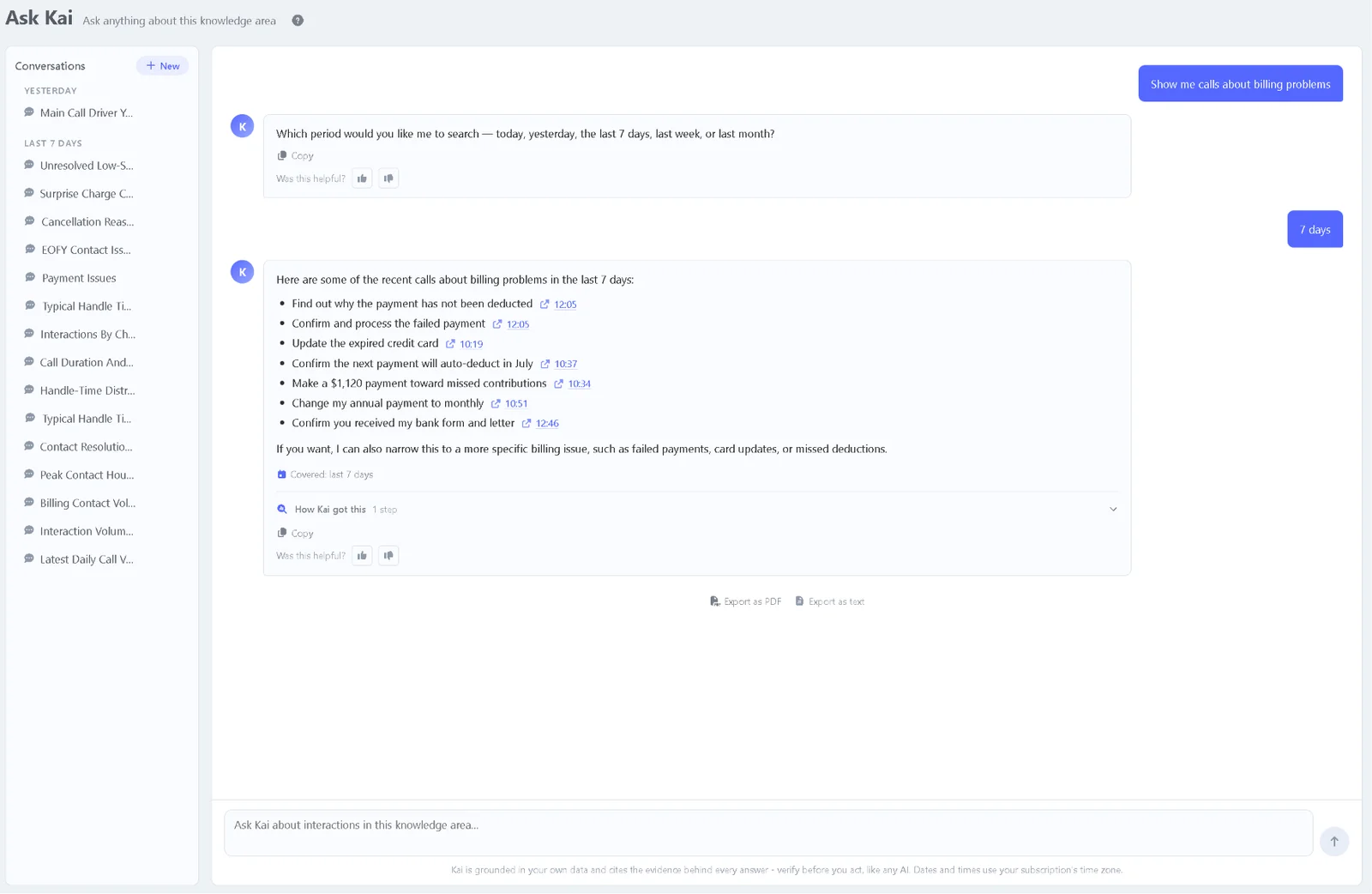
Knowledge Quest sits in that gap. It reads the interactions, measures them against the knowledge, and tells you exactly which gaps are costing you the most and what to write to close them.
It is also the capability AI now depends on. CRM and omnichannel platforms have had most of the attention and investment for years. Knowledge is being recognised as the next key platform, because AI needs a source of information to answer from. It does not need a single source, and it can use material you already have, such as training documents and web pages, which makes the quality of that material matter more than ever.
Who it is for
Four kinds of team, one closed loop
Contact centres
Reads voice, chat, messaging and email to explain the sentiment, cost and resolution drivers your dashboards miss.
Service desks
Reads incidents, requests and escalations to find the 30 to 50 per cent of tickets that should never have needed to exist.
BPOs
For operators running contact centres at scale for many clients, from three programs to three hundred, with a recovered-cost view per client.
MSPs
For managed service desks on fixed-fee contracts, where every avoidable ticket erodes margin and every deflected one protects it.
How it works
One closed loop, always on
It is not a chatbot. Deterministic scoring and calibrated probability models do the ranking, with language models used only where they earn their place, so every result can be explained.
1. Capture
Every interaction, transcript and ticket flows in from the platforms you already run. No re-platforming, no agent behaviour change.
2. Analyse
It extracts intent, classifies topics and measures sentiment the same way on every channel.
3. Discover
Emerging topics and outliers surface while you can still do something about them, rather than in next month’s report.
4. Prioritise
Gaps are ranked by the cost of leaving them open, so the team works on what matters first.
5. Resolve
Kai, the copilot, drafts knowledge articles grounded in customer interactions. For existing articles, it shows the original alongside suggested changes, so your team can review what needs updating and the evidence behind it.
6. Measure and learn
Actual impact is tracked and the model recalibrates per knowledge area every week. Sharper every cycle.
Why it matters
The cost of the gap, in other people's numbers
- of contact centres reach world-class first contact resolution of 80 per cent or more (COPC)
- 5%
- support-cost reduction at advanced knowledge-centred service maturity (Consortium for Service Innovation)
- 25–50%
- the cost of a level-three ticket against level one, $104 versus $22; every gap-driven escalation pays it (MetricNet, 2024)
- 5×
- the cost of an assisted contact against self-service, $13.50 versus $1.84 (Gartner, 2024)
- 7×
What you get
Three wins, every week
A ranked list of gaps
The knowledge gaps that cost you the most this week, with the interactions that prove it and the article that would close each one.
Answers with provenance
Team leads and agents ask Kai and get an answer with its sources, so trust is earned on every reply rather than assumed.
A brief for every level
Real-time for team leads, weekly for managers, monthly for the executive who has to sign off on the knowledge investment.
Discover
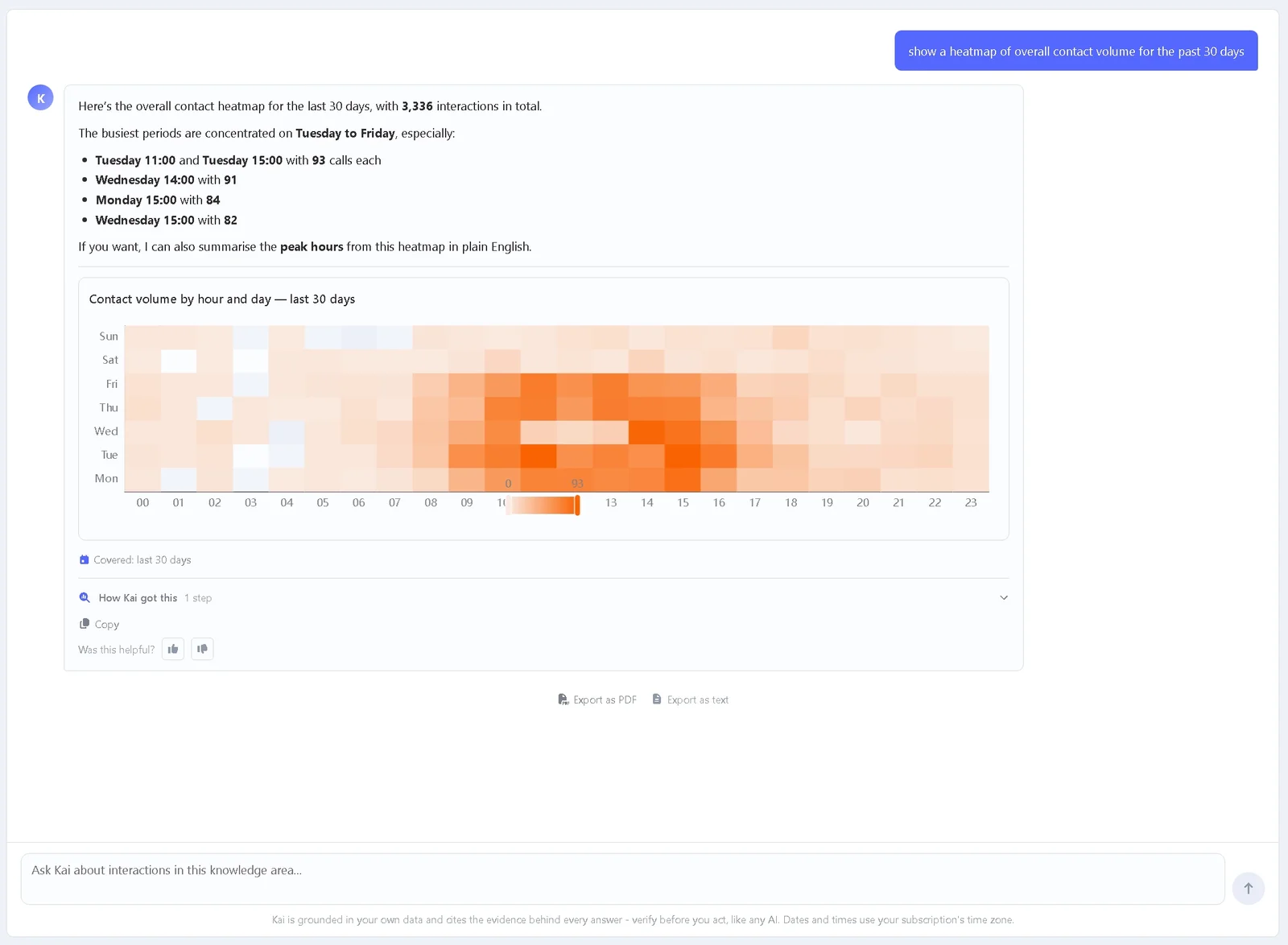
Contact volume by topic and hour, before anyone has filed a report
The heat map is one of the views Kai draws on. Every cell is real interactions, and the hot ones are where the knowledge gaps are costing you today.
Built by practitioners
Built by a consultancy that did this job by hand for decades, and got tired of it
Knowledge Quest was not built by engineers with a deck. It was built by Customer Science, a CX and service management practice that spent years finding knowledge gaps manually for contact centres and service desks across Australia. The product is that method, run continuously.
It connects to Genesys, Amazon Connect, NICE CXone, Talkdesk, Twilio, Vonage, ServiceNow, Jira Service Management, Freshservice, Zendesk, Salesforce, Zoho Desk and LivePro, and the same practitioners who built it are available to run the first cycles with your team.
Ways to start
Start with a sample, or go straight to a pilot
Knowledge Tune
A complimentary assessment of up to ten of your knowledge articles, with a review workshop and prioritised fixes.
Gap-to-Draft
A dedicated Knowledge Quest subscription, started with a hands-on workshop.
Assisted Migration Accelerator
A pilot implementation of Knowledge Quest in your own environment.
Insights
Related insights
Information Architecture Design for Enterprise Search
Enterprise search improves when information architecture design gives every page, record, policy, and knowledge article a clear place, label, owner, and…
Read the article ↗
First Call Resolution Strategies That Actually Work
First call resolution improves when contact centres stop treating it as an agent-only KPI and start treating it as a service-design outcome. The…
Read the article ↗How to Reduce Customer Effort Score (CES) Across Channels
Reducing Customer Effort Score across channels in 2026 means cutting the work customers do to finish a task, not just making one touchpoint look smoother.…
Read the article ↗Taming Unstructured Data: From SharePoint Sprawl to Knowledge Graph
Unstructured data is the largest and least controlled information asset in most organisations. When left unmanaged, it creates compliance risk, weakens…
Read the article ↗
Beyond Search: How AI Can Draft and Maintain Your Knowledge Articles
A failing knowledge base is rarely a content problem alone. It is a knowledge health problem: low findability, unclear ownership, slow change control, and…
Read the article ↗Human-in-the-Loop: Ensuring Accuracy in AI-Generated Knowledge
Human-in-the-loop governance reduces AI knowledge errors by combining automated checks with accountable human review. It prevents unsupported answers…
Read the article ↗Implementing Knowledge Centred Service (KCS) with AI
A practical KCS with AI program turns everyday support work into trusted, reusable knowledge and then uses that knowledge to power faster agent assist and…
Read the article ↗Connecting Your Knowledge Base to Genesys and ServiceNow
Connecting one governed knowledge base to both Genesys and ServiceNow reduces agent search time, improves answer consistency, and enables measurable…
Read the article ↗The "Knowledge Health" Crisis: Why Your KB is Failing Your Agents
A failing knowledge base is rarely a content problem alone. It is a knowledge health problem: low findability, unclear ownership, slow change control, and…
Read the article ↗

See your own gaps. A demo runs on a sample of your interactions, not ours.
Or start with a pilot on one service desk, or ask for a sample weekly brief.