
Industry
Health & Care
Health and care work touches people at their most vulnerable, in a sector where every stakeholder group tends to work in its own silo. We put the patient at the centre of that landscape and build the connected understanding around them that the system usually lacks.

What we do
A respected voice across a fragmented sector
Customer Science has strong relationships across the health and care industry: government departments, public and private hospitals, health software providers, peak representative bodies, clinicians and patients.
The sector is large and, too often, siloed between stakeholder groups. We work to place the patient at the centre of that landscape and build a connected network of understanding and care around their needs.
That approach is why Customer Science is a respected voice in health and care, able to talk practically with people in policy and legislation as well as those delivering frontline care. We support sustainable change in the sector by giving meaningful advice and advocating for practical action.
The sector itself keeps widening: healthcare services, accommodation and meal providers, schools and workplaces all now play a part in people's health and welfare, and we work with each of them.
What patients expect
Communication is part of the care
- of patients say clear communication and the experience a provider delivers matter as much as their clinical care
- 86%
- of Australians who used telehealth would use it again if it were offered
- 90.3%
- of Australians seeing three or more health professionals had problems caused by poor communication between them
- 16.3%
Sources: The Beryl Institute, 2024 Global Healthcare Consumer Report (13 countries); Australian Bureau of Statistics, Patient Experiences, 2024–25.
Where care is going
Care is moving beyond the hospital walls
More care is being delivered at home and virtually: acute care at home, chronic condition management at home, and virtual support for older people living at home or in residential aged care.
That changes the job. The patient journey now runs outside the hospital, through discovery, access, preparation, treatment, discharge, recovery, monitoring and intervention, and every one of those stages is an interaction someone has to design and run. Supporting an older person at home, keeping their family informed or helping someone leave hospital sooner is a health outcome, a patient experience outcome and an economic one at the same time.
Where we help
Four places patient and resident experience is won or lost
Patient access and navigation
For private hospitals: scheduling, referrals, pre-admission, enquiries, digital self-service and wayfinding, designed as one experience.
Care beyond the hospital
Discharge, virtual wards, monitoring, proactive outreach and escalation, so the journey holds together once the patient goes home.
Resident, client and family engagement
For aged care: home care scheduling, family communication, care-worker coordination and clinical escalation.
AI-enabled patient operations
Automating routine interactions so scarce clinical staff spend their time where clinical judgement is needed.
Questions worth asking
Start with who owns the experience
The useful questions are rarely about seats or software. We start with ones like these:
- Who owns patient access in your organisation?
- How are you scaling care outside your facilities?
- Which interactions are using up clinical capacity when they don't need to?
- How do you communicate with patients after discharge?
The work
Health and care organisations we have worked with
CX & Service Training Specialist
Renting a trainer with specialist training capability helped to bridge a gap.
Read the case study ↗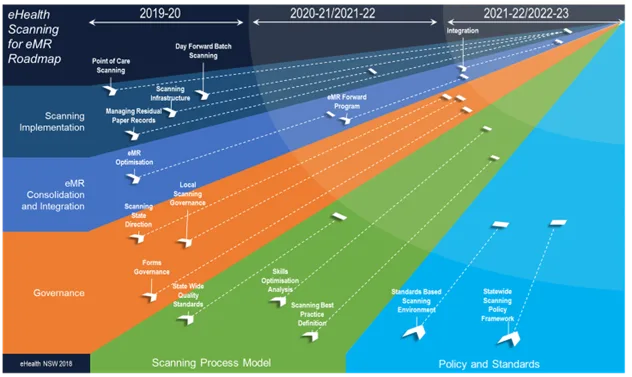
NSW clinical documentation digitisation strategy
A strategic review of scanning into the eMR was needed to support eHealth’s strategy towards an integrated paper-lite clinical information system
Read the case study ↗
Government Health Data Integrity
Improved the collection of nationwide performance data and reporting.
Read the case study ↗Insights
Related insights
Health Data Security Standards: Protecting Patient Info
Health data security standards protect patient information by combining privacy law, security controls, breach response, access governance, and…
Read the article ↗
Protecting Patient Data: Cybersecurity Essentials for Health Providers
Patient data protection in healthcare depends on a small set of consistently executed controls: strong identity security, rapid patching, resilient…
Read the article ↗EMR Optimisation: Getting Value Beyond the Implementation
EMR optimisation means moving from “system installed” to “system improves care”. It focuses on usability, workflow fit, data quality, interoperability…
Read the article ↗Bridging the Gap Between Clinicians and Technologists: The Role of Health Informatics
Health informatics bridges clinicians and technologists by turning clinical intent into safe, usable, interoperable digital health systems. It does this…
Read the article ↗The National Digital Health Strategy: What It Means for Private Providers
Private providers should treat Australia’s National Digital Health Strategy as a practical operating mandate, not a policy document. It raises…
Read the article ↗The Future of Remote Patient Monitoring in Chronic Disease Management
Remote patient monitoring is moving from pilot programs to mainstream chronic disease management. The next phase will be defined by clinical workflow…
Read the article ↗
Designing Virtual Care Models: Lessons from the Australian Health System
Virtual care works when it is designed as a service model, not a video call. Australian experience shows that safety and scale come from clear clinical…
Read the article ↗Patient-Centric Digital Health: Mapping the Care Journey
Patient-centric digital health works when it maps the real care journey, removes avoidable friction, and connects data and channels safely. The practical…
Read the article ↗Solving the Interoperability Puzzle: FHIR Standards in Australian Healthcare
A practical interoperability strategy in Australian healthcare uses HL7 FHIR APIs plus national implementation guides, identity, and terminology. The goal…
Read the article ↗Your team